18 December 2008

International Migrants' Day

On December 4th, 2000 the General Assembly of the United Nations, taking into account the large and increasing number of migrants all around the world, proclaimed that December 18th is forthwith the International Migrants' Day.

On this day, back in 1990, the UN Assembly adopted the International Convention on the Protection of the Rights of All Migrant Workers and Members of their Families.

I have been a migrant myself at various stages of my life, and have lived and worked in several different countries on three continents.

To mark this day I have researched and written a special feature, titled The Samba is over, which highlights a little known and rarely reported element of modern life in Ireland. You find it right below this post and I hope it will be an interesting read for you.

The Emerald Islander

The Samba is over

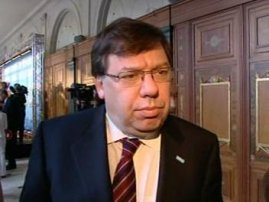
It is a cold and unfriendly morning in December, just after breakfast time. Gaspar Arcanjo de Lima (photo above) - a 49-year-old Brazilian - leaves his home and walks the short distance to the town square to look for casual work. He does this six times a week - every day but Sunday - and the local people are well used to seeing him there.
"I used to get work three or four days each week here," he says, looking serious. "But if I get one day a week now, it's a lot."
Gaspar is not the only one offering himself for hire in the central urban spot of this small rural community. Each weekday more than a dozen men - aged between early twenties and early fifties - gather there in the morning and hope that someone in town, or perhaps a local farmer from the surrounding area, needs an extra pair of hands for a day or two.

However, Gaspar and the other men are not standing on a town square in Brazil. They are standing in Gort, a rural Irish market town in the southern part of Co. Galway, not far from the border with Co. Clare.

Even though rather small and of no great importance these days, Gort is a place with a long history that goes back to Guaire Aidhneach, the sixth century King of Connacht, who had a reputation for generosity. The lore has it that his right arm, the giving arm, was longer than his left.
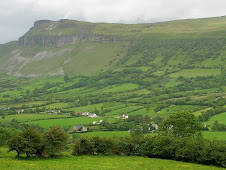
One legend tells the story how King Guaire was sitting down for dinner when mysteriously the plates with the food disappeared out the windows. He quickly followed them on horseback and soon met St. Colman, a pious monk who had just finished a seven-year fast and was so in need of sustenance that the King's food literally flew to him, so he could eat. King Guaire was impressed by Colman and granted him lands at Kilmacduagh, where he built a famous monastery (photo above), which is one of the oldest in Europe.

The town's modern Irish name An Gort (the meadow) is only used in official documents, while the locals still refer to their town as Gort Inse Guaire, thus keeping in touch with the distant past and King Guaire.

In the Middle Ages the Ó Seachnasaigh (O'Shaughnessys), chiefs of Cinél Aedha na hEchtghe (a clan descended from Guaire Aidhneach), had their principal stronghold in Gort.

At the end of the seventeenth century all the O'Shaughnessy lands were confiscated by the English crown and later granted as a favour to Sir Thomas Prendergast, whose grandson was John Prendergast-Smyth, the first Viscount Gort.

The best-known member of that family was Field Marshal Lord Gort, VC (pictured here on the left with the famous US Lieut. General George S. Patton in North Africa).
During World War I this distinguished Anglo-Irish officer won the Victoria Cross (VC) - Britain's highest gallantry award - as well as three times the Distinguished Service Order (DSO) and the Military Cross (MC).
Between the wars he rose to the Army's top position - Chief of the Imperial General Staff - and in 1939 he was commander-in-chief of the British Expeditionary Forces in France. Later in World War II he also served as the Governor of Malta and High Commissioner for Palestine & Transjordan.

Another resident of the area was Lady Augusta Gregory, the famous dramatist, co-founder of Dublin's Abbey Theatre and close friend of William Butler Yeats. She lived at Coole Park, only a short distance away from Gort.

The O'Shaughnessy's old stronghold in Gort was turned into an English cavalry barracks, which was used by troops until modern times.
In 1831 the market town had 563 houses and a total population of 3627. But then the Great Famine of the mid 1840s set in and devastated the population and future of Gort, as it did with so many towns in the west of Ireland.

After many decades of a sleepy existence, Gort has grown by nearly 50% in recent years and has now about 3000 inhabitants. But it was not an influx of Irish people that made Gort almost a little boom town, it was a large number of Brazilians that arrived and settled here since 1999.

What attracted them to Ireland and to Gort especially?

Well, the unexpected economic boom - known as the 'Celtic Tiger' - that started under the 'Rainbow coalition' government in the mid-1990s created more jobs in Ireland than could be filled by Irish workers. Many unfilled vacancies began to attract foreign workers.
While the vast majority of migrant labourers came from eastern Europe and especially Poland, there were also many from further abroad, including plenty from Brazil.

There are long-established links between the Irish meat industry and the producers of beef in South America, especially in Argentina and Brazil.
Vacancies in booming Irish abattoirs and meat processing plants, which are the predominant business in and around Gort, soon attracted the first Brazilians to southern Galway. They sent happy letters - and plenty of money - home to their families, and thus ever more of their fellow countrymen arrived.

Meanwhile more than a third of the whole population of Gort is Brazilian. This has of course changed the life in the sleepy little market town in many ways. Sunday Mass in the local Catholic church is now said not only in English, but also in Portuguese.

There are special Brazilian shops, restaurants and services in Gort, including a food store, a hair dresser and a money transfer office. The latter provides the Brazilians in Ireland with a vital link to their homeland and families, many of which depend entirely on money sent from Ireland. (It is amazing how things can change, as until not so long ago many Irish families lived on money they were sent by a relative working in the UK, the USA or Australia.)

There is now also a strong Brazilian element in Gort's school, and in every other aspect of the local community and culture.

Surprisingly no incidents or cases of racism or xenophobia have been reported, which proofs that even a rural community can absorb a large amount of strangers, as long as they are peaceful, able to work and willing to integrate themselves as much as it is possible.

Overall the new residents of Gort are well integrated. Many of them live in comfortable new homes, built during the economic boom. They are more modern than those they could afford back home in Brazil, and even more modern than the houses of most Irish residents of Gort.

But there seems to be no envy or animosity. The Brazilians were welcomed by the locals as friendly, warm-hearted people who are as Catholic and easy-going as they are themselves.
The local St. Patrick's Day parade has probably benefited the most from the South American influence and is now quite close to the carnival parade of a Samba school in Brazil. In fact, it has been said that Gort has meanwhile some of the best Samba dancers in the whole of Ireland.

But despite the positive example of integration, all is not well in Gort a week before Christmas. Like everywhere in Ireland, the boom times are over in Gort, too.
A fall in people's buying power has led to a reduction of production and the loss of many jobs. And the rule in Gort is not different from elsewhere: Last in - first out. There is now a great shortage of jobs, in Galway and Ireland as a whole, with plenty of Irish and foreign workers on the dole.

For the Brazilians in Gort things are especially difficult. When they came here, they thought to have found their little piece of paradise, where they could stay and work, earn good money and live a life in happiness and comfort, perhaps forever.
For most of the past five or six years work has indeed been plentiful and there was everything else one could only dream of in Brazil. Some of the workers even brought their wife and family to Ireland, while most were sending money to their families at home. They still do, but now things have changed and the money transfers are less frequent.

Simonsen Miller Silva (above right), who runs Gort's Brazilian-owned money transfer service, knows exactly what the downturn is costing his community.
"People send anything from € 350 to € 650 back home," he says. "That is the same as ever. They are just doing it less often."

Most of the Brazilians still send money about three times a month. "For many," the transfer agent explains, "it is a commitment. They have to provide for their family, to pay for schooling or for healthcare."

"Four years ago it was a lot easier to find a job and to send money home," says Miro Pires (photo left), who transfers up to € 1000 from Ireland to Brazil every 40 days.
"Now I wait until the exchange rate reaches at least three Reals before I send anything. Although it's harder now, I'm going to wait at least another year before going back. The situation is difficult now everywhere."

The good news for Miro is that despite our recession the Euro is still gaining in value. Yesterday it stood at more than 3.40 Reals, which means that his family in Brazil will have a very happy Christmas with the money from Ireland.

26-year-old Raquel Samuels (above top left), one of the many Brazilian women who followed the male workers to Gort, is co-owner of Real Brazil, one of the Brazilian shops in town.
Amid piles of cassava beans, sugary sweets and many other kinds of imported food she sits with mixed feelings and hopes the Brazilians can tough out Ireland's recession.
"This town would be like a ghost town, without the Brazilians being here," she says with amazing frankness. "Many Irish are like sticks in the mud."

During the boom times jobs in cleaning, cooking, catering and shop work were easy to find for Brazilian women, even if their English was often poor. The newly rich Irish did not care, as long as the work was done. No one was hiring a cook or cleaner for conversational skills.
But now fewer Irish families employ home helpers or cooks. It is one of the first luxuries people let go when the money gets tight for them. So many Brazilian women - who do not stand in the town square seeking work like the men - are finding jobs and cash ever harder to come by.

Some of the women have left Gort already, with the intention to return to Brazil. But rumour has it that at least some of them only went as far as Dublin and are now working there in the growing lap dance and sex industry.

At Gort's Brazilian hair salon (left) fewer customers are now styled, but there is still plenty of gossip.
"It's really very difficult for everyone now, so people take whatever work they can get," says Simone Bueno Marques, the 30-year-old hairdresser who runs the salon.
Although her husband and two children live with her in Ireland now, she still sends € 700 each month to Brazil, to support her mother and pay for a house.
"It's a little bit of a problem," she admits. "Sometimes I miss Brazil, but I don't want to go back - not yet, anyway."
Once her Brazilian house is paid for, she might change her mind, especially if Ireland is then still in recession.

27-year-old Sandro Santana Mendes (photo right) tells me that he "enjoyed the good times in Ireland". But he has bought a ticket and will go home for Christmas. He has not seen his four-year-old son for three years.
"I've been in Europe seven years now," he explains. "I liked it, but it is not a place to stay forever. Too cold for me, and I don't mean only the climate."
Then he shows me a large brown envelope filled with banknotes.
"I have € 2000," he says with a smile. "That's enough to live for a whole year in Anapolis [his home town in Brazil]."

Others are preparing to leave Gort and Ireland as well. To go home for Christmas is the main reason, but some are already sure that they will not be back in January.

"I've been very happy here. It's been good," says Joao Luis da Silva Costa (left, watching TV with his son in his house in Gort), another 27-year-old Brazilian meat-plant worker who is preparing to leave.
"But I'm not earning enough money any more in Ireland, so I'm going home. I've done my time. It's enough."

In the town square the mood is mixed this morning. Few Galway farmers have turned up, looking for handymen, and most of the Brazilians look gloomy in the cold.
Gaspar Arcanjo de Lima was lucky and has found work. But his companion Antonio Galdecio da Silva (photo below right) has not. Eventually he calls it a day just before noon.

"I come here every day, looking for work," he says. "But I've not sent any money home for three months."
Antonio is 50 and tells me about his hard and eventful life. Back in Brazil he has no less than eleven children, and was hoping to bring some of them to Ireland for better education and jobs.
But that was during the good times. He is realistic enough to see that Ireland is no longer a place that could offer a future to him or his children. "Now I'm just trying to work enough to buy myself a ticket home," he says with a sigh and leaves the square with some of his compatriots.

It appears that for Gort in Co. Galway the Samba days are over.

The Emerald Islander

17 December 2008

Dempsey does more Damage to CIÉ

Is there anyone in our incompetent government who understands at least the basic rules of Economics, and how markets and societies work? Obviously not.

The latest example of a goat made gardener is Noel Dempsey (right), a pigheaded Fianna Fáil apparatchik from Co. Meath and the Cabinet's bouncer, who has been in charge of too many government departments to keep track of them all.
However, people working in those departments do remember him well, as he left each of them in a real mess when he was moved on to run down and wreck the next one. (They loathe him especially in Education, and among the civil servants in the Customs House - home of the Dept. of the Environment - he has a status only one step removed from the Anti-Christ...)

Currently Dempsey is in charge of Transport, since Martin Cullen (left), our very own little clown from Waterford city who had it before him, did not manage to destroy the public transport system quickly enough.
Not for want of trying, mind you, but Martin is just not very effective, regardless what he does.
Dempsey will do better, and today he moved another step closer to dismantle the already poor structure of public transport in Ireland.

He told the Dáil that Coras Iompair Éireann (CIÉ) - the state-owned holding company that controls Iarnród Éireann (the Irish railways), Bus Éireann and Dublin Bus - "will make a deficit of € 39 million this year", compared with a deficit of just under € 1.5 million in 2007.

Anyone who knows CIÉ with its arrogant and self-serving attitudes, sluggish and inefficient management, under-qualified but over-paid staff and total lack of regard for its passengers will not be surprised. Only those who have no other choice ever travel with the three CIÉ companies.

To give you an example: Both Iarnród Éireann and Bus Éireann provide regular services from Waterford to Dublin (and back, if you are lucky). So anyone here who has business in Dublin can get there by either train or bus. The problem is that there are only a few services per day, and none at all in the evening or through the night.
If I want to use a train, I can leave Waterford at about 7.30 a.m. and will be in Dublin by 10 a.m., unless there is "a problem on the line", which happens rather often. By bus it will take me three hours, but the costs are almost the same.
I have to be very quick in Dublin, as the last bus back to Waterford leaves the capital at 6 p.m. and the last train only a few minutes later. This means that anything that extends beyond 5 p.m. cannot be done in Dublin when using CIÉ services. Not even to mention the idea of going to a concert or seeing a play in a Dublin theatre. Impossible for an Irish provincial person depending on public transport.

So if one has a longer day in Dublin, a car is the only way to get there - and back - in a reasonable way. However, there is - at least from Waterford (and several other towns along the route) - an alternative to the CIÉ services. A private bus company runs a regular service to Dublin (city and airport) seven days a week. And guess what? Their fare is half of what CIÉ charges, and they go a lot more often, including at night. It is no surprise that their buses are usually well filled, while CIÉ services drive around the country with their buses often more than half empty.

Irish People are not stupid. But unfortunately our current government (a coalition of Fianna Fáil and the Green Party) is, and the management of CIÉ follows the government closely.

CIÉ's mismanagement has now run up an amazing deficit of over € 39 million. This is a lot for you and me, but only a small sum for a government these days.
Especially one that has just declared it will hand over € 10 billion to save our failing (privately owned) banks.
In many other EU countries public transport operations like CIÉ receive hundreds of millions of state subsidies every year, in order to provide a proper, functional and affordable system of public transport. And there people use their trains, buses and trams all the time, in large numbers and quite happily.

But what is Ireland doing? Our idiot of a Transport Minister has nothing better to offer than an increase of (the already way too expensive) fares by a further 10%, a reduction of the frequency of services, and a withdrawl of some routes altogether.

Is there a doctor in Leinster House? (There are actually a few...)
Because someone qualified needs to certify Noel Dempsey as insane and remove him from his job to a lunatic asylum, where he belongs!

What Noel Dempsey proposed today will make CIÉ even less attractive for potential passengers, and thus create an increase in losses, and nothing else.
But then again, who knows, perhaps this is exactly his intention and brief. If FF's chief wrecker makes CIÉ even more uncompetitive as it is already, the government could justify to break it up and privatise its pieces. I am sure some greedy financial vultures with deep pockets and friendly relations to Fianna Fáil are already waiting in the wings.

In order to flourish - or at least function properly - CIÉ needs to lower its fares (in some cases significantly), increase its frequency of services, improve the technical quality and comfort of its rolling stock, get rid of its incompetent management and its arrogant attitude, and then - under new leaders - train and motivate its staff for the 21st century. It is not difficult to do that, as long as there is a will and competent people. All over Europe it works very well.

Only here in Ireland the government is incapable of creating and maintaining a decent public transport system, available to the majority of the people and affordable for all. Besides Health, Education and the financial sector, public transport and infrastructure is the most seriously underfunded part of our nation and one of the worst managed as well. But it is a vital factor for the economy, and essential in the attempt to get out of recession.
Without proper transport systems, neither goods and materials will flow, nor will people have enough regular mobility.

This is not rocket science. Everyone with common sense and at least some understanding of the economy will grasp this nettle quite easily.
However, when it comes to brains, new ideas, imagination and the ability to solve problems, our current government is an infertile wasteland. And among the intellectually challenged in Leinster House Noel Dempsey is one of the most serious cases. If he ever had a brain, it must have gone AWOL at some stage without anyone noticing.

The sooner he is removed from his current position, the better for CIÉ and public transport in Ireland. In fact, the sooner the whole government goes, the better for everyone and everything on this island.

The Emerald Islander

105 Years ago: The First engine-powered Flight

On this day - 105 years ago - the world's first power-driven heavier-than-air machine in which man made free, controlled and sustained flight lifted off its starting block on the beach at Kitty Hawk, North Carolina and stayed in the air for twelve seconds.

Even though this might not be seen as much these days, it is the moment that historians around the world recognise as the first engine-powered flight and therefore the birthday of modern air transport as well as military air power.

The world's first ever pilot on that historic December 17th, 1903 was Orville Wright (left), who - together with his older brother Wilbur (photo right) - developed and built the famous flying machine they named the Wright Flyer I (photo above).
It was by far not the first flying machine they had developed and constructed, but the first with an engine. Previously the brothers had built and flown a number of gliders and were among only a handful of people who achieved successful glider flights during the last years of the 19th century.

The most famous of their 'rivals' was the German engineer and flying pioneer Otto Lilienthal, who - after a number of successful short flights - was killed in 1896 when his glider malfunctioned and fell out of the sky.

The news of Lilienthal's death is said to have inspired the Wright brothers to build a more stable and controlable flying machine, one that would be steered and was powered by an engine.

After several failed attempts their Wright Flyer I was eventually ready in December of 1903. (By the way, it still exists and can be seen - well preserved - on display at the Smithsonian Institute in Washington, D.C. - see photo left)

Within the twelve seconds it stayed airborne, the brothers claimed an everlasting place in world history.

Many good books have been written about the Wrights, and I recommend to read at least one of them. Here I can only mention the fact of their first flight, but not give a full historical account. (If I would attempt that, it would well break the frame of a weblog post... so you better get yourself one of these books.)

However, I would like to mention one element in the brothers' lives which is rarely reflected on. Both were brilliant engineers and built printing presses and bicycles before they turned their attention to flying.
But both never married. When asked about this matter by a reporter, Wilbur Wright once replied rather witty that he "could not support a wife and a flying machine".

Somehow I can understand why he preferred the flying machine...

The Emerald Islander

Doctors and Patients concerned over HSE Cuts

Health unions and patient campaign groups in Ireland have raised concerns about plans by the Health Service Executive (HSE) to review full-time Accident & Emergency (A&E) services at eight Dublin hospitals and three in Cork.

The details are contained in the executive's 2009 service plan, which has yet to be published, but has been seen by RTÉ News.

The Irish Hospital Consultants Association (IHCA) says that while 24-hour accident and emergency services can not be provided at every hospital, any replacement services must be "at least as good as what currently exists".

IHCA deputy head Donal Duffy said that given the population of Dublin and the large number of patients on trolleys in A&E each day, more services rather than less were needed.
He accepted that some rationalisation of services was needed and predicted that next year would be a "very difficult one for patients".

Meanwhile the Irish Patients Association says it hopes the HSE's plan is not a resurrection of the 2003 Hanly Report. On its behalf Stephen McMahon said all those affected should be involved in consultation on such a major development.

The Labour Party has called for an immediate publication of the plan. Its health spokesperson Jan O' Sullivan said that closing full-time A&E units, particularly without providing additional resources to other units, would simply "make a bad situation worse".

The 90-page-long HSE service plan for 2009 is already approved by the Minister for Health Mary Harney (left).

Part of its projection for 2009 is the plan to "cut inpatient admissions, the average length of hospital stay, and outpatient numbers", while "increasing day case procedures".
The measures also envisage rationalising A&E services in the mid- west and the provision of 24/7 emergency services by three paediatric hospitals in Dublin.

Around € 530 million in savings is being sought in the Health Service throughout next year.

The plan will see the HSE cutting the number of management and administration grades by 3% and it must stay within a staff ceiling of 111,575 people.

Alleged Sexual Assault on Waterford Bus

Two investigations - one by Gardaí and the other by Bus Éireann - are under way in Waterford into an alleged sexual assault on a 15-year-old schoolgirl on a bus. The incident is reported to have happened at the end of a scheduled Bus Éireann service.

A Bus Éireann driver from Waterford with strong interests in Football and younger women has been questioned about the incident.

In the evening of Friday, December 5th, a 15-year-old girl who lives in Co. Waterford, reported to Gardaí through her parents that she had consensual sex with a bus driver earlier that day.

The incident is alleged to have happened when everyone else had left the bus at the end of a scheduled route in Co. Waterford.
The girl was returning from school, but Bus Éireann says it was "not a school run" and "not a school bus". Which leaves only the regular line services the state-owned company runs from the city centre to various parts of the surrounding county, in particular to Tramore and Dungarvan.

After Gardaí were informed, they arrested and questioned the married man from Waterford.

They also carried out a forensic examination of the bus the following day and searched the driver's locker. But they would not confirm if they found a mobile phone belonging to the man and which is now forming part of their investigations.

Gardaí have confirmed that a file is being prepared for the DPP, but so far no one has been charged.

Bus Éireann says that the man "is not driving at present", and an internal investigation is under way.

16 December 2008

Slave Labour and Exploitation in Ireland

If you thought that there was now a day without a new scandal being exposed in Ireland, think again. It appears that this country of ours, of which many are still proud in various ways, has become one of the worst and most unfair places in Europe.

A new report, published today, has found that large numbers of foreign workers in Ireland - in particular in the restaurant and catering industry - are being exploited, many of them seriously and systematically.

The study, which was conducted by the Migrant Rights Centre, shows that more than half of the foreigners working in the Irish restaurant and catering industry are regularly paid less than the national minimum wage and do not receive a pay slip.
According to the report some workers earn as little as just € 2 an hour and work up to 75 hours a week. This is slave labour, and we should be ashamed of ourselves!

Unfortunately the report does not publish the names of the worst exploiters. I think that Irish customers and consumers have a right to know who is taking short-cuts and behaves illegally with its staff. Many of us might then prefer to eat somewhere else.

However, some recently published independent research has found that most of the fast food outlets in Ireland are systematically underpaying their staff.
Trade unions as well as trading standards officers are also concerned over the high percentage of foreign catering staff with little or no ability to speak and understand English. Many of these workers come from third-world countries where hygiene standards are rather 'casual', if they exist at all.
The only way of communicating with these people is through one of their fellow nationals who speaks and understands at least some English.
Not surprisingly, both communication and hygiene are very poor and these workers are also the most likely to be exploited financially.

Many are not even sure where they are. I encountered African kitchen workers in Dublin who thought that they were living in the USA. They are organised by ruthless gangs - mostly led by Nigerians - who pay them a pittance and pocket the difference from what they receive from employers. (It is actually not the first time that foreign refugees are brought to Ireland but told that they are in America. In the 17th and 18th century this was done on a large scale by English land agents, and the victims then were mostly French Huguenots and Mennonites from various parts of Germany and the Netherlands.)

Amazingly, there are no government inspectors or Gardaí working on these cases, and three government departments that are involved have not a clue how big the problem actually is.

In fact, it is almost impossible these days to find anyone working in catering in Ireland who is actually Irish.
The reason is a combination of two elements: Huge amounts of foreigners - especially from parts of Africa and southern Asia - are smuggled into Ireland and then available as cheap labour, which again suits catering companies who manage to cut their costs that way.
Caught in between are thousands of bewildered people from far-away countries whose existence is not much better than that of slaves.

Bill Abom, the co-ordinator of the Restaurant Workers' Action Group, says the government needs to take action to stop this exploitation.

I agree with Mr. Abom. Government action is needed and in many cases overdue.

However, it is rather unlikely, as the Irish government is fully occupied with trying to survive and saving the big banks' bacon at the same time. The idea that anyone in Dublin would have time now for some poor exploited migrant workers is too much to hope for.
After all, this is 'the season to be jolly' and the Oireachtas are going on their six weeks Winter holidays on Thursday, barely three months after they returned from their even longer Summer holidays.
It's turkey and ham that is on the minds of TDs and Senators now, not those who are exploited while cooking and serving them.

The Emerald Islander

15 December 2008

Robbers used Minister "as Human Shield" during an armed Raid on Luxury Hotel in Co. Wicklow

Nine people, including an Irish junior minister, have been held hostage at gunpoint during an armed robbery at a luxury hotel in Co. Wicklow today.

The Minister for European Affairs Dick Roche (right) and his driver were leaving the Marriott Hotel in Druids' Glen (photo below left) when they were confronted by three masked men, one of whom was armed with a sawn-off shotgun.

Roche, who is also a TD for the Wicklow constituency, was at the Druids' Glen - one of the most luxurious and expensive hotels in Ireland - as a private citizen, "just going for a swim in the fine pool" of the establishment's fitness centre.
Afterwards he said that he was "used as a human shield" by the armed gang who carried out the robbery. He also described his experience as '"fairly threatening" and "not pleasant".

The minister did not think the raiders recognised him, he added. And he is probably right, which says a lot about his political profile. But in this case it probably saved him, as some enterprising gangsters could well have added the abduction of a prominent politician to his usual portfolio of armed robbery.

The three men forced Roche and his driver back into the reception area, where they demanded money from staff at the desk.
They then moved their captives at gunpoint to another room, where they took more money.

Later the armed raiders forced a total of nine people - Dick Roche, his driver and seven hotel employees - down two flights of stairs into a room in the basement, where more money was found and stolen.
From their behaviour it appears that the gang had precise information where in the hotel money was stored at a certain time. This points clearly to an insider connection of some sort.

Eventually the robbers locked all nine people, three men and six women, into a store room and escaped with around € 20,000.

No shots were fired during the incident and nobody was injured. But all nine hostages - including Minister Roche - are said to be "quite shaken" by the experience.
Gardaí
have started a major search operation for the gang, but so far no further developments have been reported.

I am no crime expert and do not have further details, but the modus operandi of the gang looks very much like a number of similar raids that have been carried out in several parts of eastern Europe throughout this Summer.
It would not surprise me if there is a connection with the Russian or Bulgarian Mafia (most of whose gunmen are ex-KGB agents and former professional wrestlers).
If so, it would also explain why the robbers did not recognise Dick Roche. Anyone who has lived in Ireland since the Spring of this year would have seen him many times in newspapers and on TV, as he is the minister responsible for the Lisbon Treaty and the referendum over it.

The Emerald Islander

Waterford Man feared drowned in Rome

A rural community in Co. Waterford is slowly coming to terms with the tragic loss of one of their younger local farmers, who is missing in Rome and presumed drowned.

The 27-year-old dairy farmer Vincent Thomas Wall from Colligan, a townland about five miles outside of Dungarvan in Co. Waterford, was staying in the Italian capital to attend the wedding of a friend.

Although precise details are not known, it is reported that Mr. Wall fell from a bridge into the swollen river Tiber (left) on Friday.
He was swiftly swept away by the fast moving waters and has not been seen since.
The incident is especially tragic as Mr. Wall was due to get married himself in January.

Italian emergency services, police units, Carabinieri and the Tiber river authority mounted a large search operation. But after three days no body has been found.

Several days of torrential rain have battered Rome and the surrounding provinces, causing the Tiber and other rivers to rise to dangerous levels. According to Italian news reports four people - not counting Mr. Wall - have so far died in the recent winter floods.

€ 10 Billion Rescue Programme for Irish Banks

The Irish government has announced its support for a massive recapitalisation programme of up to € 10 billion for some of the most battered credit institutions in the country.

A statement from the Department of Finance says that its objective is "to ensure the long-term sustainability of the banking sector in Ireland".
The government will support the programme "alongside existing shareholders and private investors", and it will "underpin its contribution through the availability of credit to individuals and businesses in the real economy".

That sounds rather positive and gives some hope for the Irish economy, which is not only in recession, but also mismanaged by an bunch of third-rate people whos - meanwhile only too obvious - incompetence is only matched and even outshon by their self-serving arrogance and greed.

After long meetings with bank executives the Minister for Finance Brian Lenihan (left) confirmed that money from the National Pensions Reserve Fund will be used for the new recapitalisation programme.
State investment will take the form of preference and/or ordinary shares in the institutions receiving funds, which means in fact a part-nationalisation of our major banks.

Lenihan said that State investment would be "assessed on a case-by-case basis" and all the institutions in question were being asked to submit their proposals by early next month.

A spokesperson for the Allied Irish Bank (AIB) said that the bank's board would "discuss the government announcement" when it meets later this week.

There has also been a special Cabinet meeting today, in addition to the regular meeting on Tuesday.

The Irish Business & Employers' Confederation (IBEC) has welcomed the announcement on recapitalisation.
The group's Director General Turlough O'Sullivan (right) said that "the banking sector is vital to the effective functioning of business and the economy generally".

And he is right, of course. But there remains the so far unmentioned large elephant in the room, whom neither the government not IBEC seems willing to tackle.
I am talking about the people who are fully responsible for the crisis, the chief executives and board members of the banks and building societies, who created the huge financial bubble and then let it burst without any concern for their own institutions or the nation as a whole.

If these people remain in their well remunarated - in my opion highly overpaid - positions, we can as well take the € 10 billion to the cliffs of Moher and throw them into the sea. Everyone can see the dimensions of the crisis now, and everyone agrees that only drastic measures will make a difference, save the banks and restart the economy. But it will only mean throwing in a lot of good money after plenty of bad debts if the creators of the problem are allowed to stay in charge.

The Minister for Finance must insist on the resignation of the entire boards and the chief executives of the failing banks. And should they refuse to do so, he must use his authority and remove them by force.
Only with such a clean sweep of the boards the way will be free for new and inspired leadership that can do things differently and give us hope to come out of the crisis in a reasonable time frame.

We need also to remember that the € 10 billion now offered by Brian Lenihan come from the National Pensions Reserve Fund, which is limited in seize and supposed to guarantee our future pensions. This is not money we can freely and easily use for speculations and gambling.
Only two weeks ago it emerged that there could be a deficit of between € 20 and € 30 billion in our pension system (see my entry of November 30th), which is not yet fully investigated. If we now give € 10 billion of pensions money to the banks as recapitalisation fund, we need to be sure that this money will come back - and hopefully with interest and some profit - and not be lost like the many billions the banks and their incompetent executives squandered in recent years.

Only a radical change in management and policy can secure that. No matter how much of our money the government will pump into the financial institutions, it will only do them some good if the lost confidence in the banks is restored.
With all the old duffers who were either too greedy, too ruthless or too incompetent (and in some cases all three combined) staying in their cosy jobs, there cannot be any confidence-building.

One of the main elements of the crisis is that banks are now refusing to give loans to each other.
Have you ever wondered why? Well, the answer is simple enough: Because they don't trust each other. The people who run our financial system make a relatively small group, and they all know each other only too well. And since they don't trust each other any longer - and for very good reason - it is clear that they have to go. How can the government and the general public have confidence into bankers who are no longer trusted by their peers?

Money is only one element of banking. The second - and way more important - is trust. And that is worth a lot more than € 10 billion, it is in fact priceless. I urge Brian Lenihan not to forget this and to make sure that our money is only injected into the banks after they have cleaned up their management structure.

The Emerald Islander

14 December 2008

Splendid Isolation

There is an old joke about the English that makes the round now and then, and I just heard it again at a corporate Christmas party (one of the few I could not avoid). You probably know this joke, as it has quite a 'beard'. But, like most jokes, it carries a good bit of truth and reality as well.

The story goes that - back in the good old days before the Channel Tunnel - there was a very bad and thick fog over the Channel and thus the British ferries could not sail to Belgium and France. The headline in a London newspaper was: "Continent isolated".

This is an expression of attitude, often described as 'Splendid Isolation', which was for centuries part of the official political doctrine of England and then Britain.

Well, as it happens, I have seen quite a few real headlines in British newspapers that come close to the fictional one in the old joke. I also remember the year of the great British EU referendum (yes, they did hold one, back in 1975, but it has been the only one in the UK so far). The kind of speeches I heard then, and the kind of imperialistic newspaper headlines I saw, make the one in the joke look rather simple and bland.

I had just turned 18 that Spring and knew already that on July 1st I would join the Navy. (I had taken and passed the test during the mid-term holidays the previous Autumn.) Having a little time to spare, I decided to travel to London and experience British politics live and first-hand before I would go to sea. So I became an impartial but very observant witness to the UK's 1975 EU Referendum.

Harold Wilson (left), then the Prime Minister, led the YES campaign. He was supported by most of his Cabinet ministers and about half of his (Labour) party, with good additional support coming from about two thirds of the opposition Conservative Party, which had just elected its first female leader, a certain Margaret Hilda Thatcher, the MP for Finchley. At that time she was quite pro-European. But after becoming Prime Minister four years later, she turned - oh yes, she was for turning after all - and became a very strong Euro-sceptic.
The Liberal Party, the Social Democratic and Labour Party, the Alliance Party of Northern Ireland and the Vanguard Progressive Unionist Party also campaigned for a YES vote and thus for Britain to remain a member of the EU (which was then still only the EEC).

The NO campaign was a truly motley crew, with the largest contingent being the left wing of the Labour Party, including the Cabinet ministers Tony Benn, Michael Foot, Peter Shore and Barbara Castle, and many Labour backbenchers.
The far right of the Conservative Party and most of the Ulster Unionist Party (UUP) also campaigned for a NO vote.
It is worth remembering that a certain Ian Paisley of the Democratic Unionist Party (DUP) - then a minor Unionist splinter group - publicly supported the NO campaign as well and wanted the UK to leave the EU again, barely two years after joining it. (This was of course long before he enjoyed the perks that come with being an MEP, a pleasure he would never have known had his side succeeded in 1975.)
The NO campaign also attracted support from the extreme right, such as the National Front, and the extreme left such as the Communist Party of Great Britain.
The Scottish National Party (SNP) and the Welsh nationalist party Plaid Cymru joined the NO camp as well.

The referendum was called in April 1975. Since there were strong pro-Europeans and staunch anti-Europeans in Wilson's Cabinet, the Prime Minister decided to suspend the constitutional convention of collective responsibility and allowed his ministers to publicly campaign against each other, which was sometimes really funny and quite hilarious.
In total, seven of the twenty-three members of the Cabinet opposed EEC membership.

On April 9th the House of Commons voted with 396 (70%) to 170 (30%) in favour of retaining the Common Market on the new terms negotiated by Wilson's government. The main deal had actually been done in Dublin, during a meeting of the EU heads of government (what we now call a 'summit').

But the big day was June 5th, just one day before the anniversary of the famous D-Day (when Allied troops began to land in German-occupied France in 1944). If the selection of the date was a pure coincidence or if someone in 10 Downing Street with a sense for history had thought about it is not known (and has stimulated speculations ever since).

On a turnout of 64.5% eventually a solid two-thirds majority of British voters decided to stay in the EEC.
The exact numbers were 17,378,581 votes (or 67.2%) for YES, and 8,470,073 (or 32.8%) for NO (leaving the Common Market).

After such a clear decision one would expect that everyone settled down and life returned to normal. But as we all know, this did not happen. Ever since 1975 various elements of the UK's political structure - including four Prime Ministers from both major parties - have become the most serious anti-Europeans inside the EU. Whole political parties were founded on the sole manifesto promise of getting Britain out of Europe. They still exist and even have MEPs, a couple of MPs and some members in the House of Lords.

I have no problem with people who do not share my opinion. Quite the opposite, in fact. Often they make good partners for a really interesting debate.
But I do wonder how much the principles of Democracy - which are apparently so important for the British system (although not really) - are still alive in modern Britain.

In the world I grew up in it was normal that one played by the rules once one had joined a particular club. This is in fact still widely regarded as very 'English' and part of the 'British fair play' concept. The problem is that the British expect everyone else to play by their rules, while they feel entitled to break any rules at any time if they no longer suit or fulfil its purpose for them.

The British EU membership since 1973 has been overshadowed by the problems the UK has to accept and live by the rules someone else has made. Personally I would not shed a tear should the UK decide to leave one day, and there would certainly be loud cheers all around Brussels. (I stopped counting how many times I have heard the phrase that "General de Gaulle was right when he blocked British EU membership. We should never have let them in...")
On the other hand, I don't mind them staying either. As Churchill said in his unique way: "It is better to have some strange people inside the tent, pissing out, than the other way round..." He had a point.

But no matter how awkward someone is, when in Rome, do like the Romans, and when in a club, play by the rules (which are the same for everyone).

One of the most crucial elements of belonging to the EU is the monetary union. When it was proposed to have a common currency called the Euro (after the working title 'Euro Dollar' was thankfully dropped long before there were actually notes and coins), the UK was immediately against it.
Apparently the British would not be able to function without their Pound Sterling.

There are even people who claim that money would not be money without the Queen's head on it. Well, we have not had any monarch's head on our money for nearly nine decades now, and we are still around. And nobody would stop the Brits from putting H.M. visage onto the coins, where we have our harp (and other countries have their symbols).

Do you remember William Hague? Also known as 'Hague the Vague'... Yes, the youthful Tory leader (elected when John Major resigned to spend more time with Cricket and Edwina Curry in the aftermath of the 1997 election) who always looked like a baby that had grown too large without changing its infant features... yes, exactly him, who wore the silly baseball cap to "appeal to the young". (The real reason was to cover his prematurely balded head.)

This William Hague, as leader of the Conservative Party, went around Britain with a lorry, carrying a huge billboard that said "Save the Pound!"
Whenever they stopped, he came out and shouted the same slogan again and again, if people wanted to hear it or not.
Actually, no-one has ever threatened the Pound Sterling, and no-one forces the UK to adopt the Euro. So the whole campaign, which happened only six years ago (and not far back in the silly seventies), was as pointless as the other election ploys the Tories came up with since Tony Blair won his first landslide victory in 1997.

Both Blair and his Chancellor - and now successor - Gordon Brown (right) were and are strong Poundistas and dislike the idea of a common EU currency. They developed a unique system of "five economic tests" that the Euro would have to pass before it could be accepted as the UK currency. And as they set the questions and parameters, it was no problem to fix the settings in a way that the Euro would never pass the 'five tests'.

Since 1997 these 'tests' have been applied three times officially, and each time the Euro fell short of the expectations in at least two of the five areas.
When the Euro - created 1999 - was eventually introduced as physical notes and coins on January 1st, 2002, twelve of the then 15 EU countries adopted it. Only Denmark, Sweden and the UK kept their independent national currencies.

At first there was a lot of grumbling against the Euro in Ireland. The notes looked apparently too similar, and the coins were too small, complained a lot of people. But they all got used to them and manage well now every day.
While the Danish and Swedish Kronas have been sinking in value to the Euro slowly but steadily over the years, the Pound Sterling had always remained strong, giving the British government ever more arguments for holding on to it.
Personally I advised my clients to buy Euros in the UK and keep them in a British Euro account (which is no problem and done all the time). I told them not to touch this money, until the Euro had risen to a strong position towards the Pound.

Over the years the Euro has indeed done so, first very slowly, but steadily and for good reasons. So once again a long-range prediction I made has been correct. Over the last few months even more so, as the Pound is at present in free-fall, thanks to the chaotic UK economy and its many unregulated or 'self-regulating' sectors.

And today comes the news that the British Pound Sterling is now worth less than the Euro on Britain's high streets. This is the first time ever since the single European currency was launched.
Exchange rates are now as low as € 1.0532 to the Pound, so with commission and a handling fee taken into account, customers changing £ 200 might receive as little as € 197.13.

Welcome to the world of real politics and harsh economics.

I bet that Gordon Brown is now regretting his tough and arrogant stance against the Euro. What would he give tonight to be in a safe financial community of - meanwhile 15 - friendly European states...

Ireland is one of the 15, and even though there is a lot going wrong here right now, especially in the economy and with our banks, at least we have one worry less this time: Our currency cannot be taken to the cleaners by some ruthless international speculators and fiscal vultures. The EU as a bloc and its common currency - the Euro - are too strong for that sort of game.

Vultures only attack what is dead or too weak to defend itself - like poor Iceland a few weeks ago.

Splendid isolation, the old phrase of the British island doctrine, has its points. But in times like these it is a lot better to have enough friends and partners. The Euro gives us that support, which the UK is lacking. It is no longer the Continent that is isolated in the fog, it is Britain and its old and battered Pound Sterling.

Perhaps it is time for Gordon Brown to put the list with his 'five economic tests' on the fire and ring the ECB in Frankfurt...

The Emerald Islander

13 December 2008

Three missing Fishermen found safe and well

Three fishermen, who had been missing at sea and were the subjects of a major search and rescue operation off the west coast of Ireland, have been found alive, safe and well.

Their boat - the 14 m long timber-hulled Bainrion na dTonn - was spotted about 50 miles west of Slyne Head in Co. Galway at around lunchtime today and has meanwhile returned to Rossaveal Harbour.

It has emerged that the fishing vessel got into difficulty when it developed a problem with its fuel system. The engine stopped and subsequently the boat drifted out into the Atlantic without power for more than 24 hours.

The crew eventually succeeded in repairing the technical fault and had restarted the engine shortly before they were located by a Coast Guard helicopter and a fixed-wing reconnaissance aircraft of the Irish Aer Corps.

The alarm was raised and search operations were launched after the trawler and its three crewmen failed to arrive - as it had been expected - in the small port of Rossaveal (photo) in Co. Galway a number of days ago.
Nothing had been heard from the vessel and her crew since they left the port of Killybegs in Co. Donegal on Wednesday, and no contact could be established with them from shore.

Two Coast Guard helicopters, based in Sligo and Shannon, an Aer Corps CASA aircraft from Baldonnel, the Clifden lifeboat, six Coast Guard units and a number of trawlers took part in the search.

The skipper and owner of the boat is an experienced fisherman who comes originally from Co. Kildare, but has lived and worked in both Donegal and Rossaveal for several years. He has purchased the Bainrion na dTonn only recently.

I am glad to share this rare bit of good news with you tonight. For many years we have lost Irish fishing vessels and their crews, and most of these tragedies happen during the winter months, when the weather around here is rough and tough, and nowhere more than at sea.

My special thanks go our Coast Guard for their tireless search operation, and to the Aer Corps for their professional support. As much as I have been critical a few days ago, as much I do acknowledge that they are both doing a great job in coastal and inshore waters. This case is a typical example for a well organised and executed search, which was successful and ended happily with no-one being lost or hurt.

I also like to point out the courage, stamina, skills and endurance of the crew of the Bainrion na dTonn. The three men had a tough time out there, and a very difficult task to perform. They succeeded, and are to be congratulated.
But anyone who has ever experienced a vessel in distress with engine trouble, a ship or boat that is unable to manoeuvre and left to the natural drift of the ocean, will share my special feelings of empathy with the three fishermen.

May they be save in future as they are tonight, and may their further sailings be happy, successful and without troubles.

The Emerald Islander

11 December 2008

CSO reports the lowest Inflation Rate in Years, but there is little Evidence in the Shops yet

The annual rate of inflation in Ireland has eased sharply in November, falling to 2.5% from 4% in October. This is the largest reduction since monthly records began.

According to the Central Statistics Office (CSO) in Dublin, the overall cost of living fell by almost 1% during November alone.
Lower mortgage repayments, as well as petrol and diesel price cuts were the main reasons for the reduction. However, there are no signs of food prices coming down. They are still as high as they were last month, and in some cases one can even see further rises, even though not as much as they rose throughout the first half of the year. (see also my entry of February 28th)

2.5% is the lowest inflation rate Ireland had for three years, and many economic indicators suggest that further reductions are likely in the months ahead.

The key factors behind the reduction are global, including a sharp interest rate reduction by the European Central Bank (ECB) in October, as well as rapid cuts in international oil prices due to mounting evidence that the global economy has entered recession.

Today's figures show average mortgage repayments fell by 8.4% in November, as banks began to pass on to borrowers the first of three interest rate reductions. Rents also fell by 6.1% during the month.

There was also a sharp reduction in the cost of home heating oil, which was down by more than 10% in November.
Since I heat my little house with peat and wood, that does not help me. The price for fire wood rose by 20% this year, and peat went up 12.5%. (This came on top of similar rises in 2007.)

Petrol prices were down 7.3% and diesel by almost 10%, as international oil price speculation rapidly unwound. Nevertheless people in Ireland still pay a lot more at petrol stations than anyone else in Europe. Only a few days ago Fine Gael's deputy leader and Finance spokesman Richard Bruton stated that petrol is 24% more expensive in Ireland, while diesel costs 18% more than in the other 26 EU countries. (see my entry of December 3rd)

With further interest rate and oil price cuts still to be passed on to consumers, all the signs suggest that inflation will ease further in the months ahead. There is also likely to be significant downward pressure on inflation coming from the strength of the Euro, which hit another record high of 88.8 pence against the British Pound Sterling today. This would be the equivalent of the old Irish Punt being worth almost £ 1.13, its highest value ever.

At least the currency value proves that adopting the Euro was a good and sensible decision, even though there were plenty of critics and grumblers during the first few years. But that has eased now.

Overall, today's figures are a little bit of good news from the CSO, which has delivered only bad news to us for most of the year.
However, for people like me, who don't have a mortgage and don't drive a car, the fall in inflation is only another number. I watch very closely the prices in the shops, and there have been no reductions at all. The whole of 2008 has seen an ever further rice in prices for even the most basic food and consumer goods. It will be interesting to see if the apparent fall of the inflation rate will reach the shops before Christmas. I somehow doubt it, with the exception that probably pork and products made with pork will be offered at reduced prices as soon as they are back on the shelves.

But that will have nothing to do with inflation. It will be an attempt to make good for the losses shops as well as producers made due to the recent contamination scandal and the subsequent food scare.
Being a vegetarian, this will not do me any good either. So, as much as I welcome the CSO's news of falling inflation, I have not seen or experienced any of its benefits yet.

The Emerald Islander

10 December 2008

Injured Seaman airlifted from Container Ship

An injured crewman from a German cargo vessel has been successfully lifted from the ship off the coast of Co. Kerry, flown to Shannon Airport and brought to an Irish hospital for medical treatment.

Two US helicopters involved in the operation landed at Shannon at about 10 pm tonight and the injured seaman was taken by ambulance to the Midwest Regional Hospital in Limerick.
The man's injuries are described as "serious", but his condition is said to be stable.

The seaman, reported to be a Burmese national in his forties, sustained his injuries when he fell into the hold of the German container ship Anna Rickmers (photo).
The 28,148 gt Polish-built 'conbulker' vessel is a little over ten years old now and belongs to the famous Rickmers-Linie of Hamburg, one of Germany's largest and most traditional shipping companies, founded in 1834 by Rickmers C. Rickmers.
She is on the way from Canada to the Belgian port of Ghent with a mixed container cargo.

When her captain radioed for help, the ship was about 600 miles off the Irish coast, to the west of Co. Kerry.
Since the distance was too far for the Irish Coast Guard helicopter, British and US aircraft were dispatched from bases in the UK. Two US Pave-Hawk helicopters and a US Hercules C-130, stationed at RAF Lakenheath in England, participated in the rescue, which - because of the long distance - involved mid-air refuelling of the helicopters. The RAF supported the operation with one of their Nimrod maritime reconnaissance aircraft, based in Scotland.

My thanks and congratulations go tonight to the American and British airmen for a difficult rescue mission well executed and accomplished, and my best wishes for a full and speedy recovery go to the injured Burmese seaman in Limerick.

However, this case shows once again how extremely limited the air-sea-rescue capacity of the Republic of Ireland is. Our Coast Guard helicopters are well capable of dealing with incidents and rescue operations in Irish coastal waters, and have done so many times and with great success.
But for a rescue operation further out at sea the helicopters' range is too short. As the Irish Aer Corps has no mid-air refuelling capacity at all, Ireland can offer no help and assistance to vessels passing our island in a greater distance. This is regrettable.

In the current situation of economic recession and financial crisis it is most unlikely that the Irish government will find money to purchase at least one long-range helicopter for our Coast Guard. This could - and should - have been done during the decade of economic boom we enjoyed until the recent decline. But unfortunately only very few of our politicians have any understanding of the sea at all, and none of them have been in government for more than ten years. (To make things worse, last year the then Taoiseach Bertie Ahern even abolished the long-established and traditional Department of the Marine and made it an integrated sub-division of the Department of Transport.)
So all we can do in cases like this is to offer medical care in one of our hospitals, while the Irish Aer Corps and Coast Guard are forced to sit idly on shore when assistance is needed far out at sea.

We often pride ourselves of being a sovereign and neutral nation, but we still depend completely on British and even US forces when a serious rescue operation outside our immediate coastal waters is required.
A truly sovereign country would have the wish, the capacity and the resources to provide a full and proper air-sea-rescue service, no matter how far off its own coast a vessel in need is.

The Emerald Islander

Two Men arrested in CAB Operation

Two men are being questioned in Dublin Garda stations tonight, following a series of raids by the Garda's Criminal Assets Bureau (CAB).

According to a statement, the bureau is investigating the activities of a north Dublin criminal gang which is involved in drug crimes and suspected of using illegal guns.

Earlier today the CAB - assisted by Gardaí in Co. Cavan, Co. Meath and Dublin - raided and searched a solicitor's office, an accountant's office and a restaurant and arrested the two men on "suspicion of money-laundering the proceeds of drug trafficking".

05 December 2008

The Con of the Season

Ireland's Commission for Aviation Regulation has urged a travel company called United Travel to wind down their business and refund the customers.

At least 1175 children and adults are booked with the agency to fly from Dublin to Lapland during the month of December, for the sole purpose of meeting 'Santa Claus' at his apparent home there.

But this is now unlikely to happen, as United Travel does not have a licence to operate. The Aviation Regulator refused to grant the travel agent a licence because he was unhappy with the company's financial situation.

Con Murphy, Managing Director of United Travel, says that he applied for a licence again this week, and that he is "hopeful the passengers intending to travel to Lapland will be able to do so", whether with him or another agent.

I will refrain from playing on the obvious that Mr. Murphy is aptly named. There are many like him who provide illusions, escapism, idiotic stunts and a whole variety of silly things to people with more money than brains.

When I heard of this, I first refused to believe it. But some research established that there is indeed a thriving 'industry' in Ireland that flies stupid and irresponsible parents and their gullible children to northern Finland each December, in order to meet 'Santa'. United Travel is only one of the agencies involved, but apparently the only one without a licence to operate.

The prices for these trips are quite substantial, especially when one takes into account that the people actually pay good money for a flight into the middle of nowhere, to encounter a figment of imagination, portrayed for gullible idiots by an actor who works for the company and is placed in some suitable stage settings.
People phoning into Live Line on RTÉ Radio 1 stated that they had paid as much as € 4000 for the ultimate exercise in self-delusion.

And there I was, under the impression that we are in a recession and money is tight. Obviously not yet tight enough when thousands of Irish people are willing to spend thousands of Euros each on such an unbelievably idiotic trip.

Since there are apparently three classes of idiots, United Travel offers three 'packages': the basic one-day round trip (fly to the middle of nowhere, meet a non-existent person, and fly home again) as well as visits of two and three days length.

On the company's website the one-day trip is described as follows:
"Upon arrival at the official airport of Santa Claus, having cleared passport control and customs, you will be met by your local guides in traditional Lappish costume to assist you to your designated coach and help you in collecting your thermal outfit (overalls, winter shoes, scarves, socks and gloves will be provided) for the duration of your stay in Lapland.
As soon as you get your thermal outfit organised, your elf guide will be waiting to transfer you to Santa's Winter Wonderland, which is reserved exclusively for United Travel guests, located around 30 minutes distance.
At Santa's Winter Wonderland, you will be welcomed by the sound of your favourite Christmas carols, which are played all over this magical playground. Keep yourself and your party warm with warm berry juice and ginger bread served beside the fireplace during the stay."

Similar texts - with more details - also describe the longer trips.
Just a few remarks to the text above:
  • The place people are flown to is actually Rovaniemi, the administrative city of Lappi, the most northern - and by far largest - province of Finland.
  • I wonder what Lappi's governor Hannele Pokka (in office since 1994 and the first woman to hold the post) would say to a dodgy Irish travel agent renaming her regional airport. (What would we say if someone in Finland would declare - for example - Knock Airport "the official airport of the Leprechauns"?)
  • As both Ireland and Finland are members of the EU, there is neither a passport control nor any customs clearing. (After all, one of the main functions of the EU is a customs union.)
  • People who cannot collect a few clothes without being helped by others must be in a serious state of physical and mental deterioration. (But then again, if they were sane and sound, they would never book the trip in the first place...) And anyone flying into the Arctic Circle without proper clothing and outfit is either an enormous fool, or suicidal.
  • The website does not say if those clothes and shoes are given to every passenger to keep, or if they are worn by a different person every day. If the latter is the case, the concept of hygiene seems not to be part of the world United Travel and its passenger live in.
  • It is interesting to learn that "Santa's Winter Wonderland" is "reserved exclusively for United Travel guests". Isn't it rather befitting that the imagined home of a fictional person is "reserved exclusively" for a company without a trading licence, which therefore is legally as non-existent as 'Santa'. (One wonders if there is any 'wonderland' at all, or if the whole thing is a massive con through and through... somehow the old story of the emperor's new clothes comes to mind...)
  • In case there is actually a place with some 'Santa', being bombarded with piped music all day is a form of mental torture (banned by the UN) and can seriously damage one's mind. On second thoughts - those who go there have probably not much to lose in that matter.
Now, I regard myself as quite a tolerant man, and I have an open mind for all sorts of things most people would regard as unusual or weird. But this is way beyond the Pale, and I wonder how daft and brain-dead people must be who find this utter nonsense attractive, book it and pay € 4000 for it up front.

It is certainly the most shameless, tasteless and senseless commercialisation of the already highly secularised and consumerist idea of Christmas. And the fact that the company is selling expensive tickets without having a licence to fly really is the biscuit. It's definitely the con of the season.

But then again, people who are so devoid of brain functions that they willingly go for such a fraud and even tell Joe Duffy of Live Line how "devastated" they would be if they really could not fly to Lapland, probably had it coming and deserve to be taken for the fools they are. And - as an old word of wisdom tells us - a fool and his money are easily parted.

The Aviation Regulator has advised United Travel to wind down their business and refund their customers. But I have a better idea. Instead of giving back the money to fools who seem to have way too much of it, the sums paid for the flights should be seized by the Revenue Commissioners as a special new fools' tax.
As we are in recession and the government is so short of money, they can do with every extra Euro and cent. I would even go further and charge all 'Santa flyers' an annual levy of the same amount for the next three years. Hard times bring hard measures, and those who feel that they can in these times waste good money in the most idiotic way deserve to be punished.

Not even to mention the extra pollution and damage to the environment caused by the idiotic nonsense. Perhaps Finance Minister Brian Lenihan should modify his new air travel tax and raise it for any flights to Lapland to € 100 per passenger and flight.

Parents who drag their little children along to such a preposterous tissue of lies and exploitation should be charged with mental cruelty and child abuse. They should lose custody of the children.

It is bad enough to feed small children all the elaborate lies about Christmas and 'Santa', and worse to go to the so-called 'grottos' greedy shopping centres erect every December.
There mindless and cruel parents pay between 15 and 25 Euros (in some places perhaps even more) per child, in order to have their offspring conned even further by a fat man in a red suit, wearing a fake beard of white cotton wool.

Children are not stupid, and most know from observation how a real beard looks. So what is the point to usher a child for a few minutes into the presence of an obvious fake and pay good money for it?

Most modern people are really not fit to be parents, but in December they behave the worst.
Why are parents lying to children? And furthermore, why do they construct elaborate tissues of lies which are then supported by encounters with someone pretending to be a 'Santa'? (The most confusing thing for small children accompanying their mother or parents into the city is to see in the different shops several versions of 'Santa'. That a very young mind cannot work out properly and it can lead to all sorts of behavioural problems.)

Psychological research has well established that children are not stupid and can spot lies rather easily. Children also have a growing memory and often remember even the smallest details from their early years. When they grow older, they begin to realise that their parents are lying to them, and not just with regards to Christmas and 'Santa'.
This leads to mistrust and alienation, which can end in parents and children living in completely different worlds. Breakdown of family structures, disrespect for the parents, odd and unruly behaviour and petty crime are often the consequences. Some of these children will then progress through further stages into more serious crimes, gang culture and drug abuse.

Of course not every child that is dragged to 'Santa' ends up as a criminal or druggie. But there are many other kinds of illusion and escapism, often happily supported and even fuelled by the media, and especially television.
If we are wondering why our society is becoming ever more dysfunctional, we should look at the way that we - parents, teachers, the media and society as a whole - treat children and young people.

The disrespect we show children from earliest age onwards by feeding them with lies and all sorts of weird and unreal stories is stored, replicated and multiplied over the years, until the natural bonds of trust break. Once this happens, there is really no way back. And all attempts of repairing the damage later is not more than papering over the cracks, pretending - with another lie - that all will be fine. The cracks are still there, we cannot make them disappear. In most cases they will become larger with time, no matter how much we cover them up.

So if you want to live in a better society, stop lying to children and stop exploiting every last bit of culture, lore, tradition and imagination for the sole purpose of making already rich people even richer.

Few people seem to remember that the modern image of 'Santa' in its commercialised form was created during the 1920s in the USA, by no other than the Coca Cola company of Atlanta, Georgia.
They used it first to increase their sales figures during the Winter, when people were naturally less thirsty than in the Summer.
And as the corporate colours of
Coca Cola are red and white, 'Santa' was clad accordingly (and still is).

The traditional roots of 'Santa' go of course much further back into history and mythology. They combine several figures - animistic wood spirits, Pagan gods and a Christian bishop - into one fictional creature, which is depicted and enacted quite differently, depending on the country, its culture, tradition and religion.
But that is really an article in its own right, and I will write it tomorrow, the traditional feast day of Saint Nicholas.

Until then I can only urge you to keep your sanity - and your money - and stay well clear of the Con of the Season.

The Emerald Islander

04 December 2008

Historic Cork Brewery Beamish & Crawford will be closed in March by its new Owner Heineken

If you have waited for today's scandal from Ireland and wondered what it could be, you have to wait no longer. Here it is, with bad news from Cork.
It is not as large and significant as the scandals uncovered in previous days, but for an Irishman, and especially one who lives in the southern province of Munster, it is bad enough.

The giant international brewery group Heineken - originally a Dutch company - is to close the historic Beamish & Crawford brewery in Cork (photo above), which they recently acquired.

The closure is scheduled for next March and will also mean the loss of 120 local jobs in Ireland's second-largest city.
Production of the famous Beamish stout, which looks like Guinness but tastes better, will be transferred to one site at Heineken Ireland's brewery (formerly Murphy's Brewery) in Cork's Leitrim Street. Up to 40 employees from Beamish & Crawford will move to Heineken Ireland, while 120 others are losing their jobs.

In a statement Heineken Ireland has said today that it made the decision "following a review of both individual brewing operations with particular focus on capacity, expansion capability and future investment".

This is nonsense. The real reason is most likely the interest Heineken has in selling off the large Beamish & Crawford site in the city centre of Cork, which would be very lucrative for some new commercial development.

Heineken's Managing Director Gerrit van Loo said: "Retaining two breweries in Cork is not sustainable and the loss of so many jobs remains a sad but unavoidable outcome. We will do all we can to minimise the impact on people and the community. We have agreed comprehensive severance terms with the trade unions, we will provide outplacement support, including career counselling, job search training and pension advice to all departing staff."

This is a severe blow for Cork as a city, but even more so for the traditional culture and lifestyle in the south of Ireland.
While the other three provinces have long been dominated by the Dublin-brewed Guinness stout, Munster had always more diversity and choice in the beer market. Though Guinness is available here as well and has meanwhile a large share of the stout market, there were also the alternatives from Cork: Beamish and Murphy's. The latter has been taken over by Heineken years ago and became the core operation of Heineken Ireland. Ever since it has gradually lost its unique identity, character and special taste. Subsequently it also lost a lot of its market share and has become a real minority drink now, rarely to be found anywhere outside Cork city.

Until recently Beamish remained the only true alternative to the international beer giants, although it has been foreign-owned already since 1962.

The Beamish & Crawford brewery was founded in Cork city in 1792 by William Beamish and William Crawford. They purchased an existing brewery on a site in Cramer's Lane that had been producing beer at least since 1650, but probably began brewing already in the early 16th century. Which ever date one takes, it makes this brewery the oldest existing beer producer in Ireland, beating its arch rival Guinness by at least 109 years and perhaps even by 250.

The historic brewery is still situated on the same site in the heart of Cork's medieval city, close to the site of the city's South Gate. (The old Cramer's Lane is now South Main Street) .

Under Mssrs. Beamish and Crawford the brewery prospered, and by 1805 it had become the largest in Ireland and the third-largest in the United Kingdom as a whole, with an output of 100,000 barrels per annum, up from 12,000 barrels per annum in 1792.

In 1865 the brewery underwent a full modernisation programme. This cost the owners £ 100,000 (which was a huge fortune at a time when middle-class people could live comfortably on £ 100 a year).

Alfred Barnard, a renowned brewing and distilling historian, remarked in his book Noted Breweries of Great Britain & Ireland in 1889 that: "The business of Beamish & Crawford in Cork is a very old one, dating as far back as the seventeenth century, and it is said to be the most ancient porter brewery in Ireland".

The company went public in 1901 and issued a share capital of £ 480,000. Further expansion was aided by the acquisition of a number of smaller local breweries in the early 1900s.

Beamish & Crawford remained a strong and independent brewery and survived both world wars and two serious economic depressions without major problems.
It became famous in Ireland and beyond for its tasty stout (which is superior to Guinness and Murphy's, but was always sold a little cheaper in order to keep the old ties with the dockers and other working men intact) and also for 'Beamish Red', a lovely sweetish high quality ale that is lately only available in Cork. (It is a favourite drink with the Cricketers of Cork County CC and still on tap at their pavilion on the Mardyke.)

In 1962 Beamish & Crawford came under foreign ownership, when it was purchased by the Canadian brewing firm Carling-O'Keefe Ltd.
Even though the new owners embarked on a modernisation programme at the brewery, the take-over meant the end of a 170-year tradition and it started a slow but steady process of decline.
In 1987 the brewing group Elders IXL purchased Canadian Breweries (incorporating Carling-O'Keefe) and eight years later they sold the Cork brewery to Scottish & Newcastle, brewers of the famous 'Newcastle Brown Ale', the favourite drink of north-east England.
For them Beamish & Crawford was always only a side-show, and thus there was not much new investment in modern technology.
In addition to their own products, Beamish & Crawford now brew or distribute also a number of internationally known brands of foreign beer. They hold the Irish franchises for Carling, Fosters, Kronenberg 1664 and Miller.

Earlier this year Scottish & Newcastle, already a very large company, was taken over by an even larger rival, the Dutch brewing giant Heineken International. And with that move Beamish joined its local rival Murphy's as one of the many minority beers in the ever growing portfolio of Heineken International.

The planned closure of the Beamish & Crawford plant in the city centre might well make some commercial sense for the managers and share holders of Heineken, but for the people of Cork and many others in Ireland it is a severe blow. It comes - to make things worse - at a time of severe recession, when every job is vital for a recovery.
By closing the historic brewery on South Main Street, Heineken is committing an act of cultural vandalism that shows ignorance for our Irish traditions and contempt for the people of Cork.

I have no power to stop this, even though I wish I had. And I am not even a great drinker of beer. But now and then - in the right company - I might have a few pints like almost everyone else here in Ireland.
I will make sure that from now on not a drop of Heineken will ever again pass my lips, as a personal act of protest against the ruthless cultural vandalism of Heineken International.

You might think that such a personal protest is futile and makes no difference to a giant like Heineken. And you are probably right.
But I will still do it, in the same way that I have not used any airline in more than 18 years, not been to any fast food outlet for more than 40 years, never use any products from Nestle and Kellogg's, and not buy anything made in the USA since George W. Bush occupied the White House unelected in 2001.
I do have my principles, and one of them is not to give any money to people and companies who abuse their political or commercial power. Heineken has just joined this group, and it is a sad development. They used to be a decent Dutch brewery, but that seems now a very long time ago.

The Emerald Islander

Cluster Bomb Convention signed in Oslo

An important landmark convention that bans the use of cluster bombs has been signed during a special ceremony in Oslo.

The Minister for Justice Dermot Ahern travelled to the Norwegian capital and signed the convention on behalf of Ireland.

Ireland is one of the - so far - 108 countries who support the international convention, which aims to prohibit the use of weapon systems that disperse large numbers of sub-munitions.

Dropped from aircraft or fired from artillery guns, cluster bombs explode in mid-air to randomly scatter hundreds of so-called 'bomblets', which are miniature mines and can be as small as 8 cm in size.

A certain percentage of the bombs do not explode on impact and remain a threat to soldiers and civilians alike, often long after a conflict has ended.
The small 'bomblets' are an even more serious menace, as they can remain undetected on or in the ground for a long time.

Thousands of civilians who live in former war zones have been killed or seriously wounded by them. Many of those injured are children, as cluster bombs are often mistaken for toys.

The campaign group Handicap International estimates that some 100,000 people have been killed or injured by cluster bombs since 1965.
A number of victims and relatives of the victims of cluster bombs travelled to Oslo as well, to support the treaty and to call for more countries to sign.

However, three of the world's largest producers and stockpilers of cluster munitions - the USA, Russia and China - still refuse to sign the convention.
So is Israel, which dropped more than a million bomblets on Lebanese cities in July and August 2006, an act of unprovoked and criminal aggression that has been condemned by the UN and many countries around the world, but keeps killing and wounding Lebanese civilians almost on a daily basis.

The convention to ban cluster munitions was debated and eventually agreed on during a twelve-day-long conference in May of this year in Dublin. (see my entry of May 19th)
It was the largest international event of its kind ever hosted by Ireland, and the deliberations received much media attention in Ireland and many other countries.

The convention to ban cluster munitions is a large step forward towards world peace, and one hopes that under the up-coming presidency of Barack Obama the USA will join the rest of the civilised world and sign the document as well.

The Emerald Islander

Cowen tours Europe in Search for a Solution to the Lisbon Treaty Deadlock

The Taoiseach has stated that he hopes "to find an acceptable way to break the deadlock over the Lisbon Treaty with his EU partners" ahead of a summit next week.

Brian Cowen (left) is mulling whether or not to call a second referendum on the Lisbon Treaty after its rejection by the Irish voters in June of this year.

"Working closely with my colleagues within the European Council, I'm hopeful that we can identify the elements of an acceptable way forward next week," Cowen said, referring to the EU summit in Brussels next Thursday and Friday.

Speaking in Berlin, he also said that "any resolution to the impasse must address not only the concerns of the Irish public about the charter".
"I'm very conscious that it must also be acceptable to colleague member states who have made clear their desire to see the reforms contained in the Lisbon Treaty enter into force as soon as possible," Cowen declared during a joint press briefing with the German Chancellor Angela Merkel.

Germany was the second stop on Cowen's mini-tour of European capitals to discuss the treaty. He will head to London today to meet Prime Minister Gordon Brown, and to Paris tomorrow for talks with President Nicolas Sarkozy, as France currently holds the rotating EU presidency.

Cowen's first destination yesterday was Luxembourg, where he met Prime Minister Jean-Claude Juncker (right), who - despite the small size of his country - is a very influential European politician and often seen as the éminence grise of the EU. The meeting took place behind closed doors, in an atmosphere of great secrecy, and no details about it have emerged.

Cowen is thought to be considering whether Irish voters would back the Lisbon Treaty in a new referendum, if guarantees were given on key concerns including abortion, corporate tax and the Republic of Ireland's cherished military neutrality.
Government researchers found that those issues, as well as opposition to losing the permanent Irish EU Commissioner in Brussels, were the main reasons for the rejection of the Lisbon Treaty by 53% of Ireland's voters on June 12th.

"The Taoiseach's discussions with his EU counterparts will focus on the situation in relation to the Lisbon Treaty ahead of next week's European Council," Cowen's office said today.
"Other EU issues, notably the climate change and energy package, and the international financial crisis, are also likely to feature."

In 2001 Irish voters rejected the EU's Nice Treaty, but the result was overturned the following year in a second referendum, when clarifying declarations were given by other member states. So Cowen hopes he can orchestrate another U-turn, if he brings the right kind of compromises home from Europe.

Though this calculation has a certain logic, there is a significant difference between then and now. In 2001 Taoiseach Bertie Ahern (left) enjoyed strong support from the Irish electorate, and the first Nice referendum was defeated narrowly, with a very low turnout of voters.

The Lisbon Treaty was rejected by a clear majority, and the turnout of voters was high. And - in contrast to 2001 - the popularity of the government, its main party Fianna Fáil and the Taoiseach himself are now at an all-time low.
So it is more than likely that the Irish electorate would reject the Lisbon Treaty again, should they be forced to vote in a second referendum, by a government that is now loathed throughout the country.

While Brian Cowen flew off to discuss the treaty with his EU counterparts, the opposition leader has pressed for private briefings from the Taoiseach.

Fine Gael leader Enda Kenny (right), whose party supported the treaty even stronger than Fianna Fáil, said that the issue was "a matter of national importance", and that Ireland was now "becoming the butt of some anti-European pressure".

"We need to know what it is that the government proposes to do when the Taoiseach goes out to Brussels next week, to explain to the other heads of government the strategy for Ireland," Enda Kenny demanded.

I am sure that he will be informed about those plans in time, but I doubt that it will help him and his party to be a more effective opposition against an ever more incompetent government.

The cross-party pact in support of the Lisbon Treaty has damaged the standing of both opposition parties that took part in it - Fine Gael and Labour - with a significant section of the Irish electorate.
In order to unseat and replace the current government, the opposition needs to be seen distant from Fianna Fáil and Brian Cowen, and not - once again - as his partners.

The Labour Party seems to have grasped that nettle. At their national conference in Kilkenny last weekend delegates still said that the Lisbon Treaty had "positive elements for the future of Europe", but they also stated clearly that "the decision of the Irish voters should be respected".

This is the right approach. The people have voted - fair and square - and made a decision. If every time a referendum brings a result the government does not like a second round of voting is forced on the nation, it is a clear affront to Democracy and to the people, who after all had a choice and made their decision.

In the current situation of crisis and great instability every Irish politician - regardless of party - should be aware of the public mood and show the electorate more respect. After all, it is the people who elect the TDs. And if they wish to remain TDs, they need to listen carefully to their voters and follow their will.

The Emerald Islander

Police Action against African Prostitutes and organised People Trafficking across Ireland

A total of ten people have been arrested yesterday in a major coordinated police operation, targeting people trafficking and prostitution across Ireland and Wales.

Four women and three men were taken into custody following coordinated Garda raids on nine brothels and six other locations across the Republic of Ireland. Another man was arrested by the Police Service of Northern Ireland (PSNI) in Newry, Co. Down, and a couple were detained by British police in Wales.

Those arrested in Wales are a 47-year-old Irishman and a 31-year-old woman from South Africa. The four women and three men being held in the Republic are suspected of committing a number of criminal offences, including organising and managing prostitution.

Brothels in Cavan, Drogheda (Co. Louth), Athlone and Mullingar (Co. Westmeath), Sligo, Kilkenny, Enniscorthy (Co. Wexford), Newbridge (Co. Kildare) and Waterford were raided and searched by officers of the Garda Síochána (Ireland's police).

Six other locations in Co. Carlow were also searched by Gardaí, including the homes and offices of a number of professional individuals, among them an unnamed accountant.

The raids followed an international investigation into organised people trafficking, which involved the Garda Síochána, the PSNI and the UK's Serious Organised Crime Agency (SOCA).

The PSNI said that the man arrested in Newry was being detained on suspicion of immigration offences.
It also conducted a number of covert inquiries at several locations throughout the North, which are being used as brothels by an criminal gang, organised through the internet.

A spokesman said the PSNI believes it has "dismantled an organised crime gang which was operating in three jurisdictions in Europe and has close links to South Africa".

03 December 2008

Broadband Operators con Millions in Ireland

Like a string of pearls one Irish scandal lines up neatly beside the next, and the next, and the next...
Today we had already the revelation that we pay a lot more for petrol and diesel than anyone else in the EU, but since there are so many scandals in Ireland, they now come out at the rate of two per day. So - here is the second for today:

New research shows that broadband subscribers in Ireland can rarely access the maximum connection speeds advertised by Internet service providers.

A study on broadband available in Dublin, Cork, Galway and Limerick has found that - on average - consumers with fixed lines benefit from just 60% of the advertised speeds, for which they pay a monthly fee.
This is like being charged for champagne, but being served a cheap third-rate sparkling wine from Italy.

The report by the Epitiro Internet monitoring firm has found that wireless and mobile users do slightly better, receiving on average about 64% of the bandwidth they pay for. But still, this is less than 2/3 of the service one has contracted and pays for.

A high-speed Internet connection helps web pages to load faster, makes it easier to download or view video content, and increases the potential for gaming or making telephone calls over the world-wide web.

The Epitiro results were compiled following over 5 million tests on the services offered by nine different companies.

Overall, Smart Telecom was deemed to be the best of the providers surveyed, followed by BT Ireland and Digiweb. And to no-one's surprise Eircom - Europe's worst and still most expensive telecommunications company - brings up the rear, carrying the red lantern.

Because the report only examined trends in urban areas, further tests are planned in 2009, to compare services on an urban to rural basis.

The authors of the report say that broadband users should be aware of their connection speed and chose their provider and subscription according to their needs.

There are easy ways to test one's one connection speed, and if one finds that the actual speed is significantly lower than the service one is billed for, a serious word with the service provider is advisable.

The Emerald Islander

Unemployment Rate in Ireland reaches 7.8%

The latest unemployment figures from the Central Statistics Office (CSO) show another record number of Irish people signing on to the Live Register in November.

16,900 people signed up for unemployment payments or Social Welfare credits last month. This brings the total to 277,200 - the highest level since September 1996.

In the year to November, the Live Register saw an unadjusted increase of 106,864 - a jump of 66.1%. This compares with an unadjusted increase of 94,502 or 60% in the year to October.

The figures released today show that another 13,600 men signed on the Live Register in November, reflecting the ever slowing construction industry. There was also an increase of 3,300 women.

The CSO says that the standardised unemployment rate in November rose to 7.8% from a rate of 7.4% in October.

We are living beyond our Means

Brian Lenihan (photo), our Minister for Finance, says that we are living beyond our means. And of course he is right.

In fact, we have been living well beyond our means for years now.
And we all were heavily encouraged to do so by his party, the government he is part of, and the whole orchestra of Irish banks, industry, retailers and media.

Only a few silly old-fashioned fools like me, for whom traditional values are still important, did not participate in the gigantic spending spree of the 'Celtic Tiger' years.

I was mocked for not going on two or three foreign holidays each year, and some people think I am 'dull' because I do not get drunk every weekend like many of my compatriots do.

I cannot remember how many times I was offered to buy a newly built apartment - "as an investment" - or to spend good money on some 'holiday home' in Bulgaria. There were offers to invest in a golf resort on the Algarve in Portugal, and when I told the man that I like Portugal, but hate golf, he looked at me like some child that has seen the real Santa Claus.

No, I did not fall for the bubble, as I could see for years that it would not last, the way Irish people were behaving and spending as if there was no tomorrow. Our banks encouraged us to do even more, offering ever more loans and credit cards, even to people with little or no regular income.

Until this summer I did receive at least one "pre-approved" offer of a new credit card in my e-mail each week. Sometimes there were more. Had I been a scoundrel, I could have taken them all, used them to their limit, and then just moved on. Some people have done that, and now they have no idea how to get on with their lives. They see debt counsellors and stress counsellors, and heaven knows how many other specialist counsellors for whom the taxpayers' foot the bill.
Some others simply emigrate and leave their financial millstones behind in Ireland. Well, in fact they put them around our necks, as we - those who remain here - will have to share the burden, no matter how large it is.

I like openness, and when a minister comes out and tells us the plain truth, straight to our face, I really appreciate it. So - thank you Brian Lenihan, thanks for telling us as it is.

The only little problem I have with it is that it was your predecessor (who is now the Taoiseach) and his great mentor Bertie - the 'cute fellow' - who told everyone to spend, spend, spend, as we "never had it so good".
It was your party Fianna Fáil that inherited the infant 'Celtic Tiger' in 1997 from the 'Rainbow coalition'. Instead of treating him well and feeding him carefully but modestly, you overfed him with greasy chips, bags of crisps and bags of sweets. Thus you created a monster that grew too fast and in the wrong way. And before you knew it, this monster devoured the economy, and then imploded.

So, Mr. Lenihan, I hope you don't mind me saying that you have quite some brass neck making such a statement. I presume you have heard the phrase about those sitting in glass houses, and what they should do - or better not do - with stones...

Yes, we are living beyond our means, at least most of us. And as a country we definitely do, thanks to eleven years of Fianna Fail in government. It is good that someone important has the guts to say it openly and in public. But now your government, Mr. Lenihan, and especially your department, should begin to give a good leading example we all can follow.
  • Stop wasting any more taxpayers' money on projects and things nobody wants and needs.
  • Cut the princely expenses accounts of ministers, TDs and senior civil servants.
  • Stop the lavish lifestyle your government got used to during the boom times.
  • Instruct the Revenue Commissioners to claw back the money that 'fat cats' like Rody Molloy took out of the taxpayers' coffer and used it on themselves while mixing with stars and millionaires in Florida.
This would be a start. And then you could cut all salaries of TDs, Senators, Ministers and that of the Taoiseach himself by 50%. That should give you a lot of extra money, plus a lot of popularity around the country.

You are right, we are living beyond our means as a nation, especially one with very few natural resources. But no-one in Ireland lives more beyond their means than our government.

By now you must know that we are a trusty lot, not too bright and not too critical. We followed you into the spending spree, and as you led the way, we even followed you into the recession.
Be sure we will follow you out of it again, if you know the way and go ahead as fine example.

You do know the way out of the crisis, I hope... If not, we can start thinking of eight songs, because then we are all doomed on a desert island.

The Emerald Islander

The Irish are ripped off at the Petrol Pumps

A new day, and another new Irish scandal - as I have predicted it last week.

According to Ireland's largest opposition party Fine Gael (FG), Irish people are paying significantly more for petrol and diesel than anyone else in the rest of the EU.

The party says that Irish motorists have to spend every month on average € 30 million more that they should, and it is not because of higher taxes.

In recent weeks the costs of petrol and diesel have dropped significantly, due to a drastic fall of the price for crude oil. But Fine Gael says that the prices Irish drivers have to pay at the petrol stations are not going down enough, as oil companies and petrol stations decide not to pass on the full benefit of price reductions and pocket the money themselves instead.

The party has been comparing the prices people in Ireland are paying to everyone else in the EU.

Fine Gael's deputy leader and Finance spokesman Richard Bruton (photo) explains that petrol is 24% more expensive in Ireland, while diesel costs 18% more than in the other 26 EU countries.

Once again we are ripped off in a shameless and criminal way by big businesses - in this case the oil and petrol companies - and no-one seems to be able to do anything about it.

The government does not care, as its members are driven around in their luxurious ministerial cars by Gardai and have not even a clue what Irish people pay on the petrol pumps.
And the National Consumer Agency - a toothless paper tiger established by Bertie Ahern to give his ex-girlfriend Celia Larkin a cosy little job - shows no interest in the matter either.

What - I wonder - will Irish people have to do before the complacent and lazy louts in government begin to take any notice of us, our needs and our misery?

Might some demonstrations do the job? Or will it have to be a revolution after all...?

The Emerald Islander

Revenue Commissioners recover € 24 Million

The latest list of Irish tax defaulters shows that 111 individuals and companies have made settlements with the Revenue Commissioners and paid them more than € 24 million in back taxes and penalties.

One building company, Condron Concrete from Tullamore, Co. Offaly (home county of Taoiseach Brian Cowen), has paid the Revenue Commissioners over € 8.1 million in owed tax, interest and penalties.

This is the largest recorded settlement since the Revenue Commissioners began to publish the names of tax defaulters.

However, it is only a drop in the ocean compared with a tax deficit of € 8 billion for 2008 (see yesterday's entry below) and the vast sums squandered by the senior management of FÁS out of their annual budget of € 1 billion.

As much as it is right for the Revenue Commissioners to go after tax dodgers in the private sector, it is a telling sign of double standards that wasters of large sums of taxpayers' money in the public sector are getting away with it. And if they are forced to resign - like Rody Molloy - they go home with their pockets full of good-bye money and will enjoy a princely pension for the rest of their lives.

This two-tier system with one law for the government and its minions, and another for the rest of us, needs to be abolished. One would hope that the Revenue Commissioners would support such an overdue move.

The Emerald Islander

02 December 2008

Ireland's Tax Deficit will exceed € 8 billion

Ireland's Minister for Finance Brian Lenihan (left) has said that he will take "remedial steps" to reduce government spending after the latest Exchequer figures revealed a very sharp deterioration in the country's public finances.

The new figures show that the shortfall for this year is now set to exceed € 8 billion, which is almost € 2 billion more than the government expected just two months ago.

November is the most important month in the tax collection calendar for the government, since it includes all self-assessed taxes as well as a larger proportion of corporation and capital gains taxes due for the year.

According to the new Exchequer figures there has been a massive shortfall of close to € 7.5 billion in the amount of taxes collected by the government during the first eleven months of the year.
This is a much more than was predicted, and analysts now expect the tax shortfall for 2008 to exceed € 8 billion, which is about twice as much as the amount allowed under EU guidelines.

Richard Bruton (right), the deputy leader and Finance spokesman of the opposition Fine Gael party, accused the government of "rushing the 2009 Budget" and of "making a bad economic situation much worse".

As a neutral observer and analyst I cannot help but agree with Deputy Bruton, who is regarded as one of Ireland's most capable experts on fiscal politics.

But what is even more significant is the fact that for years the Department of Finance - under Brian Cowen and now under Brian Lenihan - got every single forecast of taxation totally wrong. So-called 'experts' of the government and the highly paid senior civil servants in the department alike seem to have no clue about the real economic and fiscal situation in the country.

During the boom times they were each November "surprised" by a sudden surplus of several billions in extra taxes they had not expected to rake in. (But they saw well fit to waste them very quickly on needless projects and - more significantly - on themselves and their luxury lifestyle.) And now they are equally surprised that the shortfall is much larger than it was calculated only a few weeks ago.

One has to wonder what qualifications these people have to hold their senior positions. There are very few economists among them, but plenty of pig-headed apparatchiks whose inflexibility has cost the country already dearly - and it will get a lot worse next year.

No-one in the government, and especially in the Department of Finance, listened to the regular and steady warnings that some well-known and highly qualified Irish economists like David McWilliams, Senator Shane Ross and George Lee (of RTÉ) have issued over years. They predicted with amazing clarity everything that has happened during the past months of rapid economic decline, and I have contributed my own two-pence of analysis and advice as well.

It becomes ever more obvious that our current government, and in particular its majority party Fianna Fáil - which is in charge of the Department of Finance for more than eleven years now - is completely incompetent to govern the country.

Furthermore, the government is directly responsible for many of the elements that caused the current crisis.

But instead of doing the decent thing - resign and call a general election - the clueless and highly overpaid scoundrels muddle on and pretend that they understand what is going on.
Every day they cling on to their power - and the beloved perks it brings them - the situation for our country and economy will get worse. It is now time for the people of Ireland to take matters into their own hands, stand up and be counted.

People power has recently made a huge change in the USA, and people power has also just forced the corrupt government of Thailand to resign. We could learn a lot from those examples, and if we still care for ourselves and our future, we need to act now.

The Emerald Islander

SIPTU Members accept Aer Lingus Compromise

Members of Ireland's largest trade union SIPTU at Aer Lingus have voted to accept a compromise package of cost-cutting measures, aimed at saving the troubled Irish airline around € 24.5 million.

Almost 80% of the ground staff voted in favour of the proposals, which would see redundancies, lower pay and more efficient work practices. The turnout for the poll was also around 80%.

In total, the airline is seeking to reduce its staff costs by € 50 million. (for details see my entry of October 7th)

Cabin crew, which is represented by the IMPACT trade union, will announce the result of the vote on their reform package on Sunday.

Following talks at the Labour Relations Commission last month, SIPTU members were asked to consider a range of proposals put forward as an alternative to outsourcing more than 1000 jobs.

Meanwhile SIPTU's National Industrial Secretary Gerry McCormack said that he thought the latest bid to take over the company by Ryanair (see my earlier entry below) would have "little or no effect on the ballot, except to make members even more determined than ever to defend decent pay and conditions within the aviation sector".

McCormack said that given Ryanair's track record, he thought Ryanair CEO Michael O'Leary's claims about fleet expansion and job creation would carry little credibility.
Even if the claims were credible, the bid still raised the spectre of a monopoly position for "an airline not noted for its concern for the public".

He added that SIPTU would be calling on the Irish government and on EU Competition Commissioner Neelie Kroes "to ensure competition and strategic connectivity are preserved for the Irish people".

Aer Lingus rejects new Ryanair Take-Over Bid

The board of Aer Lingus has rejected a € 748 million offer by Ryanair to buy and take over their airline.
In a statement, the board strongly advised its shareholders to "take no action" in relation to the Ryanair offer.

An earlier take-over bid by Ryanair, issued more than two years ago, was also rejected and later blocked by the European Union as well.

On October 5th, 2006 - only days after Aer Lingus was floated on the stock market - Ryanair announced it had bought a 16% stake in Aer Lingus and was offering € 2.80 for each of the remaining shares.
After Aer Lingus rejected these advances, Ryanair declared a few hours later that it had raised its stake to 19.2%. The low-cost airline also said it had no problem with the Irish government keeping its 28.3% of shares.

It is no secret that Ryanair's CEO Michael O'Leary (right) has a dream. The maverick entrepreneur who changed the structure, character and costs of European air travel in a few years beyond recognition and forced many other airlines to adopt his concept at least in parts, wants to create a single powerful Irish airline, which could carry over 50 million passengers a year.

Ironically this is exactly the opposite of what he wanted - and did - when he established Ryanair, which was to break the monopoly of Aer Lingus. The new large airline he now envisages would in fact restore the monopoly situation Ryanair has broken.

After the rejection of the 2006 take-over bid, which was criticised by the Irish government and eventually banned on June 27th, 2007 by the EU Commission on competition grounds, some analysts believed that this was the end of it and Ryanair would be content with owning a significant portion of their rival's shares.

But they did not take into account the personality of Michael O'Leary. He is a man used to get what he wants. And when he has set his mind on something, he usually keeps at it like a terrier. Whenever there is a chance, he points out the "unique opportunity" to form a large, competitive and profitable Irish airline.

In a move that surprised most analysts and was announced to the Irish Stock Exchange in Dublin yesterday morning, Ryanair declared it was offering now € 1.40 per Aer Lingus share (exactly half of what they offered two years ago).

It already owns now 29.82% of the former state airline, having bought up more Aer Lingus shares steadily and quietly all the time.

Ryanair says it wants to "merge the two airlines into one strong Irish airline group under common ownership, similar to recent mergers in Europe such as Air France-KLM and Lufthansa-Swiss".
It points out that its proposal represents "a premium of about 28%" over the average closing price (€ 1.09) of an Aer Lingus share in November 2008.
In fact, it also represents an premium of about 25% over the closing price of € 1.12 of an Aer Lingus share on Friday.

Ryanair suggests that both airlines should operate as separate companies and keep their separate brands, but share and combine organisation and facilities (such as maintenance, catering etc.).

It says that if the offer is successful, it will double the size of the Aer Lingus short haul fleet from 33 to 66 aeroplanes over the next five years. And it also promises 1000 new jobs.

But still the board of Aer Lingus is having none of it. For them Michael O'Leary is what the Carthaginian General Hannibal was to the Senate of Rome: the arch enemy "ante portas" (at their gates).

Aer Lingus, previously a fully state-owned company, floated on the Dublin stock exchange only in 2006, after the Irish government had decided on a part-privatisation. Within days Ryanair began snapping up shares, before going public with its take-over interest.
Only outsiders and people who never heard of Michael O'Leary could have been surprised by that.

And O'Leary still keeps trying, now with new arguments. "The world has changed", he says, pointing out the various mergers of other airlines and dwelling gloomily on the recession and global financial crisis.

"Over the past two years, the trading environment for all European airlines has deteriorated dramatically as a result of high oil prices and the global recession," O'Leary states plainly. "And more than 30 airlines have failed this year alone."

He says that the airline has requested meetings with the Ministers for Finance and Transport (Brian Lenihan and Noel Dempsey), the board of Aer Lingus and the airline's ESOT trustees to discuss the latest move.

After the announcement Aer Lingus shares jumped over 16% to € 1.30 on the Dublin stock exchange, while Ryanair shares were down marginally.

As much as one might think that with the formal rejection from the Aer Lingus board this second attempt of Ryanair to swallow their rival has ended in failure, just like the first one more than two years ago, this is not necessarily so.
Michael O'Leary is a man with vision and long-term plans, and as long as there is even the slightest chance of success, he will not give up.

Take-over battles can be lengthy and costly, but Ryanair has deep pockets, filled with plenty of cash, which is becoming ever more scarce elsewhere. I am sure that O'Leary will continue to buy up as many Aer Lingus shares as he can get hold of. And the larger his stake in the company grows, the more likely it is that he might one day succeed with his take-over ambition.

With the Irish government finding itself in ever more financial trouble now, I would not rule out a deal in which Ryanair offers Finance Minister Brian Lenihan a nice lump sum for the 25.1% of Aer Lingus shares that are still in state ownership.
Michael O'Leary has long argued that it is "not the job of a goverment to run an airline". With an increase of the financial crisis and a decrease of government liquidity such an argument could suddenly find new supporters where there were none two years ago.

Only time will tell, but I would advise anyone - in government or private business - never to underestimate Michael O'Leary.

The Emerald Islander


P.S. In a separate development it has been reported that British Airways (BA) are in merger talks with Quantas, the main airline of Australia. If successful, this would create the world's third-largest airline.
In a statement BA says that a merger would be through the creation of a dual-listed company, listed in both London and Australia.
This follows indications from the Australian government that it may be prepared to relax the rules on foreign ownership. Under current Australian law, Qantas must be at least 51% Australian-owned and any individual foreign airline can only own up to 25% of it.

01 December 2008

Cowen puts his Hope and Trust in Coca Cola

Yesterday was a really bad day in Ireland.

We still have the most incompetent Irish government in living memory, and its performance is getting worse by the day. The country is in the grip of the most serious recession for decades, with unemployment rising faster than ever and its numbers reaching and surpassing those of the last recession we had. As if that were not enough, ever more scandals are uncovered. They appear almost faster and more often than overland buses.
And to make things even worse, it has been freezing cold, with temperatures below zero degrees Celsius for most of the day. (The Meteorological Office meanwhile announced that it was the coldest November day since 1985.)

Ireland's Sunday newspapers are usually a good indication of what is going on in the country and what is on people's minds.

There were of course numerous articles about the outrageous FÁS scandal. Its revelation - slice by slice - began a week ago with a large Sunday Independent article by the independent Senator Shane Ross (who happens to be also the paper's business editor).

The outrageous price hike for health insurance, which hit us on Friday and exposes the now uncontrolled greed of the insurance companies VHI and Quinn, also received much attention.

And then there was the latest bomb shell, revealed by the Sunday Tribune, that many of our pension schemes are in danger of collapsing, as Irish pension funds have apparently accumulated massive deficits of between € 20 and € 30 billion.
Since the report was based on a leaked internal memo from Mary Hanafin, the Minister for Social and Family Affairs, one has to take it very serious, even though she and the Taoiseach do not.

With the recession, the crisis and all the scandals and problems at his door, one would expect Brian Cowen to be very concerned and very busy, spending as much time as possible in his office and trying to sort out all the elements that make us ever more poorer and uncompetitive.
One would also expect him to keep a keen eye on the rising tide of violent crime and drug abuse in Ireland, a situation which worsened steadily over the past ten years. These were the years of previously unseen wealth and economic growth in Ireland, the years when Bertie Ahern was Taoiseach and ignored all the nasty sides and elements the boom brought along as well.
He did absolutely nothing about the spreading of ever more violent gangland crime, fuelled by the increasing drug habits of stupid Irish teenagers and even more stupid and irresponsible middle-class professionals who take drugs to spice up their dull lives or to cope with the stress of their jobs.
Brian Cowen was a senior Cabinet Minister for all these years, and now, that he has inherited the mantle of power from Bertie Ahern, he also does nothing about crime and violence on our streets.

No, our new Taoiseach has other priorities.

Instead of sorting out the country's many problems, he went down to Wexford yesterday, for an - as he sees it - very important event.

He took great pride in personally attending the official ground-breaking ceremony to mark the start of building work for a new Coca Cola 'flavouring plant', which will be established on a 41 acre site there, sponsored and supported by the IDA (Industrial Development Agency).
All smiling, as if the 'Celtic Tiger' were still alive, the Taoiseach and his entourage were anxious to point out that the new factory will "create 60 jobs in the area" and even "up to 100 jobs after five years".
Brian Cowen also praised Coca Cola for its "major investment of € 190 million in Ireland".

One really has to wonder on which planet Cowen is living these days! 60 new jobs - and perhaps another 40 in five years' time - are tiny drops in the vast ocean of the Irish labour force, where now 10,000 people are losing their jobs each month, thanks to his and his ministers' arrogant incompetence!
And what are € 190 million compared with € 20 or € 30 billion deficit in the pension funds, or the € 400 billion the government has pledged to save our rotten banks, who brought the trouble they are in on themselves?!
This really goes far beyond a bad joke. This is an insult for the whole Irish nation!

Not even to mention the fact that Coca Cola is producing nothing but fizzy sugary drinks, which are very unhealthy and at least partly responsible for the massive increase in people - and especially children - being overweight or even obese. Sugary drinks, like the ones made by the Coca Cola company, are also blamed by dentists for "serious damage to children's teeth".

This is a company the Taoiseach favours so much that he has to be personally present when the first piece of sod at the new building site is turned by a worker's spade.

It is the same company that had - until recently - a similar factory already in Ireland. That one was in Co. Louth, and it was closed by Coca Cola after the management was unable to come to an agreement with the local workforce. Coca Cola wanted a 'union-free shop', while the workers insisted that as free Irishmen they have the right to join a trade union. Neither side budged, so Coca Cola closed the plant in Louth and is now planning to build a new one in Wexford instead. (I wonder why... Aren't the people from Wexford nick-named the 'yellow bellies'...?)

Well, now that we know Brian Cowen's list of priorities, many things become a lot clearer. How could anyone even think of bothering him with the future of the country, when he has to turn a piece of sod for Coca Cola?

Surely, those 60 new jobs in Wexford will turn the tide for him, end the recession, bring the banks back into shape and make the people vote for the Lisbon Treaty in a second referendum.

It's all the power of Coca Cola, and Cowen obeys when he is called to come with a spade.
"Put your trust in Coca Cola," he says, "and all will be well again."

I just wonder what he might be thinking when he eventually wakes up, sees the country in tatters and the streets full of people, demonstrating against him and his silly little Coca Cola government...

The Emerald Islander

Irish Farmers "won't go away quietly"

Padraig Walshe (left), the President of the Irish Farmers Association (IFA), is warning the Irish government that "farmers won't go away quietly and accept the Budget cuts".

He was speaking yesterday evening in Ennis, Co. Clare, where more than 7000 IFA members from counties Clare, Cork, Galway, Kerry, Limerick, Offaly, Roscommon, Tipperary and Wexford had gathered for a mass demonstration to vent their anger.

Since October more than 20,000 Irish farmers have now expressed their anger over the 2009 Budget cuts at various IFA meetings all over the country. (see also my entries of November 2nd & 16th)

The IFA says that the recent cutbacks will mean a € 20 million loss to farmers in the region every year and is urging the government to think again.
It also accuses the Minister for Agriculture Brendan Smith to be "in denial over the impact of the government cuts on farmers".

Padraig Walshe says that Minister Smith is "disingenuous by referring to 2008 payments, which have nothing to do with the government's farm cuts for 2009".

"The way farmers have been hit is totally unacceptable", Walshe declared in an interview with RTÉ.
"The cuts are a direct attack on the viability of low-income farmers, especially in the West. Many farmers will not be able to make a living from farming under these conditions."

In reply, Brendan Smith (right) said that he did "not accept claims about the impact of the cuts on farm incomes".

This is another example of a Cabinet Minister closing his eyes and ignoring the facts, hoping that the problems will somehow 'go away'.

Smith, who was only appointed to his current position in May of this year when Brian Cowen became Taoiseach , seems to be quite a fast learner when it comes to collective ignorance and - as Padraig Walshe pointed out - denial.

He makes a fine addition to a Cabinet that is meanwhile so far removed from reality and from the Irish people that no argument, no matter how valid, can get through the ring of political cotton wool it surrounds itself with.

There are two ways to deal with this: Either the government removes the cotton wool, or the people have to remove the government. Personally I think the latter is the more desirable and more effective solution to improve our lives, our country and our economy.
As the IFA would be a welcome ally in such an operation, I hope that this time the farmers will indeed "not go away quietly" and remain strong and steadfast in their protest.

The Emerald Islander