30 November 2008

Now our Pensions are in Trouble as well...

Two days ago I wrote that a new scandal or outrage appears in Ireland now on a daily basis. Sadly, I have not been wrong and even Sundays are no longer free of bad news.

After the FÁS scandal dominated last week (see my entries of November 25th, 26th & 27th) and on Friday a 'double whammy' from the country's two largest health insurance companies hit us with immense and unaffordable increases in health insurance premiums (see my entry of November 28th), we are learning today that our pensions might be in serious trouble as well.

One cannot help wondering if there is actually anything left here in Ireland that is working well, functioning properly and in good order.

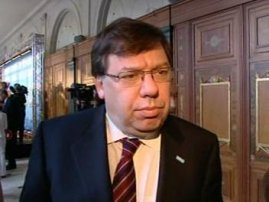
Taoiseach Brian Cowen (left) was quick to react this time and declared that the government would be "engaging the pension industry" to "review funding arrangements".

Once again he only gives us a few empty and meaningless words, despite the seriousness of the matter. What does it mean when the government is "engaging the pension industry"?
Should not the government be in regular contact with and in control of the 'pensions industry'?

(By the way, the use of the word 'industry' in this connection turns my stomach. An 'industry' produces things. Pension funds do not produce anything. They only administer money and shift it around in the hope to make profits, obviously not with much success lately.)

What will happen after the government has "reviewed funding arrangements"? And what exactly is a "funding arrangement" when it is at home?

If the Taoiseach thinks that he can bamboozle us with such hollow language, he is in error.

We demand to know what is really happening, when it is happening, and what the consequences are. And while we are at it, we also like to know why nothing has been done about the problem in the past.

Brian Cowen's empty statement today follows the leaking of a confidential report, which warns that a number of pension schemes "could collapse within the next six months, affecting tens of thousands of Irish workers".

The leaked internal report was prepared for the Cabinet by the Minister for Social and Family Affairs Mary Hanafin (right). So at least she seems to know what is going on.

A memo, seen and made public by Ireland's Sunday Tribune newspaper, warns that "defined-benefit schemes in the private sector and defined-contribution schemes could be under threat as the total pension deficit reaches between € 20 and € 30 billion".

The memo says that in defined contribution schemes, which are directly linked to investment returns and where a worker carries the investment risk, there is "anecdotal evidence that best practice is generally not applied", leaving people "exposed to more risk than they might realise".

"These are turbulent and difficult times for money markets, where most pension funds are invested," Mary Hanafin said in a statement today.
"Pension fund managers have yet to report on their funding standards to the Irish Pension Board, but in public comments they have indicated that funds are subject to market fluctuations."

She added that the government is "continuing to closely monitor the situation and is preparing proposals on the long term strategy on pensions, following the submissions made to the Green Paper on Pensions earlier this year".

Following the example of her master, Mary Hanafin is trying to keep us in the dark. How stupid does she think we are? Does she really believe we need to be told that "these are turbulent and difficult times for money markets"?
And what does it mean that "the government is continuing to closely monitor the situation"?

To 'monitor' something means a passive observation from a distance, in modern times usually via an electronic media screen, or monitor. So this is all the government does. Sitting there and watching numbers running over a computer screen.
No wonder that the country and our economy are in such a shambolic state!

Anyone can look at data on a computer. Even my cat is able to do it. And I am almost certain that she understands them better than our government does.

If incompetence and complacency would make people small, our present government would have a very comfortable existence beneath the floor carpets in Leinster House!


The Irish Business & Employers' Confederation (IBEC) has also repeated its recent expression of concern (see my entry of October 7th) that a number of private sector defined-benefit schemes are in danger and said "this situation could put companies themselves in danger".

Brendan McGinty (left), IBEC's Director of Industrial Relations and Human Resource Services, said he is "concerned that three out of every four providers of private sector defined-benefit schemes" would not be in a position "to meet total pension payments if they were required to do so tomorrow".
"This is the scenario which the government and pensions board use to determine a scheme's liquidity," McGinty explained.

Employers are increasingly seeing defined-benefit provision as a "bottomless pit", he added, stating that IBEC is "calling for the liability to the taxpayer from defined benefit pensions in the public sector to be capped" and urging the government and pensions board to take immediate action.

Meanwhile the Irish Congress of Trade Unions (ICTU) has called on the government to introduce a State-run mandatory pension scheme.

ICTU General Secretary David Begg (right) said that - given the current market difficulties - it is "almost inevitable that some of the schemes will be in trouble".
Begg also agrees with a recent IBEC suggestion that "funding standards for pension schemes may need to be relaxed".

Having lived in a number of different countries, I am familiar with different systems of government, economy and also pensions.
And it really puzzles me why Ireland has not established a State-controlled universal pensions system a long time ago. Why are we - after 86 years of independence - still copying everything Britain does, while there are much better options and models elsewhere that we could adopt?

In my entry of October 7th - titled "Irish Pensions System in Need of Reform" - I have written about this matter already. So I will not repeat all my points and arguments here and suggest you go to the archive and call up this entry, which includes a detailed plan Ireland could follow.

The Emerald Islander

29 November 2008

Farmers protest against Fianna Fáil in Co. Offaly

While more than 8000 teachers and parents protested in Donegal town today against cuts to the education budget (see my earlier entry below), the Irish Cattle and Sheep Farmers Association (ICSA) demonstrated outside the Tullamore Court Hotel in Tullamore, Co. Offaly, where Fianna Fáil were holding their National Councillors' Forum Annual Conference.

Around 200 Fianna Fáil county and city councillors from around the country gathered for this meeting and had to pass the gauntlet of the angry farmers, who displayed banners, placards and a small flock of miniature plastic models of cows and sheep in front of the conference hotel.

ICSA's angry protest was directed against recent cuts in the agricultural budget, and especially against a reduction of support schemes for small farms, which affects mostly people farming in the west and north-west of Ireland, where they raise cattle and sheep.

The Taoiseach, the Tánaiste and three other government ministers were addressing the Fianna Fáil meeting, and it has been reported that especially Brian Cowen gave "a rousing speech" to his party members.
This is probably quite necessary, as the current unpopularity of the Irish government worries many Fianna Fáil councillors, particularly in light of the up-coming local elections next year.

The Tánaiste and Minister for Enterprise, Trade & Employment Mary Coughlan, Transport Minister Noel Dempsey, Education Minister Batt O'Keeffe and Agriculture Minister Brendan Smith also addressed the meeting and then faced the councillors in a questions-and-answers session, especially over the details of the controversial 2009 Budget.

However, in their usual arrogant way neither the Taoiseach nor his ministers had any time for the protesting farmers and showed no concern for their problems. I am sure the farmers - and not only those who were present today in Tullamore - will remember this when they cast their votes in future.

The Emerald Islander

8000 protest in Donegal against Education Cuts

Today over 8000 people took part in a protest march in Donegal town against the government's cuts in the education budget. The protesters included teachers, parents and members of boards of management from schools across the north-west of Ireland and came mainly from counties Sligo, Leitrim and Donegal.

They outnumbered the 2500 inhabitants of Donegal town by more than 3:1, and a good number of local residents also joined the demonstration.

The gathering in Donegal was addressed by John Carr (right), General Secretary of the Irish National Teachers' Organisation (INTO).
Representatives of other teaching unions were also present.


INTO, which has already organised a number of protests around the country (see my entries of October 29th and November 22nd) since the 2009 Budget was introduced by Finance Minister Brian Lenihan on October 14th (see my entry of that day), is planning further demonstrations in the near future.

The largest of them is a national rally, which will be held in Dublin next Saturday.

INTO's courageous President Declan Kelleher (left) said that there is strong political support for the campaign, and from my own observations I can second this statement.

I would also urge anyone who has the time and opportunity to be in Dublin next Saturday to join the protest march. Education is the key to our future, and we should do everything in our power to prevent the damaging cuts the government has proposed for the education budget.

The Emerald Islander

28 November 2008

Irish Health Insurance becomes unaffordable

Another day, another outrage or scandal. This is the life now in modern Ireland, under the most careless and incompetent government imaginable.

Today's outrage is that the two main health insurance companies in Ireland, VHI and Quinn Healthcare, announced substantial price increases, to take effect in the New Year.

VHI has announced it is increasing its prices by 23% (!!!) from January 2009, while Quinn Healthcare said that it is to raise its insurance premiums by an average of 16% and in some cases up to 19%!

The announcements came out of the blue and have hit the people of Ireland unprepared, at a time of severe economic recession and a serious financial crisis that affects everyone, from the largest companies to the last unemployed youngster.

In case of the VHI it also follows a long chain of continuous price hikes over the past few years. Last year their premium went up by 8.5%, and in 2005 and 2006 by 12.5% per annum. This is an increase in health insurance costs of one third over three years, and - adding today's price rise to it - of 56.5% over four years.
Although many things have become more expensive over the years, there is no evidence that in fact the costs for providing health care have risen by more than eleven times the inflation rate in the short period of four years. So what we see here from VHI is nothing but plain extortion.

Both companies are trying to excuse the announced price increase with the new health insurance levy, which - they claim - "is twice its intended rise of 8%".

Anyone who has the slightest bit of common sense and at least some knowledge of mathematics will know that this is hogwash.

The real reason for this scandalous - and for most people unaffordable - increase in premiums is that the insurance companies want to streamline their membership. Their main target is to push many older and poor people, who are more likely to need medical and hospital treatment, off their books. Thus they will become more profitable, which will please their share holders.

On the Live Line programme on RTÉ Radio 1 there were already many calls today, all from distressed and outraged Irish people, who realised that they can no longer afford their health insurance. Some have been cancelling their policies already today, others are in despair, not knowing what to do.

Thank you, Mary Harney, for making Ireland's health service even more American, unfair and unaffordable as it is already!

For an average family the price rise will mean about € 400 extra payment for health insurance per annum. For people on low incomes, and for recipients of ordinary state pensions, this is simply impossible.
And there are even a lot of the younger people who - now that we are in a recession - will find it extremely difficult to afford the additional payment, which is more than four times the inflation rate with VHI and three times with Quinn.

The Minister for Health Mary Harney (left) came out today rather fast and said sheepishly that she was "very concerned about the rise", describing it as a "major burden for families".

Of course this is an immense burden for families, and for everyone who is single as well. We don't need 'Miss Piggy' to tell us so.

In fact, her statement adds insult to injury, as it was Mary Harney herself who removed the ministerial regulation from the health insurers. Thus they can now raise their prices as they please, no longer controlled or restricted by the government. (Under the old rules any increase in health insurance would have to be approved by the Minister, who could object to it within 28 days after it was announced.)

Mary Harney has no concerns for the Irish people, their health and well-being, and least of all for their financial problems. She lives in the cosy cocoon of another world, perhaps even another planet. She never sees sick people and is only concerned with the ever more radical privatisation of hospitals and health services, so her friends in the private health industry can rake in ever more and ever larger profits.

On the Live Line programme today it was mentioned that an ordinary (public) general hospital in Ireland is now charging a patient the outrageous sum of € 4,300 per day, just for the bed and the little food that is served. Operations and other medical treatments are charged extra (but surprisingly often less costly than just the bed, which is there all the time anyway).

And if that were not scandalous enough, one caller reported that his sick wife was charged the princely sum of € 12,000 per day for a bed in a private hospital in Dublin.
This is even beyond the level of a scandal. This is criminal extortion!

It is also another example of the utterly corrupt culture Fianna Fáil and the PDs have created in Ireland over the past eleven years they have been in government. Under their leadership ever more money is given to their rich and super-rich friends, while the ordinary and hard-working people of Ireland are ever more squeezed and robbed of the little they have.

As regular readers of this weblog will know, I am no friend of the British and their 750 years of colonial rule over this island. But in all fairness one has to acknowledge that even under British rule conditions were not as scandalous, unfair and corrupt as they are now, after eleven years of continuous rule by the incompetent and cleptocratic regime of Fianna Fáil and their coalition partners.

While ministers, senior civil servants and self-serving spongers like Rody Molloy are living the life of Reilly at our expense, the majority of Irish people are robbed left, right and centre by an unholy coalition of the government, the banks, the insurance companies and many other private businesses.

Life in general, and everything connected with it, is on average at least twice as expensive in Ireland than it is in other EU countries. And I am not even talking about the newer members of the union in the east and south-east of Europe. Anywhere in Europe - from Austria to the UK - people have a better quality of life, at half of the costs (or even less) than people in Ireland have to pay.

We have the highest insurance rates - for people, houses, cars and everything else - as well as the most expensive food, drinks, supplies, fuels and utility services. Our infrastructure is of 19th century standard, but we are charged more than twice for public transport, electricity, gas and communication services than anyone else in Europe.

Even with house prices falling now, the purchase of a home here is still between two and three times more costly than on the Continent. And rents, although falling as well now, are twice as high as in most of the other EU countries. Not to mention that tenants on the Continent have plenty of rights and protection from exploitation and rogue landlords, while there are still no proper tenant rights in Ireland.

In 86 years of running our own affairs no Irish government has made the slightest effort to improve the living and general conditions for our people. However, since a majority of Irish voters keeps electing the same incompetent and corrupt people - many from the same 'political' families - and the same old parties over and over again, we probably deserve nothing better.

"Every country has the government it deserves," a wise old philosopher wrote a very long time ago. And his words are still correct.

If we want change, we have to stop being lazy fools, get up from our chairs and do something about it. The Americans have just elected a new President, whose main message is "Hope and Change". If we want to see some new hope for a better future, and a change of our political and social conditions, we have to do the same and elect new people with fresh ideas, people who are capable of change and untarnished by the corrupt and cumbersome system that drags us down, but makes politicians rich and complacent.

We don't know when the next general election will be called. Theoretically the government has still 3 1/2 years of leeway, although I very much doubt that they will last that long.

But next year we have local government elections coming up, and the election of the members of the European Parliament. These are the first opportunities to show what we really want. We can kick the incompetent Councillors from the old parties out and fill our county and city councils with new people of different parties, or - even better - Independents.

Waterford has done this already in 2004. Of the 15 Councillors on Waterford City Council four are now Independents, while there is only one man from Fianna Fáil left. The Council shows a healthy mix of people's views, with four seats for Fine Gael, three for the Labour Party, two for Sinn Féin and one for the Workers' Party.
I very much hope that the rest of Ireland will follow Waterford's example and make sure that Fianna Fáil and the Green Party are told where to go: home, and out of business.

But this will of course not solve the problem of the criminal increase in health insurance. I would advise to make your anger felt and heard as much as it is possible. Write letters to newspapers, call Live Line and your local radio stations, and speak with your constituency TDs, regardless of their party.
Express your anger, your thoughts and feelings, and let the TDs know that you will hold them responsible for what happens.

It might not make the rises disappear, but perhaps one can bring them down to an affordable level.
Even though Mary Harney has relinquished her intervention right, a simple act of government could reinstate it, or introduce other measures.

VHI is a large, solid and wealthy organisation, which has extorted more than enough money from the Irish people over the past years.
And Quinn Healthcare (formerly BUPA Ireland) is part of the Quinn Insurance Group, privately owned by Sean Quinn (above) from Co. Fermanagh, Ireland's richest man with a personal fortune of over € 4 billion.
He became a billionaire on the backs and with the money of Ireland's sick people. And he still rakes in massive profits. So he can well afford to show some generosity to our sick and elderly, especially at a time when the country is in a serious recession that makes most of us poorer.

And you can of course always switch your insurance to another company. Even though VHI and Quinn are the two largest in Ireland, there are others as well.

For example, Hibernian Health has said today that it has "no plans to increase its health insurance premiums at this time". That is a piece of good news at last, in this sea of scandals.

This is still a free country with a free market, so shop around and select the best option available. One of the worst traits of Irish people is inflexibility, which leads to the ridiculous attitude of preferring "the devil you know" to anyone else.
If we stick to that sort of thinking, we can as well hand over all our money to those who are out to rob the poor for the benefit of the rich.

And as under EU laws the insurance markets are deregulated, you could even obtain insurance cover from a company outside of Ireland. Look and shop around, search on-line and talk to an independent advisor. There are better ways than just resigning yourself to the apparent 'powers to be'.

Ireland is in general a great little country, full of decent people. If they all combine their will, initiative and power as citizens, consumers and voters, we can and will see a change for the good. If not, we can as well pronounce Brian Cowen Taoiseach for life, swallow 40 sleeping tablets and jump into the next deep river.

The Emerald Islander

27 November 2008

PAC begins Investigation of FÁS Scandal

Today a member of the Board of FÁS has appeared before a Dáil committee in Leinster House in Dublin and said that "the approval of some expenses" at the State's training agency was "fundamentally wrong".

Niall Saul (left), who is one of the four employers' representatives on the 17-member board, told the Public Accounts Committee (PAC) of Dáil Éireann that "a root and branch investigation is required".
He said that following last night's board meeting, it was clear that there was "a failure of control and oversight of expenditure".

Mr. Saul is the HR Director of McNamara Constructions and held similar positions before with Irish Life & Permanent (owners of the permanent tsb bank) and - until 1997 - with Waterford Crystal. He is also the chairman of the Audit Committee of the FÁS Board.
Amazingly Mr. Saul was the only member of the entire FÁS Board prepared to attend today's hearing, and one has to wonder what a bunch of spineless cowards the other 16 members must be.

Former FÁS Director General Rody Molloy (right), who has resigned two days ago after coming under severe pressure from the media and public outrage, refused stubbornly to appear before the PAC (saying he was "no longer in office") and to account for his agency's affairs and his own eccentricities.
This is the man who was praised by Taoiseach Brian Cowen twice in the past four days. (see my entries of November 25th & 26th)

PAC Chairman Bernard Allen (Fine Gael) said that he finds it "incredible that members of FÁS can just ride into the sunset without holding themselves accountable".

Deputy Allen (left), who represents the Cork North Central constituency, stated that it was "regrettable that Mr. Molloy is not in attendance", but he said other members of FÁS would be able to address issues, as they were also in the organisation during the time being examined.

He added that he was "inviting" Mr. Molloy to come before the committee next week. There were also speculations in Leinster House if Rody Molloy could be forced by law to attend the next PAC meeting.

Bernard Allen also sent a formal invitation to FÁS Chairman Peter McLoone, who in his main job is Secretary General of IMPACT, the (with about 55,000 members) largest public service trade union in Ireland.

McLoone (right) was appointed as Chairman of FÁS on December 23rd, 2005, succeeding Brian Geoghegan, the husband of Health Minister Mary Harney. (When the two got married in 2001, Harney - then the Minister for Enterprise, Trade & Employment - was in fact Geoghegan's boss and supervisor, as her then Department controls FÁS.)

Appointed for a five-year period, Peter McLoone could remain as FÁS Chairman until the end of 2010, unless he has the decency to step down from his position. In the light of the recent revelations, McLoone has certainly not done a good and proper job in overseeing the running of the agency.

The PAC also heard today statements from civil servants from the Department of Enterprise, Trade & Employment and the Department of Finance.

In a further development of the affair, Fine Gael TD Jim O'Keeffe (left) told the PAC that he has established that State travel policy did not include any entitlement to first class travel. (On Monday Rody Molloy said live on air - in an interview with Pat Kenny on RTÉ Radio 1 - that he was "entitled to first class flights".)

Deputy O'Keeffe, who represents the Cork South West constituency, was questioning FÁS Assistant Director General Christy Cooney - one of the seven people who hold this title, and thus a member of the FÁS Executive Board - about the organisation's travel policy.
Besides his senior job with FÁS, Christy Cooney (on the photo - with Sean McCague - right, holding a book) is also the incoming new president of the Gaelic Athletics Association (GAA), the organisation in charge of Ireland's popular national sports Hurling, Camogie and Gaelic Football.
The 52-year-old from Youghal, Co. Cork has long been involved with the GAA, especially in the southern province of Munster, and was elected in April to succeed the current GAA boss Nickey Brennan next year.

Meanwhile FÁS has located credit receipts for the € 32,000 worth of flights to Florida, which the organisation earlier told the Committee it had failed to get refunds for. It said that "the credit notes were incorrectly coded, due to an administrative error". Which means that sloppy work at the FÁS head office is costing the taxpayers of Ireland € 32,000 for absolutely nothing in return.
This amount should be deducted from the generous salary of the FÁS director responsible and returned to the Department of Finance.

In a separate statement the Taoiseach declared that the Board of FÁS "now needs to get back to work and appoint an interim Director General soon, following the resignation of Mr. Molloy".
Brian Cowen (left) said that "it is important the Board of FÁS continues to operate". Instability should not be re-created and a sustainable and credible way forward needed to be found.

He seems however completely unconcerned with the massive scandal that brought down Rody Molloy and might yet claim more heads from the senior staff of FÁS, as ever more details emerge about the self-indulgent and irresponsible lifestyle the agency's executives enjoyed for years at taxpayers' expense.

With his cavalier attitude and - even worse - his praise for the main culprit of the scandal, Brian Cowen associates himself with the corrupt spongers and thus becomes co-responsible, by deed and by association, even if he himself might not have directly benefited from the colossal misuse of public money. As the Taoiseach he is responsible for the whole government, including all its agencies, anyway. And as the Minister for Finance until May of this year he was also directly responsible for the nation's money, in particular what is spent in any part of the public sector.

So, either Brian Cowen knows a lot more about the FÁS scandal - and perhaps many more like it in other government agencies - than he is willing to admit in public, or he is immensely stupid. In either case he is not the right man to be Taoiseach and should resign immediately.

The Emerald Islander

Harney entangled in hairy FÁS 'Florida Gate'

One of the - recently revealed - spurious expenses paid for with a FÁS credit card was for $ 410, spent at a Florida beauty parlour, which was said to relate to a time when Minister Mary Harney (right) was in the Department of Health.

Last night her office said that she "might have been responsible for part of a bill incurred when she led a FÁS delegation to Florida as Enterprise, Trade & Employment Minister".
But her spokesman vigorously denied that what had amounted to "a wash and blow-dry" could have accounted for the entire bill.

It was also being suggested that "some others" on the delegation could have contributed to the controversial bill.

The Taoiseach, supporting spongers as usual, said he accepts the explanation given by Minister Harney about the hair dressing treatments, and that she has his "full confidence".
He also rejected vehemently calls from the opposition, especially from Fine Gael's spokesman on Enterprise, Trade & Employment Dr. Leo Varadkar, for Mary Harney's resignation.

Speaking on RTÉ Radio 1, independent Senator - and Business Editor of the Sunday Independent - Shane Ross (left), who investigated the misuse of FÁS money and published his findings in last Sunday's edition of his newspaper, explained that the invoice relating to a bill for $ 410 in a beauty salon in Florida is dated from 2004.
He said that there was a misprint by a year in the newspaper article on Sunday, which stated that the bill was from 2005.
He went on to say that the amount of $ 410 is correct, but that it was unclear how many people were responsible for the bill.

There is no question about the need for people in official positions to look proper in public, especially when they are representing the country abroad. However, one should remember that Ministers, TDs and Senators receive not only a very generous salary, but also have an equally generous allowance for their expenses.
This should be more than enough to cover any costs for clothes and shoes, as well as for personal hair and beauty treatments. And the same goes for senior civil servants and employees of state agencies.

Anyone working in the private sector has to pay for all these things from private funds and does usually not receive any allowance for it. So why should the taxpayers foot the bill for these private matters when it comes to public representatives and civil servants, whose income is much higher than that of anyone working in private business?!

The whole concept and attitude is wrong, and it is more than time that we end this self-indulgent culture, where those we elect to represent us believe they are entitled to the life of a king, at our expense.

Meanwhile the Board of FÁS has met last night to consider the circumstances that led to Rody Molloy's resignation and how the organisation should best move forward. (see also my entries of November 25th & 26th)
In a statement, the board said it was "gravely concerned about these matters", but that - in deference to the hearing of the Dáil's Public Accounts Committee (PAC) - it would not be making a detailed statement.

Silence is golden at FÁS, it seems, as golden as the lifestyle its senior staff enjoyed for many years at taxpayers' expense, and perhaps also as golden as the good-bye handshake for Rody Molloy will be.

We have really become a fine example of a banana republic, with the twist that we don't even have the climate to grow bananas.

The Emerald Islander

26 November 2008

Cowen praises disgraced former FÁS Boss

Taoiseach Brian Cowen (left) has commended the former FÁS Director General Rody Molloy, who resigned in disgrace late last night (see yesterday's entry), "on his decision to step down".

Cowen said that Molloy, a fellow Offaly man, had "made a valuable contribution to FÁS" and that "his resignation showed that confidence in him was justified because he has proved himself to be accountable".

When I heard these words, I first feared that there was something wrong with my ears.

But no, Cowen did indeed praise Rody Molloy (right), an unrepentant and arrogant sponger and selfish waster of taxpayers' money, who was forced to step down after eight years as Director General of the state's employment and training authority, after the brave independent Senator Shane Ross exposed the corrupt practices in the senior echelons of FÁS and the colossal amounts of money Molloy and some of his fellow directors had spent on themselves and on lavish corporate entertainment and foreign travel.

One has to pause here for a moment, let this sink in and reflect.

Molloy is a man who - as a public servant - wasted huge amounts of our money on things that were neither necessary nor justifiable. A man whose attitude was - and still is - that, as a large pig at the state's through, he was "entitled" to only the best and took uncontrolled advantage of every possible perk he could get.
And then there is the country's Prime Minister (and former Minister for Finance), who not only gave this man his "full support" when the scandal broke, saying that he was "a very good public servant", but who now - after his forced resignation - still praises him in the highest possible way, as if Molloy had just found the cure for cancer.

This is outrageous, and a scandal in itself! And adding his insult to the immense injury Molloy has caused the nation, Cowen describes him as "accountable". Has the Taoiseach now lost his mind completely?!
Accountable? If there is anything specifically Rody Molloy was not, then it is accountable.
He would still sit in his comfortable chair and enjoy the lifestyle of a king, had Senator Shane Ross not exposed the scandal.

Over the now six months as Taoiseach, Brian Cowen has shown no leadership qualities, but instead demonstrated on many occasions his incompetence, arrogance and lack of judgement. He has also again and again exposed his short-sighted and narrow-minded views on major policies, and in all this also been extremely rude, foul-mouthed and ill-mannered. In short, he is by far the worst Taoiseach this country has ever had.

But today's statement has added a new dimension to Brian Cowen. He has now publicly stated that he approves of corruption, spongers and the massive waste of taxpayers' money on a luxury lifestyle for the senior civil servants of this country. And all this at a time when we are in deep recession and face the worst financial crisis in living memory.

Anyone who can tolerate Brian Cowen any longer as the leader of our government and country must be completely blind, deaf and totally without moral fibre. The man is an utter disgrace and should resign as Taoiseach - and as TD - immediately!

However, he is still muddling on and pretends nothing has happened. And even the opposition is not (yet) willing to attack him in the way he deserves.

During Leaders' Questions in the Dáil today Fine Gael leader Enda Kenny (left) only said that "the entire board of FÁS should also consider their positions". Quite right, and well put!
But Kenny should have called for the resignation of Brian Cowen and his Tánaiste Mary Coughlan - who, as Minister for Enterprise, Trade & Employment, is directly responsible for FÁS - as well.

Yesterday Kenny highlighted a € 410 bill from a nail and beauty salon in Florida, which was paid with an official FÁS credit card. He asked if this was what taxpayers' money should be spent on, and again he was spot on.
This one outrageous example is, however, only the tip of the iceberg. Kenny could and should have been a lot more forceful on the matter, and we all would have applauded him.
But one of the problems with Fine Gael is that they are way too soft on the government and let Cowen and his cronies get away with too much incompetence, arrogance and blunder.

Meanwhile FÁS says that it will "announce the appointment of an acting Director General for an interim period, pending the recruitment of a full-time successor to Mr. Molloy".
It does not surprise me that they are very fast in shoring up the damage, as they are still hoping to get away with their scandalous culture of self-serving perks. What happened over years was not only done by Rody Molloy, although he was in charge, set the example and approved of everything. There were and still are many more culprits in the organisation, and they should go as well. How could we ever again trust FÁS if they remained in their positions?

Fine Gael TD Bernard Allen, the chairman of the Dáil's Public Accounts Committee (PAC), said that Rody Molloy had "no choice but to resign".
He told RTÉ that he had hoped to have him before the committee tomorrow, to ask him to explain his € 5.7 million expenditure for 2007. But with his resignation Molloy escaped this planned grilling by TDs.

Rody Molloy's resignation is unlikely to end questions about financial controls at FÁS, especially as the PAC and the Comptroller and Auditor General were already investigating spending at the organisation for quite some time. (see my entries of September 22nd & 23rd)
In a statement FÁS has said it will "continue to co-operate with the investigations", which will now want to know more about financial controls in the organisation, and how closely spending by senior management was supervised by the board and the government.

Well, they don't really have a choice, have they? The cat is out of the bag now, and everyone in the country knows about the scandalous practices at FÁS. People are rightfully outraged, and they want to see this quagmire of corruption and self-serving arrogance drained and sorted out once and for all.
In my opinion the best solution would be to abolish the whole organisation and replace it with a smaller, better and more efficient agency, directly controlled by the Department of Enterprise, Trade & Employment. But in order to get that, we first need a new minister in charge of this department.

The Emerald Islander

239 Job Losses in three US-owned Irish Firms

Ireland is really in the grip of a serious recession now, and almost every day one hears of more companies closing or reducing the size of their workforce. And - according to analysts - we are only at the beginning. A lot more and worse is expected to come next year.

In today's news we have learned that another 239 jobs are going to be lost in the Irish operations of three US companies in counties Galway, Limerick and Kilkenny.

The Galway-based Thermo King factory is laying off 110 of its staff as part of a 'restructuring programme'.
The company, which is part of the US Ingersoll Rand Company Ltd., manufactures 'transport temperature control systems' for a variety of mobile applications, including trailers, truck bodies, buses, shipboard containers and railway cars.
On October 15th Thermo King admitted that it was "the latest victim of the credit crunch" and decided to reduce production on one of its assembly lines.

Meanwhile the manufacturing company Filtertek in Newcastle West, Co. Limerick, announced it is to cut its almost 100-strong workforce by 59, which is a reduction of more than 60%. The Irish plant, which specialises in the production of modern filter technology, is the manufacturing part of a Dutch-registered subsidiary of the US company Filtertek Inc., based in Hebron/Illinois.

And, as certain things seem always to appear in units of three, there is more bad news from a place not very far from here.
The ball-bearing manufacturer NN Euroball, a US-owned company with its head office in the state of Tennessee, is going to close its production plant in Kilkenny with the loss of 70 jobs. The company produces high precision metal bearing components and has come to Kilkenny with IDA support in 1997.

This is normally the busiest time of the year for the firm, but there has been a steady decline in demand for its product since October. Production at the facility will cease early next year when the majority of staff will lose their jobs.
The workers at the IDA-supported company have been on 'short time' since last month and the company says the closure is "due to the global downturn in the automotive industry".

This might well be, and the current economic crisis is affecting many businesses all around the globe.
However, one cannot avoid to notice that NN Euroball is another of the many US companies that were brought into Ireland by the IDA (Industrial Development Authority) with a lucrative package of tax breaks and favourable conditions. These special conditions are usually granted for a period of ten years. And guess what...? More than 90% of the - predominantly US - companies who avail of it close their Irish operation between one and two years after the perks have ended and they have to face normal market conditions and pay taxes as everyone else.

In the case of NN Euroball the global recession might well be the main reason for closure, but it does not take the company off the long list of IDA short-term successes that turned into long-term failures.

The Emerald Islander

25 November 2008

Rody Molloy resigns as Director General of FÁS, the National Money Wasting Authority

This evening Rody Molloy (right) has resigned as the Director General of the Irish training and employment authority FÁS.
It appears that the former career civil servant, who had been in charge of FÁS for the past eight years, jumped before he could be pushed by his political masters.

Since the publication (in the Sunday Independent) of a detailed investigation into FÁS and its lavish and extravagant spending of public money on the senior executives, Molloy had come under severe pressure from the media and from various opposition politicians, in particular the Fine Gael spokesman of Enterprise and Trade, Dr. Leo Varadkar, TD.

Only yesterday morning Rody Molloy appeared on the Today programme with Pat Kenny on RTÉ Radio 1 and defended in a very grandeur manner his extraordinary spending spree. Charlie Haughey could not have done it any better.
Being confronted by Pat Kenny with the findings of the investigation, Molloy showed not a bit of regret or remorse. He had no specific answers to the allegations and only repeated the mantra that he had "done nothing wrong". With amazing arrogance he stated that he was "entitled" to first class flights to the USA, and then admitted that he had "traded them in for business class tickets", so he could take his wife along on official trips - at the taxpayers' expense.
He also said that the over $ 900 of FÁS money he spent on a single game of golf and a $ 400 bill from a 'beauty and nail bar' in Florida "was just chicken feed" compared with the overall budget of his organisation. Well, this showed clearly the man's attitude as a shameless sponger who was habitually spending taxpayers' money on his lavish personal lifestyle.

Molloy's resignation is not more than right, but he is only the proverbial tip of the wasteful and outrageous iceberg that is FÁS. And this is only one of the many state agencies, which might well have practiced the same lavish lifestyle as FÁS has.

Officially Foras Áiseanna Saothair (FÁS) is the national training and employment authority of the Republic of Ireland. It was established by the government in January 1988 under the Labour Services Act 1987.

But - as the investigation by the independent Senator Shane Ross (left) under the Freedom of Information Act has revealed - FÁS is really the national money wasting authority.

And with a weekly budget of more than € 20 million there is a lot of money to waste. Much, it appears, is spent on lavish corporate entertainment for senior staff of the state agency, as well as on frequent luxury trips to the USA.

Since Senator Ross has done all the work and research, he deserves the full credit for it and I will not repeat his findings here in detail. If you want to read them - and I would highly recommend that you do - go to > http://www.shane-ross.ie/archives/422/fas-chiefs-enjoy-a-good-life/

The article makes definitely very interesting reading and opens one's eyes to the appalling and scandalous way in which the top brass of FÁS, which is supposed to create new jobs and train Irish people who are out of work, spends taxpayers' money on themselves.

It is quite unbelievable that during the boom times of the 'Celtic Tiger', when there was virtually full employment in Ireland, the annual budget of FÁS has risen to one billion Euros. Obviously there were very few people who needed jobs then, so the FÁS management decide to spend the money on themselves.

According to its own website, FÁS has provided services for an average of 89,000 people per annum in the past few years. This means that - statistically - they spent € 11,235.95 on each of these job seekers and trainees. One does not have to be a mathematical genius to work out that they would never spend so much money on one unemployed individual.
But
as it appears, the 'clients' were only an inconvenient burden for FÁS. Its real purpose was and perhaps still is to have a safe and well-paid public service job with plenty of lavish perks, all at the taxpayers' expense.
The few times I had dealings with them I always felt that they saw 'clients' as an inconvenient interruption of their internal meetings, coffee breaks and other things that went on behind closed doors. FÁS is not really interested in the general public of Ireland. It is far more concerned with its own little world, planet FÁS.

I wonder how much Molloy will receive now as a 'golden handshake'. In my opinion he should be receiving nothing at all! In fact, the Department of Finance should go through his expenses with a very fine comb and claw back all the money he wasted on private entertainment.

Rody Molloy had been scheduled to appear before the Oireachtas' Public Accounts Committee, which will be sitting on Thursday. I wonder if he will still turn up, or if he will use his resignation as an excuse for not accounting for his wasteful and scandalous behaviour.

However, people like Rody Molloy, who comes from the Taoiseach's home county Offaly and has a cosy relationship with Brian Cowen for a long time, are - as I mentioned above - only the tips of the iceberg of waste that has been built up in the Irish civil and public service under the rule of Taoiseach Bertie Ahern, himself a man with a cavalier attitude to money.

I bet that there are plenty of people like Rody Molloy, who have spent taxpayers' money with both hands, but without any concern or prudency, over the past ten years of boom. Their lavish lifestyle was of course inspired by the late Charles J. Haughey, and further encouraged by Bertie Ahern and Brian Cowen.
Haughey is dead now, and thus has escaped the unravelling of this scandal. But both Ahern and Cowen are still with us and should be held accountable as well for their share of the waste and mis-spending of public funds.

Responsibility also falls on the shoulders of the 15 members of the Board of FÁS, who have done nothing to prevent or stop the misuse of public money by the agency's senior executives. Either they were asleep for the past eight years, or they are not up to their job. So the least they could and should do now is to resign and make the way free for a complete overhaul and reorganisation of FÁS.
Some analysts have already suggested that the agency cannot survive in its present form, and I would support the idea of scrapping it, in favour of a more streamlined and target-orientated new national employment agency.

It will be quite interesting to see how many more skeletons will be found in the cupboards of the numerous Irish state agencies. Many of these organisations, for which there is really no need in a small country like Ireland, were created by Bertie Ahern to create extra jobs 'for the boys (and girls)' of Fianna Fáil. The best way to deal with them - and their wasteful behaviour - would be to abolish them again. But before that can happen, we will need a new government.

Only yesterday Taoiseach Brian Cowen (right) has stated publicly that "he knows Rody Molloy" (of course he does, as they come from the same county) and that he is "a very good public servant".
Such demonstrative loyalty and support for an exposed sponger and systematic waster of taxpayers' money shows that Cowen is completely out of touch with reality and certainly not fit to lead the government and the country.

For him the loyalty to an old pal might be a question of rural principles, but it is not the behaviour we expect from the Taoiseach, especially at a time when he and his Finance Minister Brian Lenihan are making us all suffer for the economic failures and financial imprudence of his - and his preecessor's - government.

When he realised that time was up, Rody Molloy had at least the sensitivity to resign quickly, in order to avoid more damaging exposure. Brian Cowen seems to lack such sensitivity. Otherwise he would have stepped down already and made the way free for either a new government, or - which would be better - a general election.

The Emerald Islander

24 November 2008

Irish Customers are fleeced by the ESB to finance new Power Plants in Britain

The Electricity Supply Board (ESB), the Republic of Ireland's largest producer and supplier of electricity, is "planning to expand its operations in the British energy market significantly, with a € 4 billion investment drive to build new power plants in the UK".

ESBI, the ESB's international arm, has "acquired an interest in a number of British power companies" and plans to build "over 3000 megawatts of gas-fired and renewable energy plants before the year 2020".

ESBI currently has operations and projects in more than 35 countries including the UK, and the ESB says this initiative will rank them "in the top ten energy companies in the British electricity market".

"The investment opportunity comes because of a projected shortfall in generating capacity in Britain over the next few years", an ESB statement says.
"ESB will build and operate a gas-fired power station near Manchester, which will generate electricity for 1 million homes by 2013, while another gas-fired station near Southampton will be operational by this time next year. ESB's plans in Britain also include wind-power projects."

I don't know about you, but I was very surprised - and almost stunned - when I read this. The ESB is an Irish company, originally established in the 1920s by the government to produce and provide the energy needed for this country, its development and industrialisation.

Until recently it has been a state company, concentrated on the needs of Ireland and our population and industry. That is how it should be.
Then - following the general trend in capitalist countries - Fianna Fáil part-privatised the ESB. Since then we have experienced several significant changes in their work and relationship with customers.

1) Prices for electricity in Ireland went up several times, without real need and explanations.

2) ESB closed its nation-wide network of shops, thus cutting off the normal way for a customer to contact the company and interact with it.

3) Most of the former shops' premises were sold to a large UK bank, at the height of the Irish property boom, for a massive profit.

4) So-called 'customer relations' are now reduced to contacts by telephone only. If a customer is lucky and skilled enough to get through the system of automated messages and electronic barriers, designed to minimise the number of calls, he is connected to a 'call centre', where predominantly young and very clueless 'operators' are trying to tell him that everything is in order, even if it is not.

5) Letters of complaint written to the ESB, even those addressed to senior management, are never answered.

6) ESB, now a commercial company and no longer a national service provider, is engaging more and more in other countries, while neglecting the Irish market.

7) Nevertheless it is predominantly the money created in Ireland that finances these foreign operations.

I did not know before that the ESB is now active in 35 foreign countries. And I did not know that all the money extracted from Irish customers at exorbitant rates is now going into the financing of the electricity supply of other countries. Did you?

As things stand, Ireland has one of the highest energy prices in the world, with ESB being at the top of the league table.
Whenever we are hit by another price hike for electricity - a utility which is now needed by everyone, so we have not really any choice - the ESB tells us that it is "because of the rising prices of oil, gas and coal on the international markets".

That is a lie. In fact the most barefaced and outrageous lie we have been given by an Irish company for a long time.
And it is about time to stand up to these liars and scoundrels and tell then what we think of them!

Fleecing the Irish public ever more drastically, in order to spend € 4 billion on new power stations in the UK - for the supply of British customers and the benefit of international share holders - is not acceptable in general, and especially not now, in a time of economic recession and financial crisis.
Not to mention the other 34 foreign countries, which have not been named. (I am trying to obtain a list, and if I get it, I will share the information with you here.)

We should not take this quietly, and begin to voice our protest.

Write letters to the chairman and CEO of the ESB!

Write to your TDs and to newspapers!

Talk with your TDs when you see them, and express your anger and disgust.

And use any other form of communication as well, to make your family, friends and neighbours aware of this scandal. They might not have heard of it yet.

The ESB was created by the Irish government, using taxpayers' money, to work for the Irish nation and provide us with enough electricity at affordable prices. Its purpose does not include to fill the gap in the energy market of our former colonial rulers, whose failure to plan properly for their own needs created a shortage of energy in Britain in the first place.

At a time when every single Euro and cent make a difference, we - the Irish nation - should not be robbed of € 4 billion, which then leave the country to help those who oppressed us for 750 years. No, I say, and once again - NO!!!

If you care for your country and the money in your pocket, then follow my example and make yourself heard. There is still time to stop the ESB from this blunder, but every day counts.

Éirinn go Brágh!

The Emerald Islander

Would Fine Gael provide a better Government?

Over the past weekend Ireland's largest opposition party Fine Gael (FG) held a national conference in Wexford. It was not, as some people had thought, their annual Ard Fheis (what people outside Ireland would call AGM), which is still to come.

No, this was a special national conference, a confidence-boosting event for party members and the public alike, and set at the time when Fine Gael passed Fianna Fáil in the opinion polls for the second consecutive month.

One can understand that Fine Gael members are excited, as it is the first time in living memory that their national popularity rating is above that of their arch rivals Fianna Fáil. But one has to be realistic and analyse the reasons for this sudden increase in public support.

At the Wexford conference there was no shortage of speakers - TDs, Senators and ordinary delegates - who praised again and again the strength and performance of their party, and in particular the "great and wise leadership" of Enda Kenny.
This is no surprise and can be expected from Fine Gael as well as from any other party. Those inside the pen are always confident and sure that their flock is so much better than all the others 'out there'.

But how much of this self-assuring noise is based on real facts? Let's have a closer look.

Fine Gael's recent jump in popularity is not a result of new political ideas, new people or a fundamental change in public opinion. In fact, since they narrowly lost the 2007 general election, Fine Gael have been rather a tame and timid party, offering only the most basic opposition to the government and being silent on many important issues.

Party leader Enda Kenny (right), now praised by his party delegates like some Messiah, has not been very vociferous or aggressive as head of the main opposition in parliament.
He is undoubtedly a very decent and honest man, which sets him worlds apart from most
Fianna Fáil TDs.
He is also a hard worker and does not dodge difficult subjects. One has to give him that.
But he is not - and never has been - a charismatic leader or particularly inspiring speaker.

In fact, very few members of the Oireachtas are gifted public speakers, so one could say that Kenny is in a company of equals there. So, despite the praise now heaped upon him by happy party members, it cannot be he - or his performance - that led to the rise in popularity for Fine Gael.

What is it then? The answer is not difficult to find for outsiders, even though FG members refuse to accept it in their euphoric mood.

The only reason for the increase in public support for Fine Gael is the dismal performance and utter failure of the present government.
While Fianna Fáil and the - now defunct - PDs got away with a lot of their mismanagement and incompetence during the boom times of the so-called 'Celtic Tiger', it is a different situation now in economic recession. There is no longer a bag with endless supply of money one could throw around to cover up mistakes and failure.
Now the proverbial wolf is at almost every door, including the doors of Government Buildings, every government department and state agency, and money is extremely hard to come by, especially since the ten-year-long mismanagement of our economy has also damaged our banks, probably beyond repair.

Instead of being prudent, humble and constructive, the government decided to remain aloof, arrogant and insensible and produced an appalling budget, which annoyed most of us and outraged significant elements in our society.
Since the budget was presented in the Dáil by Finance Minister Brian Lenihan on October 14th (for detailed budget analysis see my entry of that day), there have been dozens of public protest meetings and demonstrations against the government and its policies, both in Dublin and around the country. Elderly people, students, teachers, parents and farmers have so far been the most active in showing their anger and disappointment, but other interest groups are likely to follow as well.

In such a political climate it is no surprise that the government is becoming unpopular. This is a normal reaction and would happen to any government that behaves in this way, regardless which party or parties are in power.

Had Enda Kenny not run an American-style campaign in 2007 - which was designed and managed for him by US consultants who were unfamiliar with Irish and European politics and only knew the presidential campaign mode they do at home - he would most likely have become Taoiseach in June 2007, with the then Labour Party leader Pat Rabbitte (left) as Tánaiste.
Would they be in office now, they would face the same problems and might have to encounter the same drop in popularity Brian Cowen is experiencing now. Although - to be fair - Enda Kenny and Pat Rabbitte - both from Co. Mayo - are much more kind, pleasant and serious than Cowen and might have handled the crisis more sensibly. Nevertheless the fact of a recession alone will diminish the popularity of whoever is in government at the time.

People in most western countries have little personal interest in politics and think that it is enough to go once every four or five years into a booth and make a cross on a ballot paper. The rest they leave to the people they elect, and expect them to do a good job with the country and the economy.
All the average voter really wants is to live in peace, security, stability and prosperity. People want jobs, enough money and liberties to spend it, a proper house, a car perhaps, and nowadays also a good holiday. As long as they get that, they do not care much who is in government. This is not a shining example of Democracy, but sadly it is the reality.

When the popularity of a government shrinks, it is normal that the opposition party (or parties) will see an increase in public support. One team has failed to deliver what we want, so we no longer like them and hope the other lot will be and do better. One can see this happening all over the world, and it is the same here in Ireland.

The rise in public esteem Fine Gael is now celebrating is not at all based on anything they have done or said.
It is the natural gain they receive from the decline in confidence in the present government. Thus it is a dangerously thin sheet of ice to walk or skate on, and no matter what opinion polls might say, they are only snapshots of public views, taken from a small group of people. The only poll that really matters is the one on election day.

The understandably happy FG members should be a little bit more cautious and not start counting their chicken before they have hatched. Their party is far from perfect and - if roles were reversed - would most likely not perform much better than Fianna Fáil is doing now. (They would be somewhat better, though, as it is virtually impossible to beat the incompetence of Fianna Fáil and the arrogant and otherworldly attitude of the Green Party.)

Nevertheless the predominant opinion in Fine Gael after this weekend is that they are "ready for government" and cannot wait to form one. This is dangerous thinking.

In many constituencies the local grass root organisation of FG is shambolic, and sometimes even non-existent between election campaigns. There are faction fights over some petty issues and personalities, and overall there is a lack of proper organisation and vision.

Fine Gael might be officially Ireland's second-largest party, as well as the largest party in opposition, but it still has not learned how to mobilise the masses and provide new ideas that inspire people.

One should also not forget that only six months ago Fine Gael was very happy to stand shoulder to shoulder with Fianna Fáil and the government in the YES camp during the Lisbon Treaty campaign. In fact, for most of this campaign FG was far more visible, vociferous an pro-treaty than FF (or the Labour Party, who also stood with them and promoted the treaty).

Fine Gael's present spokesperson on Europe, the Mayo-born lawyer and Dublin TD Lucinda Creighton (right), was so arrogant, aggressive and even rude during various debates over the Lisbon Treaty that she and her attitude alone would have been enough reason to vote NO, had there not been a lot more and even better reasons to do so.

And the FG spokesman on Foreign Affairs, Wicklow TD Billy Godfrey Timmins (left), is not only a strong supporter of the Lisbon Treaty, he is also very much in favour of Turkey (a country in Asia) becoming a member of the EU.
That alone I find personally very alarming, and one should be aware of seemingly little details like this, as they can - and often do - become major policies once a party is in government.

However, during the Wexford conference there was not much discussion over the future of Europe and the EU. The dominant theme was - to no one's surprise - the economy and how to overcome the now ever more obvious recession.

Richard Bruton (left), the party's deputy leader and spokesman on Finance, had a field day and was hailed by delegates as much as Enda Kenny.
In fact, since the budget was presented in October, he has been in the frontline of the political battle every day and done most of the arguing on behalf of FG. Knowing how good his deputy is on financial and economic matters, Enda Kenny took deliberately a back seat role in many debates and let Bruton stand up as
Fine Gael's champion. (One has to acknowledge that Richard Bruton is indeed one of Ireland's best and most experienced experts on financial and economic policies.)

Dr. Leo Varadkar (right), a young first-time TD and already Fine Gael's Business & Enterprise spokesman, also received a lot of support from the delegates as he outlined his views on the economy and how to improve it. Although it is early days yet for him, some political analysts see in the 29-year-old a potential future leader of his party.

Another natural contender for the party leadership in years to come is undoubtedly Brian Hayes (left), who - after five years as the FG leader in the Seanad - is now Fine Gael's Education spokesman in the Dáil.
With the scandalous cuts to the education budget, ever rising class sizes and reduced resources for schools and teachers, Education was the second major subject in Wexford.

Fine Gael is committed to undo the current government's cuts in Education, should they form a government of their own (or - more likely - with the help of a coalition partner, which at this stage could only be the Labour Party).

Everything went well for Fine Gael in Wexford, and the special national conference coincided conveniently with another anti-government demonstration in Cork on Saturday (see my entry of November 22nd) and a very favourable new opinion poll published yesterday (see my entry of November 23rd).
So all was really hunky-dory for the opposition and would have remained so, but then FG leader Enda Kenny decided to lob the ball into his own party's goal only minutes before the end of the game.

In his leader's address he demanded that the new National Wage Agreement - signed by the Social Partners on September 17th and accepted by the trade unions only a week ago - should be "suspended for one year" to help the economy. (for details see also my entries of September 17th and November 15th & 17th)

This statement was not only the wrong one at this time, it has also destroyed Enda Kenny's chances to become Taoiseach any time soon. With these few words he offended almost every working class person, and certainly every trade unionist in Ireland.

Jack O'Connor (right), President of the country's largest union SIPTU, did not wait long with his reply to Enda Kenny and the newest Fine Gael position, also defended this morning - once again - by Richard Bruton.

“Apart from the implications for the living standards of ordinary working people, suspending the pay agreement is about the worst possible approach imaginable at this point in time,” O’Connor said.
“It would further depress consumer confidence and exacerbate the recession, when what is needed are means to stimulate demand.”

Quite right, and it is amazing that seasoned politicians like the FG leadership do not agree. But then again, one has to look a bit deeper into the party's structure and tradition.
Fine Gael is still a capitalist right-of-centre party which depends for a lot of its support on big business and very rich people. And ever so often these sponsors and lobbyists demand their proverbial 'pound of flesh'. They have little regards for FG's general policies, appearances and popularity, and only care for what matters most to them: the amount of money in their pockets and bank accounts.

So, ironically, a whole weekend that had gone so well for Fine Gael was blighted in the end by a policy statement from its revered leader. It exposed FG for what they really are: Just another of the old and worn-out parties on the Right of Irish politics, with no new ideas, but ever more appetite for power.

In that regard there is not much difference between FG and FF. Their party manifestos (and I read them both very thoroughly) have the same principles and almost identical lines on most policies. They both are establishment parties with little flexibility and are more than happy with the status quo. Which should not really surprise anyone, as they are the two sides of the same coin.
Both emerged as political 'children' of the original Sinn Féin, but fought each other during the Civil War of 1923. When peace was restored, they stood on opposite sides of the trench and there they still stand today, inflexible, self-centred and incapable to develop new ideas and political concepts.

Reflecting on all this, including the Wexford conference, one has to wonder if Fine Gael would actually provide us with a much better and more capable government, if we gave them the chance.

There is no doubt that anyone would be better than the current government coalition, and could do a better job simply by being less incompetent, corrupt and arrogant.
But after listening to many speeches and statements made in Wexford over the weekend, I am not sure that I would like to see a Fine Gael (or FG-led) government in Leinster House.

I am fully aware that the options are rather limited at the present time. Going by current numbers, there can be no Irish government without either Fianna Fáil or Fine Gael.
The Labour Party, the Green Party and Sinn Féin would be available as junior partners in a coalition. So most analysts expect that - in case the current government loses more of its TDs and is forced to step down - a new coalition of FG and Labour Party, supported by some Independents and - perhaps - even by Sinn Féin, would take over.

But should it come to an early general election, things could turn out quite different. Although the PDs are gone (to everyone's joy) and the Green Party will probably receive the same treatment as the PDs got in 2007, there is a strong possibility that Ireland will see some new political parties emerging.

Declan Ganley (left), the chairman of the Euro-sceptic think tank Libertas, which was very much engaged in the Lisbon Treaty campaign, has meanwhile registered his organisation as a political party. Even though his main interests are the EU and the up-coming elections to the European Parliament, I would not rule out the possibility that he also enters national and local politics in Ireland.

And there are some other people as well, most of them not members of established parties, who are wondering if we need some new faces, ideas, skills and leadership qualities in Irish politics.
It would not surprise me if there were several new parties in the next general election, and perhaps even already in the local elections next year.

Thus the idea of Fine Gael that they have a natural right to take over from Fianna Fáil when they eventually collapse, is a very old one, at a time when new ideas are needed to save the nation and revive our ailing economy.

The Emerald Islander

23 November 2008

Vatican forgives Lennon and praises The Beatles

The Vatican has finally forgiven John Lennon for declaring that 'The Beatles' were "more famous than Jesus Christ". 42 years after the iconic leader of the world-famous Liverpool music group made the unguarded remark in an interview with a British newspaper, the Vatican and his music-loving ruler Pope Benedict XVI have decided to be no longer officially offended by it.

Yesterday's edition of the Vatican's official newspaper L'Osservatore Romano carried an unusual article. On the feast day of St. Cecilia, the patron saint of music and musicians, a papal journalist was writing about 'The Beatles' and in particular their famous 'White Album', which was released 40 years ago.

In the paper's cultural section a large illustrated article, which covers half a page, deals with the subject in great length and detail.
The author commends 'The Beatles' for "their unique and strange alchemy of sounds and words".

"The talent of John Lennon and the other Beatles gave us some of the best pages in modern pop music," the article states.
Only "snobs" would dismiss the Beatles' songs, which had shown "great musical skill and inspiration".

After heaping more praise on 'The Beatles', in a way never before heard or read from an official source of the Vatican, the article concludes that "the fact remains that now, 38 years after breaking up, the songs of the Lennon-McCartney brand have shown an extraordinary resistance to the passage of time, becoming a source of inspiration for more than one generation of pop musicians."

The now 40-year-old 'White Album' the Vatican author calls "a masterpiece" and remarks that it is "a musical utopia where you will find everything, and the opposite of everything".

He then proceeds even further into new cultural territory and absolves John Lennon of his notorious remark, saying that "after so many years it sounds merely like the boasting of an English working-class lad struggling to cope with unexpected success".

It was back in March 1966 that John Lennon (left) made his famous - for some infamous - statement in an interview with the London Evening Standard.

"Christianity will go," he told a reporter. "It will vanish and shrink. We [The Beatles] are more popular than Jesus now - I don't know which will go first, rock and roll or Christianity. Jesus was alright, but his disciples were thick and ordinary. It's them twisting it that ruins it for me."

The boast provoked widespread outrage, particularly in the United States, where conservative 'Christians' burned piles of 'Beatles' albums in public. The band received death threats and many radio stations, particularly in the Southern states, stopped playing 'Beatles' records altogether.

More than a decade later John Lennon said that he was glad of the furore he had caused.
"My life with 'The Beatles' had become a trap," he wrote in 1978.
"I always remember to thank Jesus for the end of my touring days. If I hadn't said that 'The Beatles' were 'bigger than Jesus' and upset the very Christian Ku Klux Klan, well, Lord, I might still be up there with all the other performing fleas! God bless America. Thank you, Jesus!"

Two years later Lennon was murdered by a fanatic in New York.

For all the years after John Lennon's statement - and after his untimely death - the Vatican had kept silent and ignored the matter completely. So it comes as quite a surprise that the Holy See is now giving him, 'The Beatles' and their still popular music so much space and attention in its official newspaper.

We do of course not know the specific reason for this change of attitude, but it is well known that Pope Benedict XVI is a great music enthusiast, as well as an accomplished musician himself. (The first time I ever met him - then a young theology professor called Joseph Ratzinger who visited my grandfather - he played a few very nice pieces on the piano for us. I was only five years old then, but I still remember it well.)

Although the Pope has a personal preference for Mozart and Beethoven, it is quite possible that he does listen to 'The Beatles' as well from time to time. And despite the still prevalent opinion that he is a very conservative man, many of the decisions he made since his election have been quite progressive and surprised many observers.

About a year ago he appointed the Roman historian, writer and journalist Prof. Giovanni Maria Vian as new editor-in-chief of L'Osservatore Romano, and ever since the Vatican newspaper has become a lot more open and readable for people outside the Catholic hierarchy. Under Prof. Vian's editorship one can - beside the usual and official articles on theology and church matters - now find a lot of secular subjects covered as well, for example popular culture events such as the 'Oscars' and - yesterday - 'The Beatles'.

From time to time Prof. Vian is now also inviting articles from Muslim and Jewish contributors and has certainly widened the scope of his newspaper immensely. However, this would not be possible without the backing of his publisher - the Pope.

It appears that Pope Benedict XVI (right), who began his theological career as a progressive and was actively involved in the discussions of the Second Vatican Council, is returning to his personal and also ideological roots and now shedding gradually the strict conservatism he acquired during his time as theology professor in Regensburg (Ratisbon) and later as the chief ideologist and enforcer of church discipline under the very conservative Pope John Paul II.

In contrast to his predecessor, who came from the strict and rigidly conservative background of the Catholic Church in Poland, Joseph Ratzinger - Pope Benedict XVI - is a product of Upper Bavaria and its rather liberal and uncomplicated tradition of Catholic Baroque.
This becomes ever more obvious the longer his papacy lasts, and now even John Lennon and 'The Beatles' are receiving the benefit of his open mind.

The Emerald Islander

New Red C Poll shows FG still in Lead over FF

A new Irish opinion poll registers a slight recovery in support for the main government party Fianna Fáil, while support for the largest opposition party Fine Gael has also increased.

The Red C poll in today's edition of the Sunday Business Post shows Fianna Fáil now at 30%, which is an increase of four points since last month.

However, Fine Gael is up by two points to 35%, which represents a strong performance for the main opposition party.

The other political parties show a slight fall in support. The Labour Party is down one point to 14%, the Green Party has also dropped one point to 5%, while Sinn Féin lost two points since last month and is now back on 8%, where it stood for some time before.

Support for Independents remains unchanged at 8%.

Last month's Red C poll caused shock waves throughout Ireland's political system with a huge drop in support for Fianna Fáil in the wake of the 2009 Budget.
Fine Gael swept into a seven point lead over its traditional rival and even though the difference is now reduced to 5%, it is the best result for Fine Gael in modern times and coincides with the party's national conference in Wexford.

Last month's findings of the Red C poll were broadly confirmed in an TNS/mrbi poll for The Irish Times, also published last month, and the government's unpopularity continues on an all-time low. Besides the collapse of Fianna Fáil much of the public's anger is directed at the Green Party, which joined the government coalition as a junior partner in June 2007.

The third and smallest coalition partner, the Progressive Democrats, which were still listed in last month's poll, have meanwhile decided to dissolve their party and do no longer exist.
Its representative in the Cabinet - Health Minister Mary Harney - is now regarded as an 'independent'.

The Emerald Islander

22 November 2008

25,000 protest in Cork against Education Cuts

Today about 25,000 Irish people have been marching through the streets of Cork city in protest against the government's cuts in the education budget.

The march was part of a series of protest demonstrations organised by the Irish National Teachers' Organisation (INTO), which says that children should not be made to pay for the current difficulties in our economy.

It was the third time since mid-October that teachers, pupils and their parents have taken to Ireland's streets, protesting against education cutbacks.
INTO's General Secretary John Carr (right) declared that the marches will continue until the cuts are reversed.

Meanwhile the Minister for Education, Fianna Fáil's Batt O'Keeffe (left) who comes from Cork, said that he "simply does not have the funds" to reverse the cuts. This is his mantra ever since the major education debate in the Dáil on October 29th/30th. And unlike other ministers, who have been busy looking for extra money or alternative ways of saving on expenses, O'Keeffe has just remained stubborn, repetitive and inflexible like a stick in the mud.

Many in the education sector, who welcomed the appointment of the former teacher at first, think now that he is not really up to the job of heading the Department of Education.

The Emerald Islander

Energy Prices may remain unchanged after all

Price increases for the supply with gas and electricity, which had been expected in January, are now unlikely to go ahead. This is - after all the bad and gloomy news of this week - at last a positive turn of events.

Following significant falls in fossil fuel prices on the world markets, the Electricity Supply Board (ESB) and Bord Gáis have said that the price increases they both have sought from the Commission for Energy Regulation "may now not be necessary".

Yesterday the price for oil has reached a three-year low of $ 48.25 a barrel. Which means that crude oil is now trading at levels not seen since May 2005, and it costs almost $ 100 a barrel less than in July, when the price peaked at $ 147.27 per barrel. (A 'barrel', the old-fashioned unit of measurement still used by the US-dominated oil industry, equals 159 litres.)

Because of the global recession, the International Energy Agency (IEA) says that world oil demand will rise at its slowest pace for 23 years this year.

The price of natural gas has meanwhile fallen by 60% from the peak it reached earlier this year.

Bord Gáis sought the Energy Regulator's permission to increase its prices by 4.2% only three weeks ago, which would have added about €3 a month to the average household bill. (see my entry of November 4th)
This application for a price rise is still pending with the Regulator, who can accept or reject it. In light of the drastic price reductions on the international energy markets Bord Gáis should now withdraw the application without further delay.

The Emerald Islander

FÁS warns of a serious Employment Crisis while the Taoiseach keeps waffling on as usual

Ireland's self-serving and pompous training and employment authority FÁS is warning that "the number of people employed in Ireland could fall by more than 100,000 next year".

And what is FÁS doing about it? Absolutely nothing!

As long as unemployment rises, their own jobs are by far the safest in the whole country and they can keep enjoying their cosy existence as a well-financed State agency, which spends close to half a million Euros on 'away weekends' for its staff and nearly € 150,000 on office flowers. But then again, with an annual budget of over € 1 billion only the best is good enough for the well-paid, but entirely useless administrators of the nation's unemployed.

The figures suggested by FÁS would be four times more than the annual fall in employment registered in the Quarterly National Household Survey of the Central Statistics Office (CSO). (for details see my earlier entry below)

Commenting on the economic situation, FÁS economist Brian McCormick has said that "the 'credit crunch' is now beginning to hit employment in the financial sector, while the slowdown in consumer spending has adversely affected job prospects in the retail sector". (Now, there is a rare pearl of wisdom! One cannot help but wonder what FÁS needs an economist for in the first place. They are not a bank or financial institution.)
FÁS also says that the rate of unemployment could exceed 8.5% next year. (How fortunate for them. They will be really busy in 2009.)

Meanwhile, Taoiseach Brian Cowen (photo) said it was "obvious there is a very difficult economic situation that is affecting our economy the same as others".
But he and the government were "trying to minimise job losses".

One has to congratulate the Taoiseach on his quite exceptional observation and perception skills. He has indeed noticed that we are in "a very difficult economic situation". Well, well... I suppose they do have a newspaper in Co. Offaly after all.

But with the "minimisation of job losses" he seems not to be up to date.

Only yesterday it became known that thanks to his new regulations and Brian Lenihan's budget cuts Donegal County Council alone will have to sack 238 of their workers, and not only the 71 which were already told about it the day before. (see my entries of November 20th & 21st)

I have a very simple solution for the problem, and a suggestion that would indeed minimise job cuts in Ireland. If Brian Cowen and his government would resign (and call a general election), there would only about 45 jobs lost, but the whole country - and with it many thousands of jobs - could be saved.

The Emerald Islander

A Bag full of bad News from the CSO

There was a massive fall of 25,000 in the number of people employed in Ireland in the twelve months to August this year, according to the latest Quarterly National Household Survey from the Central Statistics Office (CSO).

This is the first annual fall in employment recorded by the CSO since 1991. The figures also show that unemployment increased by 60% during the same period.

It is the first time for 25 years that this combination of a sharp fall in employment as well as a sharp rise in unemployment has been recorded in official figures.

Men are doing particularly poorly, with the number of employed males down by 32,000 over the year, while women are faring much better, with a gain of 7,000 in employment during the year.

This shows once again and very clearly that the whole structure of the Irish labour market is changing and shifting from a male to a female dominance. There are three reasons for that:
1) The fact that most women are still earning less than a male equivalent doing the same job. Thus it is cheaper for companies to employ women.
2) The massive increase in low-skilled service jobs, which are predominantly filled with women, while there is a clear decline in manufacturing and other skilled jobs, usually held by men.
3) The ever more aggressive implication of so-called 'equality', which over-proportionally favours women and makes it increasingly more difficult for men to get a fair treatment and a proper job.

The collapse in construction has been one of the biggest drivers of the trend, with the numbers of those engaged in house building down by 40,000 compared with this time last year.
Other areas of construction expanded a little, providing some cushion for builders with a gain of 14,000 jobs on infrastructure and commercial building projects.

Employment in manufacturing is down 9,400, while the contraction in the 'leisure industry' has made another 5,400 people redundant in hotels and restaurants over the 12-month period.

It appears that the job losses are more severe for Irish nationals, as the overall employment of foreign workers is unchanged from last year.
However, the flow of non-Irish nationals into the country has slowed down to just one-sixth of the level of last year. This is not surprising. We were only attractive for migrant workers - most of them from eastern Europe - as long as there were more jobs than we could fill ourselves and more money than anywhere else. In fact, I expect that a good number of Poles will return home for the Christmas and New Year celebrations and not come back, because while Ireland is now in rapid decline, Poland shows the first signs of economic flourish and is tipped to be the next boom country in Europe.

The Emerald Islander

Frank Dunlop charged with Corruption

Dublin lobbyist, ex-journalist and former Fianna Fáil and Government Press Secretary Frank Dunlop (left) was arrested by members of the Criminal Assets Bureau (CAB) yesterday afternoon and has appeared in court in Dublin on corruption charges.

He is accused of bribing eight public representatives, six from Fianna Fáil and two from Fine Gael, and it is alleged that he paid them sums ranging from Ir£ 1000 to Ir£ 3000 to vote in favour of rezoning land at Carrickmines.

Those named in the charge sheets as having been bribed by Frank Dunlop are former Senators Liam Cosgrave of Fine Gael and Don Lydon of Fianna Fáil.
Also named are Fianna Fáil Councillors Tony Fox, Sean Gilibride, Colm McGrath, the late Jack Larkin, the late Cyril Gallagher and Fine Gael's late Councillor Tom Hand.

The money is alleged to have been handed over at the Davenport Hotel and at Buswell's Hotel in Dublin, at Conway's pub, at Mr. Dunlop's own offices, and in the case of the former Senator Don Lydon, at St. John of Gods' in Dublin.

Five of the charges relate to alleged payments he made to Liam Cosgrave and five more relate to Tony Fox (right), who is still representing Fianna Fáil on Dun Laoghaire-Rathdown County Council.

Detective Garda Martin Harrington from the CAB told the court that Frank Dunlop was arrested yesterday. When he was charged with the offences, he replied: "We always knew this day was coming and I will not be contesting the charges."

The court was told the Book of Evidence in the case was ready and Dunlop was handed a copy of it in the courtroom.

Judge Cormac Dunne acceded to a request by counsel for Frank Dunlop and sent the case forward to the next sitting of the Dublin Circuit Criminal Court.
He told him that if he intended to rely on alibi evidence he was to inform the prosecution and he remanded Dunlop on bail of his own bond of € 100.

For those who are not familiar with Frank Dunlop, or are too young to remember his past, it is worth to reflect on the career of the now 61-year-old Dubliner, who was born in Co. Kilkenny.

He first came to the public's attention when he was appointed press secretary of Fianna Fáil in 1974, with an office based at Leinster House. He then became head of the Irish Government's Information Service and Government Press Secretary (under Taoisigh Jack Lynch, Charles J. Haughey and Garret FitzGerald) from 1977 to 1982. The special position had been established on Dunlop's own recommendation.

His role involved developing relationships with the media, especially The Irish Times, the Irish Independent, other newspapers and RTÉ. (There were no other authorised radio stations in Ireland at that time, although there were quite a number of illegal broadcasters.)

Prior to Dunlop's appointment, the Government Information Service was the established unit of the Taoiseach's office for the dissemination of information relating to government activities. Dunlop described its role to the Mahon Tribunal in 2003 as being "a post office - it just delivered copies of statements, speeches, announcements and CSO details to the news desks of the papers; there was no substantive policy discussions with the media prior to that time".

Dunlop's objective was to facilitate 'an understanding in the media of what Fianna Fáil was doing or was about at that time'. This role enabled him to develop significant relationships with political correspondents, news reporters, editorial personnel and politicians.

Following a change in government, Dunlop was established as a civil servant with the rank of Assistant Secretary. He moved to the Department of Education when John Boland was the Minister, and his role was liaison with the media. He also made some inputs on policy matter on education.

Subsequently he moved with Boland to the Department of the Environment and worked there for about two years as Assistant Secretary, with responsibility for media matters. But he had no influence on planning matters then.

In 1986 Frank Dunlop, then aged 39, left the Civil Service and became a public relations consultant with the Dublin firm Murray Consultants. He had a director's role which involved developing a portfolio of clients. Dunlop's prior experience in government and the Civil Service made him uniquely qualified as a lobbyist, and he made extensive use of his contacts.

Where and when he began bribing politicians of various levels will undoubtedly be established during his trial. But one thing is certain: He is only the very small tip of an immense iceberg of corruption that was - and still is - an integral part of Irish politics.

The Emerald Islander

21 November 2008

Trade Union fears that more Council Workers in County Donegal could soon lose their Jobs

The IMPACT trade union has said that as many as 238 contract staff with Donegal County Council may lose their jobs.

71 people, whose contracts are not being renewed by the Council, will lose their jobs between now and the end of the year. (see yesterday's entry on that matter) 49 others are to be let go between January and March of next year.

IMPACT representative Richie Carruthers stated that the situation of the remaining 118 contract workers is currently "under discussion".

Despite the promise of a detailed statement on the matter earlier this week, Donegal County Council has now declared that it will be "making no comment on the situation until after a Council meeting on Monday", when the matter will be discussed further.

Under the new government rules Donegal, like all other local authorities, has to make a saving of 3% on its payroll costs.

Dinny McGinley (left), Fine Gael TD for Donegal South West, described the situation as "a virtual tsunami for the county".
He said that he had been in touch with colleagues in other Irish counties, and it appeared nothing as shocking was happening in these other local authorities.

So one has to wonder why - of all the counties in the Republic - Donegal, home of Tánaiste Mary Coughlan, is making such drastic cuts to its workforce. Could it be that the Fianna Fáil controlled Council has been overspending in previous years and is now running out of money?
Or is the rural county in the far north-west of Ireland just too eager to please the government and in particular Finance Minister Brian Lenihan, who is scraping the bottoms of all barrels in the public sector to find more money for his Budget?

Whatever the reason is, the massive cuts in Council staff will create immense hardship in Co. Donegal, and subsequently also reduce the overall quality of local services, which will affect every person living there.

Fortunately there will be local elections next year, so the people of Co. Donegal - like everyone else in Ireland - will have the chance to make significant changes and send the Fianna Fáil Councillors, who have controlled Donegal County Council for the past 4 1/2 years, where they belong: into private life and the political wilderness.

The Emerald Islander

EU Agriculture Ministers agree on CAP Reform

The European Union's Ministers for Agriculture have finally reached an agreement on major changes to the Common Agricultural Policy (CAP).
It follows all-night negotiations in Brussels to review the system of subsidy payments to farmers.

Padraig Walshe (right), President of the Irish Farmers' Association (IFA), has already spoken out against the new agreement and criticised the decision to cut the single farm payment by 5% over five years.

Meanwhile Brendan Smith (left), Ireland's Minister for Agriculture, Fisheries & Food, said that "despite difficult negotiations, it was a good package for farmers in Ireland".

The ministers at the talks agreed to sweep away various established agriculture support schemes, including diverting subsidies from large farms to countryside preservation schemes.

After concessions given by (the Danish) EU Agriculture Commissioner Mariann Fischer Boel (right), most notably to France, Germany and Italy, ministers struck an early-morning deal that still represents Europe's most significant farm reform in five years.

"It was a qualified majority, not unanimity," said an official, who did not say which country or countries in the 27-nation union had not backed the accord during all-night talks.

Apart from long arguing over how much handouts to divert into countryside funding, the main hurdles were how to liberalise the EU dairy sector before milk production quotas expire in 2015. Public purchasing of key commodities - like wheat and the future of the EU's remaining production-linked farm subsidies - where also on the agenda.

All holdings, subject to a basic threshold of € 5000 in subsidies a year, will shift 5% of their EU farm money into countryside projects by 2012, on top of a compulsory 5% already in force. Commissioner Fischer Boel had originally been seeking 8%.
Much of her vision of applying a tiered system of annual income thresholds to shunt subsidies, in progressively higher amounts, from larger farms into rural spending also got diluted.

Instead of three thresholds for farms receiving subsidies, only one will now apply - € 300,000 and higher - where 4% of subsidies will be moved into rural projects by 2012.

The policy revisions will start in 2009 and run until 2013.

Speculations fly high after Lenihan's Bank Talks

Bank of Ireland has today confirmed that it has been "approached by a number of parties interested in investing in the bank".

This news comes after reports that a major consolidation of Irish banks has emerged as a possible solution to the current crisis.

Last night RTÉ News reported that talks between Minister for Finance Brian Lenihan and bank chiefs had led to the possibility of a radical overhaul of the Irish bank system. (see also yesterday's entry on this subject)
This led to speculations about what shape this would take, and whether foreign or private equity investors would be involved.

Bank of Ireland shares, which had already climbed this morning, were up almost 25% at € 1.26 just after the statement.

Meanwhile the Group Chief Executive of Allied Irish Bank (AIB) has declined to comment at all on the situation.
Arriving at a posh function in Dublin, Eugene Sheehy (right) said that "shareholders read what they read, but we [the bankers] have no comment to make".
It is really mind-boggling how smug and arrogant Sheehy still is, after having lost 95% of his company's value since he took charge of it in 2005 and having to go now to the State and to us - the taxpayers - cap in hand...

Asked if he could see a situation where there would be only two large banks operating in the Irish market, he responded that was speculation.
Which, of course, it is, cooked up by some financial journalists in Dublin who pretend they can read the mind of Brian Lenihan.

Yesterday's talks involved a series of meetings at Farmleigh (the government's official 'guest house' in the Phoenix Park in Dublin) between Lenihan and senior executives from the financial institutions covered under the State guarantee scheme. (see yesterday's entry)

Since the guarantee was given in September, the Minister for Finance has the power to force mergers between financial institutions. This is one of the concessions the troubled banks had to make before the State was willing to cover them.

After the meetings some participants 'believed only Bank of Ireland and AIB would remain after the shake-up', but there has been no comment on the content of the meetings.

Brian Lenihan (left) said that yesterday's meetings were "focused on ensuring there would be adequate credit for Irish businesses".

The suggestion of a major wave of consolidation would also have to be linked with fresh capital for the banks.

There is, however, still no clear picture of how a final deal would be put together, or how long it would take.

I suggest that the nervous crowd of Dublin's financial journalists stop speculating and second-guessing other people, shut their laptops for a couple of days, relax and have a few pints. As the pressure of the world markets weighs heavily on our banks, Brian Lenihan will have to come up with a solution soon. He knows that, the banks know it, and we all know it.

And when he has made his decision - which is his, and his alone by the power of his office - then we can start analysing and commentating. I hope Lenihan will do a better job with the banks than he has done with the 2009 Budget. And personally I also hope that we will in the end have more than just two banks left in this country. I have never trusted the Bank of Ireland, nor the AIB, and never was a customer of theirs. And if these two - as some people suggest - would remain alone in the field of financial services, we all would be forced to do business with them. I would not feel comfortable with that at all.

In fact, mergers and amalgamations that create ever larger banks are in my opinion not the answer to the current financial crisis. The larger a bank is, the more dominant and arrogant it tends to be, and the more it will also be enticed to participate in the massive internatinal gambling that brought all the big western banks into the trouble they - and subsequently we all - are in now.

I would go in the opposite direction and break up the largest banks and create a number of new small regional banks, whose regulations would limit them to traditional banking activities and ban them from participating in the international speculation and gambling operations. They should be staffed by local people and have an actively positive approach towards small and medium-sized businesses, as well as to idividual customers.
This could and would restore the confidence and goodwill the whole Irish banking sector has lost over recent months, and would also stabilise and stimulate our ailing economy.

The Emerald Islander

20 November 2008

Brian Lenihan is meeting Irish Bank Executives to sort out the ever more serious financial Crisis

Today chief executives from the six Irish banks and building societies that are covered by the State guarantee scheme have separate meetings with Finance Minister Brian Lenihan (right).

The series of these one-to-one confessional meetings comes in the wake of the Price Waterhouse Cooper report on the future debts and capital requirements for the six Irish financial institutions covered by the scheme, which was announced by the government in September.

The participants in the talks might be especially cautious, as world markets have once again tumbled, following sharp overnight losses on Wall Street, prompted by a fresh wave of jobs cuts in the USA and another gloomy economic outlook.

But - amazingly - Irish bank shares are among the very few that are rising today. However, one should not forget that on Monday and Tuesday of this week they were hitting rock bottom, with both Bank of Ireland and Anglo Irish Bank shares falling below the € 1 mark for the first time ever. On Tuesday Bank of Ireland shares were even close to 80 cents for a while, and I suppose they could not fall much further without the whole business imploding completely. And - as we have seen in recent weeks only too often - short-term gains on the world's stock markets are often followed by further drops in value.

Today's rises are mainly on expectations that the government is edging closer to a refinancing deal for the nation's main financial institutions.

Earlier this week the Taoiseach had told the Dáil that "the often mentioned recapitalisation of banks alone will not solve the issue of access to credit for small businesses".

During leaders' questions Brian Cowen (above left) said that the government was "looking at a range of measures to remedy the liquidity problem", but he was "constrained in revealing what they are at this time". This was another fine example of procrastination in true Offaly style.

Under the bank guarantee scheme, Cowen stated, all covered banks were drawing up business plans, and this process was now "at an advanced stage". He also announced that the Financial Regulator had received a draft report on the banks from the consultants Price Waterhouse Cooper.

Today the government expects to receive the full business plans from the financial institutions.

Brian Cowen said that if these plans did not contain measures to provide adequate lines of credit to businesses, they would be rejected.

Labour Party Leader Eamon Gilmore (right) declared that the government sounded "like helpless bystanders", while Fine Gael Leader Enda Kenny demanded that the banks be recapitalised.
He reminded the Dáil that 10,000 Irish jobs were being lost every month as small businesses got squeezed.

Meanwhile the International Monetary Fund (IMF) has approved a loan of more than $ 2 billion to Iceland, to help it cope with what has been described as "a banking crisis of extraordinary proportions".
The government of Iceland had asked the IMF for help after its banking system collapsed within hours last month. Let's hope that Ireland will be spared such a traumatic experience.

The Emerald Islander

Cheney indicted for Organised Criminal Activity

A Grand Jury in Texas has indicted US Vice President Richard 'Dick' Cheney (left) and the former US Attorney General Alberto Gonzales (below right) for "organised criminal activity", related to alleged abuse of inmates in private prisons.

The Grand Jury of Willacy County, in the Rio Grande Valley near the US-Mexico border, said that Mr. Cheney is "profiteering from depriving human beings of their liberty".

The indictment cites "a money trail of Mr. Cheney's ownership in prison-related enterprises, including the Vanguard Group", which owns an interest in private prisons in southern Texas.

According to the jury's indictment, Alberto Gonzales has "used his position to stop the investigations as to the wrong doings into assaults in county prisons".

Dick Cheney's office has declined any comment. "We have not received any indictments. I can't comment on something we have not received," Cheney's spokeswoman said.

The indictment, overseen by County District Attorney Juan Guerra, cites the case of one Gregorio De La Rosa, who died on April 26th, 2001 inside a private prison in Willacy County.

The Grand Jury wrote that it made its decision "with great sadness", but said they had "no other choice but to indict Mr. Cheney and Mr. Gonzales, because we love our country".

The indictment has not been seen by a judge yet, who could still dismiss it. But the fact that it was made, and - of all places - in Texas, the heartland of right-wing conservative Republicans, is in itself significant.

It will be interesting to follow developments in this case, which also is one of the first signs for a sea-change in public attitude towards the outgoing Bush administration, after the clear win of Barack Obama on November 4th and an increased majority for the Democrats in both Houses of the US Congress.

Given the many crimes and war crimes the Bush administration has committed, this indictment on a relatively small scale might look insignificant to some, but it could be the first step of a longer and more detailed process, aimed at dealing with the numerous breaches of national and international law that were the hallmark of the Bush administration.
With some luck George W. Bush might in future be indicted himself, as he personally authorised systematic and widespread torture of US prisoners and is responsible for many more criminal acts committed by Americans at home and abroad.

As most people's memories are short, let me just remind you that only last year Cheney's former Chief of Staff and close confidant Irve Lewis 'Scooter' Libby (right) was found guilty of "obstruction and purgery" and then sentenced to "30 months in federal prison, a fine of $ 250,000, two years of supervised release and 400 hours of community service".
Even though George W. Bush pardoned his old pal four weeks later and ordered his release from prison, the fine and community service remained and Libby is therefore still a "convicted felon", as they put it in the USA.

When he was first indicted in 2005, few people believed that the case would lead to a conviction, or even go to court. But it did.

So perhaps the criminals who occupied the White House and ruled the USA for the past eight years will not be getting away scotch-free after all... In the interest of peace and justice, let's hope so.

The Emerald Islander

Bad Times for The Irish Times

It has emerged that The Irish Times is urgently seeking 30 redundancies before Christmas in a bid to reduce the overall costs at the national newspaper, which is one of the three daily broadsheets in Ireland and also a paper of record.

The company's management held briefings with members of staff yesterday morning, to outline a number of cost saving measures, including a pay freeze, a strict ban of bonuses and significant changes to the company's pension arrangements.

Staff who attended this briefing were told that the company is forecasting "possible operating losses of up to € 13 million next year". They were also told that there may be 30 further redundancies in 2009.

More briefings were held yesterday afternoon and staff were told that "revenue from property advertising has fallen by 50% since last year", while "recruitment advertising is down 20%".
However, the staff members were not told which departments would be affected by the 30 redundancies that are being sought immediately.

Management told the briefing that the people involved would be spoken to individually over the next seven to ten days. This kind of secrecy and the attempt to pitch individual staff members against each other and make them fight for being retained is very typical for the stiff and rather old-fashioned culture inside The Irish Times.

An unspecified number of casual staff and freelancers are also to be let go.

It is understood that all aspects of employment terms and conditions will be scrutinised - including the 'nine day fortnight' and the six weeks annual holiday entitlement, as well as the paper's expenses regime.

The management will not be receiving bonuses, and executive terms and conditions will also be examined. This at least seems fair, as management is mainly responsible for the situation of the company.

Staff sources who attended the meetings said that management described current terms and conditions as "relics from another era".
So it appears that after a period of exuberance and uncontrolled splendour these are now also bad times for The Irish Times.

Strangely enough the company had no problems wasting a good deal of money on a new opinion poll regarding a hypothetical second referendum on the Lisbon Treaty, which was published on Monday. (see my entry of November 17th)

If the situation is really as dire as the management suggests, maybe they should start with their staff redundancies right at the top and give editor Geraldine Kennedy the chance to spend more time with her family. She presided over the decline of the paper and did obviously not take provisions for a rainy day when the going was good.
Then the senior management should sack itself instead of pushing hard-working journalists into the dole queue.

With good right we are demanding a change of management from the banks who created our current financial crisis. And what is right for them is equally proper for our big newspapers, who fuelled the boom and spending spree of the past ten years with countless 'lifestyle' articles.

This is the start of a new era, and we should begin the long and slow march to recovery with new people leading the way.

The Emerald Islander

Donegal County Council sacks 71 Workers

71 people who are currently working for Donegal County Council have been told that their contracts will not be renewed.

The people concerned work in a range of areas within the Council, and a shortage of funds is apparently the issue which has led to the decision not to renew their contracts.

Sinn Féin Councillor Pádraig McLochlainn (photo) is blaming severe budget cuts by the government for the situation and says that the news of further job losses is "a devastating blow to the workers, especially in a rural area like Co. Donegal".

Donegal County Council had promised an official statement on this matter, but so far this has not been issued. The Council is controlled by Fianna Fáil, which has 16 of the 29 Councillors.

19 November 2008

Irish Government plans to ban Bedsits

After banning smoking in public and proper light bulbs, the Irish government is now also planning to ban the traditional rented bedsits, as part of a series of new measures, trying to improve standards in the Irish rented accommodation sector.

A new government proposal will see one-room units phased out by new regulations, insisting that rental units should have their own sanitary facilities.

The idea of fading out the many thousands of poor quality bedsits is to be welcomed in general, and the move is actually overdue. It could and should have come years ago, when there was more than enough money available to modernise and improve old apartments.

But now, as economic recession is hitting the whole country and causes great financial distress for many of us, the measure will turn out to be a double-edged sword. Most of these old bedsits, many with facilities of 1950s and 1960s standard, are owned by dodgy landlords who not even declare their earnings from them. The units are predominantly rented by the most vulnerable and poor people in the country, especially unemployed single people, recipients of social welfare and incapacity benefit, and also a good number of elderly people, living on their own.

Since the influx of many foreign workers into Ireland in recent years, a lot of these bedsits are now also occupied by people from eastern Europe, who come here to work and send as much money as possible home to their families. So they go for the cheapest possible option when it comes to accommodation, which is in Ireland the old bedsit with very little comfort and facilities. There are seldom rent books and documents, and the rent is usually paid in cash and collected by the landlord himself every week. Thus many landlords, who are not far removed from the old slum lords of 19th and early 20th century Irish tenements and often lead a shady life, make plenty of money from their bedsits without ever paying a single Cent in taxes.

It is - as I said above - a positive step in the right direction to tackle this problem, close bedsits that are barely fit for habitation and make the landlords to renovate their properties and pay at last their taxes. But the question is how the new law will be enforced? Will we see hundreds of housing inspectors going around the country, checking on rented properties and their occupants and owners? Or will we just have another piece of meaningless legislation, with looks nice on the statute books, but has no real impact on the ground?

Given my experience with Irish politicians, local authorities and landlords, I suspect that it will be the latter. There are already plenty of regulations in place under which a good percentage of old and dingy bedsits should be taken out of the market, as they are shambolic at best and even a health hazard for the occupants at worst. But nothing has happened for years. All is going on as it has been for decades, with the most poor and vulnerable tenants being exploited by landlords who grow rich and fat on them.

So one has to wonder why the government is coming up with this proposal now? The answer is actually quite simple. Rents have been falling, and continue to fall in value, all across the country.
In fact rents have fallen to their lowest levels in more than two years now, according to one of Ireland's biggest property websites.

Analysts say that Irish rents have dropped by an average of 3% across the country in the past three months, due to what it called "the dramatic increase in the number of properties available to rent".

This is of course the result of the uncontrolled and nonsensical building boom during the years of the 'Celtic Tiger', when within just a few years new apartment blocks were built everywhere, and with no regards to real demands.
Here in Waterford alone I know several of these massive blocks which are more than half empty. And if the Department of Health and the Department of Social and Family Affairs would not put large numbers of - mostly African - asylum seekers in there at the taxpayers' expense, they would be 80% empty.

At the start of November, there were over 18,000 properties available to rent nationwide, up 133% on the level of the same time last year.

Economist Ronan Lyons says that "2006 and 2007 saw an unprecedented number of new homes built in Ireland - probably over 170,000 in two years. With no shortage of unsold properties, rents can be expected to continue to fall for perhaps another 12 months".
"Much lower numbers of new homes built from 2009 on - perhaps only 55,000 over the course of 2009 and 2010 - should bring Ireland's property market back into balance," he added.

So, what is really behind the new government proposal? It is not the concern for poor tenants in dingy little bedsits with no proper facilities. And it is not the will to collect taxes from dodgy and unscrupulous landlords, who are well-known to local authorities and politicians, and often even welcome financial supporters of Fianna Fáil or Fine Gael.

No, the real reason for the new proposal - and for its timing - is that the government's friends in the property industry, the many developers who became millionaires on the back of the 'Celtic Tiger' and just kept building and building new apartments like mad - and with borrowed money - are now facing real financial difficulties. So they come running to their friends in high places, asking for help.

The government's answer seems now to force low income tenants out of their bedsits and into a vast array of empty modern apartments they really cannot afford, even at a time of low rents.
Thus the developers will have a new source of income, which might help them to survive the current crisis and economic recession.

And who will pay for all this? You and me, and every taxpayer in the country. Because the poor bedsit tenants cannot afford the rents for modern apartments, they will apply for - and receive - rent allowance from the Department of Health.
At the same time the owners of the old bedsits will apply for - and receive - improvement grants for their buildings, also paid out by the government, which means from our taxes.

None of these measures have been properly budgeted for, and are not even mentioned in the 2009 Budget. So the money will have to be found elsewhere, and most likely be brought into an emergency 'mini budget' next year, which will come anyway as things stand now.

If the government would really care for those who live in bad old bedsits with no proper cooking and sanitary facilities, they would pass a new law that defines the minimum standards for rented accommodation and make the landlords responsible for it, with the explicit provision that they will not be allowed to raise the rent after they have made the required improvements.
Those who make their main income from bedsits are wealthy people, and in the current situation they would not want to lose their tenants. So they would - and would have to - comply with new rules, and still make plenty of money.

Once again we see the government proposing what looks at first glance like a good idea, but after examination of the details it turns out to be just another scam. But then again, what else can one expect from Fianna Fáil?

The Emerald Islander

Citibank reduces Staff by 20%

The large US financial group Citibank has announced plans for about 52,000 new job cuts, on top of 23,000 redundancies already made this year. This makes a total of 75,000 job cuts in the organisation and represents a staff reduction of about 20%. About 300,000 jobs worldwide will remain in the bank "in the near term".
According to a spokesperson, the job cuts will come "from redundancies, the sale of units and natural wastage".

I cannot help but wonder what any bank needs 375,000 or even 300,000 (well paid) employees for, in an era when most of the world's money is electronic and only exists virtually, when stock market trading is computerised and automated - with pre-set cut-off points in case of extreme price drops - and when the number of traditional branch offices is at an all-time low (which is the case with all banks, not just Citibank).
The service staff in those branches also seems to get ever younger, which means two things: less experience and less pay. Personally I think that the overall very young age of bank service and trading staff is partly responsible for the current crisis.

A year ago, Citibank (with its huge and glamorous head office in New York) was the largest bank in the world. But how different things can be within a few months shows today's financial bulletin.
From being a world champion, Citibank dropped to 7th place in the international ranking, where four of the five largest banks in the world are now Chinese.

Citibank was established in 1912 as the City Bank of New York by a number of - mostly Jewish - merchants under the leadership of the former US Postmaster General Samuel Thompson.
After going through changes in ownership, the bank established its presence as the USA's largest bank in 1865, and soon it became the first US bank to set up operations overseas. Mergers and acquisition followed and the bank could only grow larger and larger.

However, the bank's many international engagements created a lot of criticism, and it was also blamed directly for "having played a major role in the Wall Street Crash" of 1929. Four years later, in 1933, Senator Carter Glass said during an investigation into the financial markets that the bank's then president Charles E. Mitchell "more than any 50 men is responsible for this stock crash".

More recently the group has faced one of the toughest economical periods, with the weakening US economy and the collapse of the 'subprime' mortgage market the main reasons for trouble.
In fact, much of the crisis was actually created by Citibank itself (again), as it was one of the main instigators of the 'subprime' mortgage market and one of the largest lenders in it.

Meanwhile Citibank has lost more than $ 20 billion in the past year and the bank's chairman and CEO Charles O. Prince III (left) had little choice but to resign in disgrace and rather hastily a year ago.
(He will, however, enjoy a comfortable retirement, as he left Citibank with a 'golden handshake' of $ 38 million in personal compensation.)

Citibank has reported four straight quarterly losses and some analysts believe the bank will not make a profit again until 2010.

Of the 52,000 newly announced job losses, about half are understood to be accounted for already, with the recently announced sale of Citibank's German retail banking business and the closing of an Indian outsourcing operation.
It is expected that the remaining 25,000 jobs will be gone by the first half of 2009, but Citibank declined to comment on the cuts.

"Underlying business remains strong and revenues have been stable," a spokesman said, adding that its capital position was also "very strong". However, business analysts and share prices tell a different story and I wonder if it is a general requirement for a banker to be a habitual liar, or if it just helps to do the job.

The share value of Citibank has dropped again by 6.2% after the announcement. It is down almost 70% since last year, and the bank's new chief executive Vikram Pandit has come under pressure from critics who have doubted his ability to turn around the company and weather the financial crisis.

However, Citibank is probably quite safe, as it is one of the nine financial institutions benefiting from the US government's bail-out programme.
The US Treasury announced last month that it would be providing cash injections worth $ 125 billion for the troubled financial sector, to be shared between Citibank, JP Morgan Chase, Bank of America, Goldman Sachs, Morgan Stanley, Wells Fargo, Bank of New York Mellon, State Street and Merrill Lynch. (And as soon a the announcement was made, Goldman Sachs paid $ 17 billion in 'bonuses' to its senior managers. One wonders what this was for. Perhaps a bonus for having successfully conned the clueless Bush administration into handing over even more billions of taxpayers' money...)

The Emerald Islander

18 November 2008

Dirty bottled Water - guaranteed Irish

The Irish Food Safety Authority (FSAI) has confirmed that - back in 2007 - a survey found that 1% of samples of bottled water in Ireland contained E. coli bacteria, which can be fatal.
A further 6.3% of water was found to have coliform bacteria, indicating possible faecal contamination.

Wayne Anderson, the FSAI Chief Specialist in Food Science, declared that the level of this contamination was "unacceptable" and that any problems found were corrected immediately.

He also said that "consumers should not be concerned about the quality and safety of bottled water on the market today".

It was found that one in every 11 of Irish produced bottled water was contaminated - which is nearly 10% - compared to one in 119 of imported water.
The study also found that over 7% of bottled water was in breach of Irish or EU guidelines.

Is there actually anything we can get right and do well, or does being Irish always mean messing things up?

Bottling water - despite certain hygienic requirements, which we seem to breech a lot more often than others - is not rocket science! But I suppose the "I don't care" attitude that has been one of the hallmarks of Irish society in recent years, comes to the fore everywhere now, even in water bottles.

Personally I never buy bottled water, as tap water is at least as good - perhaps even better - than the bottled liquid. And it is - still - free of charge. So why spend good money on bad bottled water?

Since bottled water became fashionable in Ireland about 20 years ago, it has risen steadily in price, but obviously not increased in quality. In most pubs bottled water costs almost the same as a pint, in some places even more. And someone told me last week that in a certain Dublin establishment he had paid more than € 8 for a bottle of branded water.
I told him that he must either be mad or in possession of too much money, and he replied that it had "gone on expenses". Which means he had not to pay it himself, but it still does not make it right.
I would never spend such a sum on a bottle of water. In fact, I boycott bottled water even in public and always ask for tap water. Over € 8, just think about it... that would have bought you ten Bank of Ireland shares this morning.

The Emerald Islander

17 November 2008

Bank of Ireland Shares fell below € 1

Bank of Ireland's share price is back above € 1 this afternoon, regaining some value after losing more than 15% this morning.
It was the first time ever in the 225 year-long history of the bank that its shares fell below € 1.

The bank's shares were the subject of a significant sell-off after it had announced it was suspending paying dividends in a results announcement last week.

Back in February 2007 Bank of Ireland was valued at more than € 18 billion and its shares were trading at well above € 18 a share. Today the bank's value is barely € 1 billion.

In recent times the bank has seen a collapse in confidence, aggravated by acute concern over its exposure to property lending here.

After the announcement of a 32% drop in profits in the six months to the end of September and the suspension of dividend payments last week, its share price began to drift lower to finish last week at € 1.08.

This morning that suspension of dividends has seen the sell-off gain momentum, with the share price falling to 99 Cents, then to 97 and 93 Cents, and eventually reaching the bottom at 90 Cents per share, before regaining 15 Cents to stand at € 1.05 this afternoon.

Investment funds, which hold the shares long-term to earn income from dividends, have had no option but to sell. But they are selling into a market with no appetite for Irish banks, and where 'short selling', which encourages investors to buy shares at low prices, is the subject of a ban from the Financial Regulator.

Analysts think that some people and institutions with plenty of cash - especially from the Middle East and Asia - might be picking up some of the Bank of Ireland shares at these bargain prices, hoping to make major gains when the banking crisis will be over in some years' time.

As a result of the great drop in value, Bank of Ireland was taken out of two of the Dow Jones index lists today.

For Ireland as a country and the Bank of Ireland as one of our main financial institutions today's development is a further sign of how far things have gone and how low confidence in Irish banks - and in particular in Bank of Ireland - is now. And given the bank's unwillingness to put all its cards on the table and declare its complete situation, there is no silver lining on the horizon for Bank of Ireland.

Brian Goggin (right), Bank of Ireland's group chief executive since 2004, must be living on an entirely different planet than the rest of us.
In a statement issued on Friday he declared that his bank was "strong, sound and successful" and did not see the need to raise additional capital at the moment. Nevertheless Goggin was more than happy to sign up to the Irish government's - which means the taxpayers' - guarantee scheme. The sooner he is replaced by a more capable man, the better.

It is more than time for the government to intervene, and it would also help if the bank's remaining share holders would show some more responsibility. How a man, whose business has dropped in value from € 18 billion to € 1 billion in 18 months' time can say he is "strong and successful" is beyond me. Perhaps he should see a psychiatrist, as there must be something wrong with his mind.

Irish banks have been run by a bunch of reckless dreamers and fantasists for years, and that is one main reason for the current problem. Only radical change from the top down can bring sense and normality back into our financial institutions.

The Emerald Islander

ICTU accepts new National Wage Agreement

Today a Special Delegate Conference of the Irish Congress of Trade Unions (ICTU) has voted to accept the new National Wage Agreement negotiated in September and signed on September 17th. (see my entry of that day)

The president of the country's largest union, SIPTU, called on the Irish government to withhold state contracts from employers who fail to comply with the new agreement.
Speaking at the conference, Jack O'Connor (photo) said that employers who reneged on their obligations were "guilty of nothing short of national sabotage".

Last Friday it was clear that the vast majority of Irish trade unions had given the green light to the new National Wage Agreement - albeit reluctantly - and even its strongest advocates acknowledged its shortcomings. (see my entry of November 15th)

The country's second largest trade union, UNITE (formerly AGTWU), which voted against the agreement, blamed inadequate provisions on pay pensions and union negotiating rights.

However, speaker after speaker acknowledged that in the current economic climate there was no prospect of securing anything better outside national partnership negotiations. Unions will now push for full speedy implementation of every promise - particularly on employment rights.

The Irish Business & Employers' Confederation (IBEC) will endorse the deal later today, though the Construction Industry Federation is still not guaranteed to accept it at all.

Meanwhile the Irish Small & Medium Enterprises Association (ISME) has called on the government to suspend the national pay terms, in the interests of the economy.

ISME warned that it was "self-evident that wage increases will exacerbate an already perilous economic situation and, if granted, will drive companies to enforced closure, condemning more people to redundancy".
It is more than unlikely that their arguments will find much support and that the government will follow their advice.

More Smoke Screens over the Lisbon Treaty

A new opinion poll suggests that a 'modified version' of the Lisbon Treaty (whatever that might mean, as no 'modifications' have been made yet) would be carried if certain concessions are made to Ireland.

The TNS/mrbi poll, published in today's edition of The Irish Times, asked 1000 people if they would vote YES or NO in another referendum, if the treaty was modified to allow Ireland to retain its permanent EU Commissioner, and if concerns on neutrality, abortion and taxation were clarified in special declarations.

The result of the poll is 43% for YES, 39% for NO, and 19% of those asked said they did not know.

When the 'Don't Knows' are eliminated, the result gives a slightly bigger margin to potential supporters of an amended treaty.

In the referendum in June 53.4% of the Irish people voted to reject the Lisbon Treaty, while 46.6% voted in favour.

Meanwhile the government announced that it will make its decision on whether to hold a second referendum on the Lisbon Treaty before the European Council meeting in December.
Minister for Foreign Affairs Micheál Martin (photo) stated yesterday in an interview with RTÉ that the decision has not been made yet. He said that the government "will bring the 'elements of a solution' to the meeting in Brussels" next month.

Martin said that the government wanted "to restore the goodwill Ireland has built up in the EU over many years", because "this would enable the country to play a part in future decisions".

The Minister added that "doing nothing would leave Ireland at the margins of Europe" (where it is anyway and always has been geographically - I am glad that Martin has noticed eventually).

Well, what does this mean in plain English? Not much, really, except for more smoke screens being put out to confuse us. It only shows that the government has learned absolutely nothing since June and is still treating the Irish people with arrogance, contempt and in a patronising way, as if we were little children.

The Lisbon Treaty was put before the people, they rejected it, and that should be that. It was a fair and democratic decision, with a clear majority. So, which part of the word NO is it the government does not understand?
Or are they really so naive to believe that they could win any democratic vote at all in the foreseeable future, after first creating a crisis (with incompetence and greed) and then trying to make the rest of us to pay for it?

Should the government decide to call a second referendum on an unaltered treaty, it is more than likely that the Irish electorate wll reject it again, no matter what some meaningless opinion poll - conducted with no concrete information about possible changes available - seems to suggest.
In fact, if one takes into account that about 10% of the NO voters in June rejected the treaty because they did not understand it or were uncertain, the figures of this latest TNS/mrbi poll are almost identical with the result of the referendum.

One has to wonder what is the point of having such a poll at this time. Does The Irish Times - in contrast to most of us - have too much money sitting around, which has to be spent before the end of the year?

Neither the EU Commission nor the Irish government have made any changes to the treaty, and for good reasons. They do not have the power to alter the document, even if they might wish to do it.
Should there be any changes proposed, they would need to be approved by the governments of all member states at an EU summit. In case this would happen, the whole process of ratification would have to restart in all 27 countries, not just here in Ireland.
As several of the other governments (who did not dare to hold a referendum, as they knew beforehand they would have lost it as well) had trouble enough to get the treaty through their parliaments - despite strong and vociferous objections from their opposition and public opinion - it is not likely that they want to go through all this again, just to please us stubborn Irish.

No, I cannot see an amended treaty - let's call it Lisbon II (even though it would more likely be agreed on in Brussels, Paris or Prague) - being created to appease the Irish people. More likely will be attempts to hoodwink us into the belief that things have changed, perhaps by separate protocols related to the Lisbon Treaty or statements made by the EU Commission.

Beware traps and trappers! Such declarations might well state a political opinion of the time when they are made, but they are no legal documents, not binding, and would not change the text and matter of the treaty. Should Ireland - the only of the 27 EU countries where the people have a direct vote on such treaties - accept it in a second referendum on the understanding that the EU has added a 'protocol' to it, then we should really abolish Democracy here as well, since it would proof that Irish voters are gullible and brainless, and thus cannot be entrusted with affairs of the State.

But, as we have seen in June, the Irish people are not gullible and brainless!

A second referendum, especially if it were to be held soon, would be a slap in the face for every Irish voter. At a time when the government has reached the lowest approval rates any Irish government has ever had in the history of the State, neither Taoiseach Brian Cowen nor his party can afford another humiliating defeat. Such could easily topple the government, and it probably would. If they should decide on a second referendum, they would only do it if they were certain to win it. No opinion poll can guarantee that.

So what is the real reason for having such a poll now, when the Lisbon Treaty is really no longer on people's minds and the financial crisis, the scandalous budget and the ever more visible incompetence of our government is more than enough to cope with?

I suppose the final answer to that would have to come from Geraldine Kennedy, the editor of The Irish Times. It does not make sense - even for a wealthy newspaper - to waste money on a poll when there is no real public interest in the subject and nothing new to say about it. But still they did it. Why?

Well, I suspect that this is a lot more subtle than it looks at first glance. Most people do not remember that the same Geraldine Kennedy who is now editing The Irish Times has once been a TD for the (now defunct) Progressive Democrats, the most right-wing and destructive party in our political history. But I do remember such details, as they often explain the seemingly inexplicable.

The poll in today's Irish Times is just another smoke screen over the dead Lisbon Treaty, to confuse us and suggest that it could be brought back to life. It is also a friendly test balloon in support of the government, giving the impression that they might still have a second chance if they only 'get things sorted out'. And - surprise, surprise - it coincides with more smoke created yesterday by Micheál Martin, who seems to be quite willing to sell the nation down the river in order to improve his popularity with the EU Commission.

No, Minister, we will not fall for this! The treaty is dead - good bye and good riddens.

Any other suggestion would be a clear assault on the principles of Democracy. This is not like selling soap, where you can ask and ask and ask again, until the customer is tired of your voice and buys some.
So please do us a favour, grow up and accept the facts as they are. It might help you to settle into your new job, which is to represent Ireland and her best interests abroad. So far you have been more a foreign minister of the EU to Ireland than the Irish Minister for Foreign Affairs.

Over the coming weeks we will undoubtedly hear more arguments for a second referendum. That is the way smoke screens work. They blur and distort the vision of an observer and help an enemy to hide or get away. But we are not fooled that easily.

There is absolutely no reason and no justification for a second referendum!

Our position in Europe and inside the EU has not changed since June. Ireland can happily live without the Lisbon Treaty, and so can the rest of Europe. In fact, Europe will be better and more democratic without it.

So I suggest - to Minister Martin, the Irish government and the EU - to forget all about the treaty and instead to get on with the real problems we are facing right now: Economic recession, financial and political instability, and a once again dramatical rise of unemployment.
Do something constructive for the people you are supposed to govern, stop outsourcing almost everything to China and India, get your acts together and - first of all - get a real control of the financial markets which caused much of the current crisis.

When our economies are back on track and we can look forward to a better future, we might perhaps be willing to listen to more arguments about a restructuring of the EU and - maybe - another treaty.

The Emerald Islander

16 November 2008

The West awakes and rejects Budget Cuts

It appears that the Irish government has very few friends and supporters left for its outrageous policies and in particular for the shambolic 2009 Budget it presented more than a month ago.

Ireland's farmers, who have in the past always been a strong bulwark for Fianna Fáil and were subsequently awarded with generous - and often even over-generous - grants, subsidies and compensations, are turning now in droves against their former champions as well.

This is quite a change from the last minute change of mind they had earlier this year, when they joined the YES camp for the Lisbon Treaty shortly before the referendum, after having been against the treaty for months before.
But things have changed since June, and we are living under quite different conditions now. The farmers - like almost everyone else - are feeling the pinch of economic recession and financial instability. And - with all respect - Ireland's farmers have always known on which side their bread is buttered. So now they are joining in ever larger numbers the majority and call a spade a spade, or - in this case - the government for what it is: incompetent, arrogant and not up to the job of leading the country.

The growing anger in the farming community is especially strong in the west of Ireland, which is still an agricultural area with very little industry and infrastructure. Having lived in the west myself for some time, I know these farmers. They are very sturdy, conservative people, slow to anger and mainly interested in getting on with their own business.
But once they begin to grumble, pick up placards and go to demonstrations, they really mean it and will not sit down quietly again until their grievances are addressed and their problems are solved.

Today more than 5000 of them gathered in Carrick-on-Shannon, Co. Leitrim, outnumbering the local population of this small county town.
They are concerned and annoyed, feel betrayed and were sending the government a clear and unmistakeable message. "The West rejects 25% cuts" was written on thousands of placards they carried. It was in fact like a sea of messages, but they all said the same and showed a unity seldom seen in that part of the country.

Addressing the gathering, Padraig Walshe (right), the outspoken president of the Irish Farmers' Association (IFA) accused Fianna Fáil of "forgetting their roots and letting down the west of Ireland".

The IFA estimates that the 2009 Budget measures will cost farmers in the west and north-west of Ireland nearly € 40 million.

Since the Budget was announced on October 14th (see my entry of that day), farmers have been holding meetings all over the country to voice their anger over cuts in investment programmes and in retirement and some livestock schemes.

The IFA is accusing the government of taking the easy option by cutting the income of farmers on marginal land, mainly in the west of Ireland.

Padraig Walshe said that "cuts in the suckler welfare and the disadvantaged areas schemes are a direct attack on the viability of low-income farmers".

As things are, we can expect more meetings like this and more demonstrations - by farmers and many other people - in Dublin. One wonders how long it will take for the government to realise that they have really messed up everything and that it is time to go and let better people govern the country.

The Emerald Islander

15 November 2008

More Protests against Education Budget Cuts

More than 4000 teachers protested against cuts in the education sector in Tullamore, Co. Offaly (home county of Taoiseach Brian Cowen) this afternoon.

According to he Irish National Teachers' Organisation (INTO), which represents primary school teachers in Ireland, many teachers and parents from counties Offaly, Laois, North Tipperary and Kilkenny took part.

One of the organisers said that Fine Gael TD Olwyn Enright (right) was the only national politician who was willing to speak at this demonstration, which marched through Tullamore to O'Connor Square, where the speeches were given.
Parents, principals, and representatives of boards of management were among the speakers addressing the protest meeting.

The education cuts were also raised at the annual conference of the National Parents Council for primary schools in Athlone, Co. Westmeath this weekend.

Minister for Education Batt O'Keeffe (left) was listed in the conference agenda to open proceedings this morning.
But cowardly as the government is these days, he backed out at the last moment and did not address the meeting. This led to strong expressions of anger and disgust from delegates.

Elsewhere, a protest against the suspension of the cervical cancer vaccination programme has taken place in Dublin. That rally was organised by the Feminist Open Forum, and it is expected that more protests will follow.

Meanwhile there is utter silence from the government, and especially from Batt O'Keeffe. When he was appointed by the new Taoiseach Brian Cowen as Minister for Education in the Cabinet reshuffle in May, there were some hopes for improvement in the Department, since O'Keeffe is himself a former teacher. But as it turns out, he is one the most arrogant and ignorant holders of this post in years and a complete poodle to Brian Cowen. And - as he has shown today - he is the same kind of coward as his master.

By law and by right TDs and ministers are accountable to those who elect them - the people of Ireland. But ever since the disastrous introduction of the 2009 Budget on October 14th (see my entry of that day) almost the whole Cabinet has gone into hiding and refuses to face the facts and the people.

How on Earth can they ever again expect our trust and votes...?

The Emerald Islander

Most Unions accept new Wage Agreement

Most Irish trade unions have now accepted the draft national wage agreement which was agreed upon by the Social Partners in Dublin on September 17th. (see my entry of that day)

Yesterday SIPTU, Ireland's largest union, voted to accept and earlier members of ten other trade unions also voted in favour of the new agreement as well.
IMPACT and Mandate meanwhile confirmed that their members voted overwhelmingly for the proposed deal, too.

The Irish Nurses' Organisation (INO) announced that its members, who are employed throughout the public health service, have voted in favour, and so has the construction sector trade union UCATT, whose members voted by a margin of five to one to accept the terms of the draft agreement.

To no-one's surprise the Association of Higher Civil & Public Servants, which represents 3300 members, accepted the deal with a majority of 93%.
And the National Union of Journalists (NUJ) followed closely with 90% in favour.

However, the country's second-largest union UNITE (formerly AGTWU), which represents many members across a wide range of sectors including transport and public services, voted with a clear majority to reject the offer.
UNITE is affiliated to the largest UK union of the same name. What consequences their rejection will have is at this time not certain.

09 November 2008

Vendée Globe Race 2008/2009 started

Today, at precisely 13.02 h local time (12.02 pm GMT), the 2008/2009 Vendée Globe Race was started in the port of Les Sables d'Olonne on the French Atlantic coast.

Despite severe weather conditions about 300,000 people had gathered at the port to see the 30 competing yachts off. Many of the spectators were lined up tight on the seawalls, ignoring the rain, storm and high waves, to bid the skippers a cheerful farewell.

The Vendée Globe is a non-stop sailing event for single-handed yachts, covering an average of 27,000 miles, and regarded as the toughest challenge a sailor can face on this planet.
Unlike the Velux Oceans Race, which breaks the event up into three legs, the Vendée Globe goes non-stop across some very inhospitable stretches of ocean. It is the ultimate test of both skipper and equipment.
More than a third of the boats that entered the 2004/05 race were forced to retire, and there were even fatalities in the 1992/93 and 1996/97 events.

From the start at the French coast the race goes south through the Atlantic, passing Madeira, the Canaries and the Cape Verdes, and then along the eastern coast of South America around the feared Cape Horn into the Pacific. The course continues then across the southern Pacific and - leaving Australia to the north - into the southern Indian Ocean, sailing through the infamous and dangerous 'roaring forties' past the Kerguelen Islands towards the Cape of Good Hope on the southern tip of Africa, but bypassing it in a fair distance. Halfway between Africa and South America then the course will be changed to straight north, and the final stretch - known among the competitors as 'the home run' - begins, leading all the way back to Les Sables d'Olonne

The Vendée Globe is also essentially a French event, created and developed by tough French yachtsmen, who have so far always won the race, which is very strongly supported by the French public and media. (Some commentators even call it "the Tour de France of the Sea".)
Even though there are more foreign sailors competing in recent races, 17 - more than half - of the skippers in this year's event are French.
With seven competitors - including the only two women - the UK has the second-largest national contingent in the race. There are also two Swiss skippers, and one each from Austria, Canada, Spain and the USA.

Although the skippers are alone in their boat and can never sleep longer than 20 minutes at one time, they now have quite considerable assistance from many different gadgets. This technology makes sailing the yacht easier and it also means that the skippers can be in contact with their onshore support team around the clock.
Demands to update blogs, video diaries, and calls to do live interviews with the media mean that some of the equipment has to be very advanced. It also has to be robust. Boats are frequently battered by the waves and salt spray will wreck any exposed electrical equipment.

One of the seven British yachts that entered the race this year - the Aviva (right) - is skippered by 35-year-old Dee Caffari (below left) from Fareham in Hampshire, the first woman who sailed single-handed the "wrong way" (against the prevailing winds) around the world two years ago.
On board her 72-foot boat, designed for a crew, she struggled for six months to complete this long and dangerous voyage around the planet in 178 days, 3 hours and 5 minutes. She thus entered the history books and earned herself great respect and admiration in the sailing community.

The second female skipper in this year's event is 34-year-old Samantha Davies (right), originally from Portsmouth, but now living in Concarneau in France.
"I'm really excited and relieved the race is finally here. I've been preparing for nearly two years and everything is pretty much ready," she said before the start.
"The most important thing for me is to finish. There are 20 new yachts in this race and Roxy - my boat - is quite an old lady. Realistically it will be really hard to win, and I'm very humble about being in this race."

The Roxy (right) might be "an old lady", but she is a yacht with a very serious pedigree. She won the last two Vendée Globe races under previous skippers and having a different name then.

It remains to be seen if her good luck continues and if she can win a third time in a row, which would be not only the first victory for a female skipper, but also the first time a non-French competitor in the Vendée Globe wins the race. But until then a lot can happen, and the approximately three months at sea will be hard for all 30 particpants, in particular the two English women, who are both first-time competitors in this challenging event.

They hope to follow in the footsteps of the now famous Ellen MacArthur, who - then aged 25 - came second in the 2001/02 Vendée Globe race and broke in 2005 the world record for the fastest solo circumnavigation of the globe.

The Emerald Islander

UPDATE

One of the two Swiss sailors - Bernard Stamm - had already some bad luck. His yacht Cheminées Poujoulat collided with a French fishing boat 72 miles after the start and had to return to port with a broken bowsprit. Stamm is however optimistic that repairs can be carried out fast and has declared he will not give up and sail on again as soon as possible. I wish him the best of luck.

Was Asgard II missing a 'Sea-Cock'?

Investigators charged with finding the reasons for the sinking of the Irish national sail training vessel Asgard II in the early hours of September 11th in the Bay of Biscay are said to be focusing on the possibility that the absence of a valve or 'sea-cock' could have been responsible for the loss of the brigantine.

Even though an underwater-inspection of the wreck with a remote-controlled camera vehicle has found that one of her hull planks is damaged, it is not thought that the Asgard II collided with a rock or an other object, as none of the five regular crew members and 20 trainees on board reported feeling any bump.

The French and Irish maritime authorities are conducting their separate investigations, trying to find out why the 27-year-old training vessel sank after it was rapidly overcome with an influx of water in the Bay of Biscay, off the French coast south-west of Belle-Île-en-Mer.

The vessel's insurers, who are facing a pay-out of € 3.8 million, are also carrying out their own investigation. As soon as further information is available, I will post it here.

The Emerald Islander

P.S. Those readers who wish to learn more about the loss of the Asgard II and the news that have emerged so far might also be interested to read my earlier entries of September 11th & 13th and October 3rd, 5th, 12th, 18th & 29th.

International Exercise VIKING 08

150 troops from the Irish Defence Forces are currently participating in the multinational, computer-assisted exercise VIKING 08, which began on November 3rd and will end on November 14th. This is the fifth in the VIKING Exercise series, which started in 1999 under the principles of Partnership for Peace (PfP).

The joint military, civilian and police exercise creates a realistic scenario based on complex, UN-mandated Chapter VII peace support operation, which includes security assistance during parliamentary elections.

Over 2000 international personnel (civilian and military) across eight sites in seven countries (Ireland, Sweden, Finland, Latvia, Norway, Austria and Switzerland) are involved in the exercise.
Ireland's contribution is centred on the Military College in the Curragh and mirrors a Multinational Brigade HQ with staff from Ireland, Sweden and Austria.

Brigadier General Dennis Murphy, GOC 2 Eastern Brigade, is in command of the Defence Forces personnel.

The overall aims and objectives of VIKING 08 are for both civilian and military staffs to enhance their individual knowledge and planning skills, as well as to practice co-operation and co-ordination to ensure understanding of the roles and capabilities of the various organisations.
VIKING 08 is a learning exercise for an identifiable audience that may serve on this type of operation in the future.

Representatives from the Department of Defence, the Civil Defence, the Garda Síochána, the Irish Prison Service, Irish Aid, the Irish Red Cross, the Health Service Executive (HSE), GOAL, Concern and the UN High Commissioner for Refugees are participating in the exercise.

For more details and updates visit >
http://www.mil.se/en/Organisation/Exercises/Viking-08/

08 November 2008

Progressive Democrats decide to quit

The last ever conference of the remnants of the Progressive Democrats (PDs) took place in a hotel in Mullingar, Co. Westmeath today and decided to bring the withered party to an end.

After a discussion that lasted over four hours, the 362 delegates voted by holding their registration cards aloft. The final tally was 201 votes to 161 against a motion to continue with the party.

The organisation will now be officially wound down, and not a moment too soon.

The Minister for Health declared that she would not be joining any other political party and will remain as an independent member of Dáil Éireann.
Yesterday Mary Harney had said that she would have "to reflect on her position in the PDs" if the members voted to keep the decimated party in existence.

Earlier, the party's founder said "the PDs could not expect to continue as a political party".
In a letter to the meeting in Mullingar, Des O'Malley (right), who was not present himself, wrote that "realism and common sense demand that party members have to face the facts". He added that the only realistic step is to commence the wind-up of the party.

The letter was read to the conference by former PD Senator John Dardis at O'Malley's request.

At the meeting, some of the remaining members have put forward a motion to keep the party going, although the unfortunate and unlucky new party leader, Senator Ciaran Cannon (left), made it quite clear that he believed it was now time to bring the Progressive Democrats to an end.
He was supported in his argument by the Health Minister Mary Harney and the two other remaining PD members in the Houses of the Oireachtas, TD Noel Grealish and Senator Fiona O'Malley, the daughter of the party's founder and first leader Des O'Malley.

Going into the day-long conference, Senator Cannon said that members should "vote with their heads and not their hearts" in bringing the party "to a dignified end".

Mary Harney, who was the party's leader from 1993 to 2006, received a standing ovation after she delivered a strong speech to the conference. She said that "people needed to be pragmatic in deciding the future of the organisation" and added that the party was failing to attract voters and thus was "no longer viable".

Galway West TD Noel Grealish (right) said that he hoped undecided delegates would be "convinced after today's debate that the way forward is to fold the PD tent".
He acknoledged that since the party was formed in 1985 the vote for the PDs has consistently gone down.

In the 2007 general election the PDs were almost wiped out and lost six of their previously eight TDs, including the then party leader, Tánaiste and Minister for Justice Michael McDowell (left). The party's deputy leader Liz O'Donnell and the party president Tom Parlin also lost their seats in the Dáil.
After the election disaster McDowell resigned immediately as leader - and from politics altogether - and Mary Harney took over again as temporary leader.
But ever since the PDs have been in political no-man's land and in steady decline.

Then, in April of this year, Senator Ciaran Cannon was elected as new leader of the PDs, narrowly beating Senator Fiona O'Malley (right), who had been the only other contestant for the position. (see my entries of February 17th and April 17th)
Fiona O'Malley has meanwhile declared that she would consider joining Fianna Fáil if the PDs are dissolved.

At first Ciaran Cannon was optimistic and hoped to revive the ailing remnants of the party. But it soon became obvious that this was "one bridge too far", and that the PDs were a spent force in Irish politics, with no future and no new members coming in.
Just over seven weeks ago the new leadership of the PDs came eventually to the conclusion that the party is no longer politically viable and needs to be dissolved.

This was done today, and there will be a loud cheer all over Ireland on receiving the news.

Even though the Progressive Democrats - to mention the name for a last time - were originally founded by Des O'Malley as a truly progressive party and force for reform, under the leadership of Mary Harney they mutated into a smaller and even more rigidly right-wing version of Fianna Fáil, with whom the PDs were in government for most of the past two decades.
Once the party had lost its political identity, it was only a question of time when it would also lose its electoral support. And when this happens to a party, there is no way back. So today's decision to dissolve the PDs was only a logical and - long overdue - decision.

Another right-wing politician, the late British MP Enoch Powell, said in one of his many famous speeches that "all political lives end in failure", and he was of course right.

For Ireland, and especially for the government, there is now the question what to do with Mary Harney (right), who was re-appointed as the Minister for Health in 2007 as the representative of the PDs in Cabinet.
Now that the party no longer exists, there is no justification to keep her - as a simple independent TD - in the Cabinet and in charge of one of the most important government departments, with an annual budget of over € 16 billion.
Given the fact that she is very unpopular and responsible for an incompetent and failing health service, the Taoiseach should seize this golden opportunity and get rid of her.

It might not earn him a lot of brownie points in the current political and economic crisis, but it would at least send a positive signal to the country, showing that the government is willing to improve things, and that the Taoiseach is still in charge of it.

The Emerald Islander

Waterford damaged by 'Mini Tornado'

Waterford, Ireland's oldest city, was hit by a 'mini tornado' shortly before 3.30 p.m. this afternoon.
More than two dozen houses have been damaged, following a sudden burst of extremely heavy storm that struck the area without meteorological warning.

Worst affected was the Larchville estate in the western part of the city, close to the main campus of Waterford Institute of Technology (WIT) and near our world-famous glass factory Waterford Crystal.
Significant damage has been done to houses, and some trees in the area were knocked down as well. But fortunately there are no reports of anyone being injured.


Adverse weather conditions have hit Ireland and the sea areas around the island for the past two days, and the forecast for tonight, tomorrow and the coming days is pretty bad, too. Very stormy and wet weather is upon us, with heavy rain, gusts, hail and even thunderstorms. The strength of winds around the Irish coasts for the coming night is predicted to be between force 9 (severe gale) and force 11 (violent storm).

There are also reports of localised flooding in many parts of the south-east of Ireland.

So it is once again time to get the Wellington boots out, brace ourselves, lock the door, secure the windows, and make sure that a good fire is burning in the hearth all night.

The Emerald Islander

President dedicates new Military Memorial

Today President Mary McAleese has unveiled a new national memorial monument to members of the Irish Defence Forces who have died in service.

The memorial, situated on Merrion Square in Dublin, was designed by the artist Brian King and features four sentries guarding an eternal flame.

Merrion Square was sealed off for the ceremonial event, which featured a guard of honour and then a special military parade with detachments from all branches of the Defence Forces.

The Irish government was represented by Taoiseach Brian Cowen and Defence Minister Willie O'Dea.

Senior officers and veterans of the Defence Forces, many of them with distinguished service records under the blue flag of the United Nations, also took part.

Today is the 48th anniversary of the Niemba ambush in the Congo, where nine soldiers of the Irish Army on UN duty were killed.
It was the largest single loss of life in any one incident in the more than 50-year-long history of Irish involvement in United Nations peacekeeping.

In the 1960 UN Congo operation a total of 26 Irish soldiers lost their lives on peacekeeping duty.
Sadly, after nearly half a century the Congo is still not a stable country. Today it is experiencing even more violence, turmoil and chaos than 48 years ago, when the UN tried to assist the newly independent country in establishing political structures.

07 November 2008

New Initiative to settle the Corrib Gas Dispute

The Irish government has launched a new initiative, which has the task to try breaking the deadlock in the long-running Corrib gas pipeline dispute in Co. Mayo.

A community forum for development in the area is to be established and will be chaired by the former secretary of the Department of Justice, Joe Brosnan.

Mr. Brosnan is a member of the Independent Monitoring Commission for Northern Ireland and vice chairman of the Institute for European Affairs in Dublin.

Launching the initiative, Eamon Ryan (right), the Minister for Communications, Energy & Natural Resources, said the government had "a duty to protect the rights of all its citizens, including the local community, as well as those of Shell".

His colleague in Cabinet, Minister for Community, Rural & Gaeltacht Affairs Eamon Ó Cuív (left), said that the forum would "seek to create common ground and to mediate differences constructively".

Work on laying the Corrib gas pipeline is currently suspended, but is due to recommence next year.
Meanwhile construction work on the multi-million Euro gas refinery site at Bellanaboy in the north of Co. Mayo is continuing.

The local communities in the north-west of Co. Mayo have been protesting against the scheme since its inception in 2002. They have formed the very poplar 'Shell to Sea' campaign and - in the face of constant intimidation by Shell and the government - have been objecting to the site of the gas refinery and the route of the onshore pipeline. (see my entries of April 28th, July 24th, September 14th, 19th and 24th)

Three years ago, veteran trade unionist Peter Cassells tried unsuccessfully to broker a deal between Shell Ireland and its opponents.

Now ministers Ryan and Ó Cuív, the latter a grandson of the former President and Taoiseach Eamon de Valera, are to invite all sides in the dispute to take part in new talks to try to break the deadlock.
It is understood they intend to take a more hands-on approach to trying to find an agreement which would see gas from the Corrib field being brought ashore.

It is now estimated that the field, 80 km off the Mayo coast, has deposits worth over € 9 billion. Sadly, under the current contractual agreement with Shell, Ireland will not see one Cent of this money and will have to buy its own gas back from Shell at world market prices. When the first negotiations took place, Fianna Fáil Minister Ray Burke - who was later tried for corruption, convicted and sent to prison - gave our national reserves of natural gas to Shell for free! This is a scandal in itself, and the matter should be revisited and re-negotiated. On the grounds of Burke's conviction for corruption they would have a good reason to do so.

Shell says that it is not prepared to move the now constructed € 300 million refinery (see photo right), located at Bellanaboy, Co. Mayo.

But the local residents and their very active 'Shell to Sea' campaign say they still have serious health and safety concerns about it and the gas pipeline.
So one wonders what new proposals to solve the problem will be made by the two Eamons from the Cabinet.
I will follow developments closely and continue to report on the matter in this weblog.

The Emerald Islander

06 November 2008

Irish Retailers face Sell-Out and Take-Over

Dunnes Stores, one of Ireland's major retail companies, have declined to comment on reports that they are convening senior managers for a significant announcement today.

On Tuesday the Mandate trade union, which represents about 5,000 of the 18,000 employees of Dunnes Stores, called on the company to clarify whether there are plans to sell the company.

Rumours keep spreading in business circles that the retailer, which accounts for around 25% of the Irish grocery market and also has significant clothing and home furnishing operations, might be sold to a foreign company.

Speculations have focused especially on the British chain ASDA as a potential purchaser, which itself is owned by the US giant Walmart.

On Tuesday ASDA dismissed the suggestion that they are planning to take over Dunnes Stores as "market speculation and rumour".

Some market observers have also greeted the reports with scepticism, saying they have seen such stories come and go before. However, others are not that easily put off their scent. There is a certain amount of internal information from Dunnes that was leaked into the communications circles of the Irish retail world, and they have been going around now for a while.

Dunnes Stores, which started their rise to nationwide success in 1944 in Cork, is not the only Irish retail company in the cross-hairs of foreign investors. Only two years ago the even older and more up-market chain Roches Stores - founded by William Roche in Cork in 1901 - was taken over by the British department store Debenham's, although Roches still own the buildings and sold only the retail elements of their business for a total of € 27 million. (If this was a wise move for the UK high street chain is uncertain. They not only took over Roches Stores, they also changed the character and goods range of the shops. Personally I find them now way too selective and way too expensive. The quality of their service has also dropped significantly, with most of the - almost completely female - staff being arrogant and unhelpful if customers are looking for something they used to buy from Roches, but can no longer find in Debenham's.)
The take-over of Irish grocery shops by foreign companies began in 1997, when Quinnsworth supermarkets were bought by the British retail giant TESCO.

The Irish supermarket chain Superquinn, founded in Drogheda, Co. Louth by Fergal Quinn and since his sell-out owned by a group with the meaningless name 'Select Retail Holdings', is also seeking a buyer on the Irish or international market. The Cork-based and Irish-owned grocery company Musgrave, which controls already the SuperValu and Centra chains, has shown an interest in taking over Superquinn for € 150 million.
However, their offer was withdrawn a month ago when it emerged that the current owners - represented by their London bankers Goldman Sachs - were expecting € 250 million for the up-market grocery chain.

There are also take-over rumours hanging over several smaller Irish retail companies, without any concrete information available to analysts yet.

The whole picture looks rather ominous, and one has to ask two questions: Why are suddenly so many of our own retailers, who filled their pocket during the past ten years of boom with plenty of our money, prepared to sell up and get out? And why are quite a few very large international companies interested to invest in Ireland at a time of economic recession and a drop in spending power?

One can of course never be certain about everyone's motives, but it appears that some of the Irish business owners feel that the best times for Ireland are over and it is time to sell up, take the money and run, probably to eastern Europe, where the next economic boom is expected in due course.
On the other hand, international giants like Walmart, who have so far not been represented in Ireland, see the current economic crisis as a welcome opportunity to extend their controlling influence in the retail sector. They are cash-rich and large enough to sit out a recession for a few years, confident that they can make even more profits when the Irish economy recovers again.

Ireland is already full of international chain stores, and their number is rising steadily, with or without take-overs of existing Irish businesses. At the same time more and more of traditional Irish shops are closing down, which is not only a loss for our economy, but also - and even more - a loss for our national identity and cultural diversity.

The Emerald Islander

05 November 2008

Meanwhile in Ireland...

While the people of the USA were electing a new President, House of Representatives and a third of its Senators, Ireland was watching with great interest. And what happened here on the Emerald Isle meanwhile looks rather unimportant compared with the American events.

Our small island with little more than 4 million people is in a deep political and economical crisis, and unfortunately we do not have any politician who comes even near a man like Barack Obama.
So all we can do for now is to brace ourselves for the cold winter and the ever colder winds that are blowing over our battered economy and the incompetent government a majority of us has elected 18 months ago.


Unemployment above the Quarter-Million Mark

The number of people out of work in Ireland is now more than 250,000 for the first time in over a decade.
The latest unemployment figures from the Central Statistics Office (CSO) show that the pace of deterioration in the labour market has worsened after the highest ever monthly increase in the numbers signing on the dole.

The Live Register shows a seasonally adjusted increase of 15,800 during October, and the total number of people signing on for unemployment payments or Social Welfare credits has now reached 260,300 - the highest level since March 1997.

This brings the increase in unemployment over the past twelve months to 94,600, the highest annual increase ever recorded.

Men accounted for 72% of this increase.

According to the CSO, Ireland's unemployment rate now stands at 6.7% of the labour force, up from 4.6% this time last year, and more than double the rate recorded in 2001.

Today's numbers show that the numbers on the dole rose by an average of 2347 per week during the month of October, and by an average 1800 per week since this time last year.

Taoiseach Brian Cowen said today that "the economy has to retain its competitiveness" and that "every economy is losing jobs at the moment". That was all he had to offer, and as usual it was a pretty poor statement from the man who is supposed to lead the country.

Irish Labour Party leader Eamon Gilmore (right) accused the government of "abandoning people who are losing their jobs".
He said that the only action taken in the Budget that impacts on unemployed was "to make it more difficult to qualify for job seekers' benefit and to restrict the period for which it is paid".


Relations with the USA under Review

The Irish government has announced that a review of the relationship between Ireland and the USA is to be conducted.

The review, to be carried out by H. E. Michael Collins, the Irish Ambassador in Washington, comes on foot of a request from the Taoiseach earlier this year, in order to see how the 'close ties' between the two countries can be enhanced.

Micheál Martin (left), the Minister for Foreign Affairs, said that the new US President-elect Barack Obama has in the past spoken of his commitment to the Northern Ireland peace process and has signalled that he will appoint a special envoy to Northern Ireland.

Minister Martin, who was addressing an Oireachtas committee, said this was "a positive indication that Barack Obama will be engaged in the issue".

One of the issues that will be addressed during the review is the use of Shannon airport for the so-called 'extraordinary rendition' flights, which transports political prisoners around the world to secret CIA facilities to be imprisoned illegally and tortured.
Amnesty International established that several of these flights landed and refuelled at Shannon.
The Irish government will ask the new US administration to stop the flights, or at least no longer use Irish airspace and airport facilities for them.


Taoiseach congratulates Barack Obama

Meanwhile the Taoiseach has congratulated Senator Barack Obama on his election as the next President of the USA. Brian Cowen also invited Obama to visit Ireland, and in particular the small village in Cowen's home county Offaly, where the US President-elect has distant relatives from his mother's side.

The Emerald Islander

US 2008: Democrats also control Congress

Several hours have now passed since my last post. After staying up all night, analysing and commenting as events were unfolding, I allowed myself a few hours of rest.

Returning to the computer I noticed that my earlier prediction came through and the Democrats are now also in full control of both Houses of the United States Congress.

Meanwhile 427 of the 435 congressional districts that elect the members of the House of Representatives (where the majority is 218) have declared a result. 254 Democrats and 173 Republicans have been elected.
This means that so far - with another 8 districts to declare - the Democrats have increased their 2006 majority (of 233) by another 21 seats, while the Republicans have so far lost 29 seats compared with the 202 they held in the last Congress.

In the Senate 33 (of the 100) seats were up for election, and with four results - from the states of Alaska, Georgia, Minnesota and Oregon - still pending, the Democrats have extended their 2006 majority (of 51) by another five Senators to now 56, while the Republicans have just 40 confirmed Senators in the new Congress.
Going by the currently available numbers, it looks as if three of these four Senate seats (from Alaska, Georgia and Oregon) will go to the Republicans, while the result of the Senatorial election in Minnesota will be recounted.

In the first count the incumbent Republican Senator Norm Coleman (right) polled 1,211,632 votes, while his Democratic challenger Al Franken (below left) received 1,211,167 votes.
This gives Coleman a narrow lead of only 435 votes, while a third candidate - the independent Dean Barkley - polled a total of 437,377 votes.
According to political sources in Minnesota, it "could take until December" before the final result for this contest is verified.

As things stand, this means that the Democrats will have a comfortable majority in the Senate, as well as in the House, but will not reach the 60 Senators needed for an absolute control, which could overrule so-called 'filibuster' actions (where a single Senator from either side could block a decision by non-stop talking for hours and hours). This rarely used arcane practice, modelled on a similar tradition in the Senate of ancient Rome, still exists in the USA, whose political system is still the same as it was when the Republic was founded in 1776.

In the presidential election, which was well and clearly won by Senator Barack Obama shortly before 4 am GMT, three states - Indiana, Missouri and North Carolina - had not declared a result by the time I last reported on it here. All three are so-called 'battle-ground states' and were won by George W. Bush with clear majorities four years ago. But this time the results in all three are extremely narrow, which means recounts and clarifications before a final result can be published.

Meanwhile Indiana has declared, and its eleven votes in the Electoral College go to Barack Obama, who won the states with 1,367,264 (or 50%) of the votes, while John McCain received 1,341,101 (or 49%). This result shows how hard the campaign was fought, and how close to each other win and loss can be. In Indiana's case the winning margin was 26,163 votes.

While I write this, counting and re-counting is still going on in Missouri and North Carolina. Without these two last undeclared states, the balance in the Electoral College stands now at 349 for Barack Obama to 163 for John McCain.

According to the available numbers Barack Obama has a lead of 13,093 public votes over John McCain in North Carolina, while McCain has still a lead of 5,868 public votes over Obama in Missouri.
Republicans
have carried North Carolina in nine of the last ten presidential elections, usually by comfortable margins. George W. Bush won the state by a 13-point margin in 2000 and by a 12-point margin in 2004.

Missouri
is the USA's ultimate bellwether in presidential elections. It has voted for the winning candidate in all but one presidential election for the last 100 years. George W. Bush carried the state twice, most recently in 2004 by a comfortable 7-point margin.


Should there be no new developments, it looks as if North Carolina with 15 electoral votes will be won by Barack Obama, while Missouri with 11 electoral votes will go to John McCain. That would bring the balance in the Electoral College to a final result of 364 to 174.

Even though the President is elected by the members of the Electoral College, which represent the 50 states, the public vote is always a good indicator for the overall tendency of the electorate. Looking at the numbers of the public vote, they give the same message as the numbers for the Electoral College.
Barack Obama received 63,685,576 public votes (or 53%) nationwide, while 56,280,666 people (or 46%) voted for John McCain. This means that Ipsos is the only of the 12 main polling organisations that got the result exactly right, while several others came close.

Interesting also is the high turn-out for the elections, which was 64%, the highest percentage in an election since 1960, when the Democratic Senator John F. Kennedy was elected President in a similar public surge for change as we saw it yesterday.

The Emerald Islander

US 2008: It's a Landslide for the Democrats

The 2008 US elections are over. Senator John McCain has just given his concession speech in Arizona, and it was one of the best speeches he ever made. It was decent, honest, fair and without any trace of bad feelings. The old man who did his best to win the White House acknowledged freely that he was beaten by a far superior opponent, and he pledged his full support to "his new President".

This was a great finish to a rather mediocre campaign, and for the first time in six months I recognised the old John McCain we knew for many years, the Senator of sincerity and great bi-partisan attitude. It seemed to me that in the moment of defeat he was freed from the shackles of his right-wing campaign team, from the pressure of Steve Schmidt and the shadow of Karl Rove. In defeat John McCain returned to his roots, and I salute him for this as a fellow naval officer.

Meanwhile the results from numerous US states have been coming in, and it is now without any doubt that Senator Barack Obama is the President-elect and will become the 44th President of the USA on January 20th of next year.

As I write this, the balance in the all-important Electoral College stands at

333 for Barack Obama to 155 for John McCain.

This means that Barack Obama has not only won the required majority of 270 votes in the Electoral College, but that he has already bypassed it by 63 votes (with possibly more to come).

This is not just a win, it is a landslide, as some analysts had predicted it during the past three weeks. Barack Obama achieved this massive success by winning several of the crucial so-called 'battleground states', including seven states that fell to the Republicans four years ago: Ohio, Iowa, New Mexico, Colorado, Nevada and - most crucially - Florida and Virginia.

We all remember with sadness and anger the electoral fraud the Republicans under Governor Jeb Bush - younger brother of George W. Bush - committed in Florida in the year 2000, thus depriving the true election winner Al Gore of his right to become President.
And in the case of Virginia history has truly been made tonight, as this state had not been won by a Democratic presidential candidate since 1964, when it went to President Lyndon B. Johnson.

Meanwhile the Democrats have extended their majority in the Senate by five, with now 56 Democrats to 40 Republicans (out of 100 Senators) declared elected to the upper house of the US Congress.

In the race for the 435 seats in the House of Representatives (where the majority is 218) so far 351 electoral districts have declared a result. Elected are by now 214 Democrats and 137 Republicans. This means that the Democrats are now only four seats away from a total majority in both houses of Congress. These four will come soon, and likely a good few more.

A truly massive landslide for the Democrats, indeed, and a night in which hope for a better and fairer future has been restored to the USA.

The Emerald Islander

US 2008: Barack Obama wins the White House!

With 15 more states closing their polls, a clearer picture emerges now. And even though it is still early in the night, I am confident enough to call this presidential election for the Democrats, which means that the 44th President of the USA will be Senator Barack Hussein Obama.

He will only be the second President from the state of Illinois, following in the footsteps of his great inspiration, the first Republican President Abraham Lincoln.

As I write this, the balance in the all-important Electoral College stands at

194 for Barack Obama to 69 for John McCain.

This means that Barack Obama needs only a further 76 votes in the Electoral College to become President. With the western seaboard still voting, this should be an easy task, as California alone has 55 delegates. And California has been called for Obama long before the election even began.

Meanwhile the Democrats have extended their majority in the US Senate by one, with now 52 Democrats to 35 Republicans (out of 100 Senators).

In the race for the 435 seats in the House of Representatives (where the majority is 218) so far 146 electoral districts have declared a result. Elected are by now 90 Democrats and 56 Republicans.

The Emerald Islander

US 2008: Early Results favour Obama

On the basis of the first declared votes from the US eastern seaboard, from Indiana and Kentucky, and from various exit polls in the eastern states a first trend in the US presidential election begins to emerge.

And what we are seeing indicates a strong performance by the Democrats and a likely success for Senator Barack Obama.

Even in traditionally right-wing Republican states in the South, which will undoubtedly go to John McCain, the percentage of public votes going to Barack Obama and the Democrats is significantly higher than in previous elections, and much larger than in the 2004 election, when the Democratic candidate was Senator John Kerry.

As I write this, the balance in the all-important Electoral College stands at

81 for Barack Obama to 34 for John McCain.

The Emerald Islander

04 November 2008

US 2008: Huge Turn-Out for the US Elections

A huge turn-out for the US presidential election and various other elections (for the whole House of Representatives and a third of the Senate) is reported from all over the United States.
Everywhere the number of people voting is significantly higher than in previous elections, and this is - as most analysts predict - positive for
Barack Obama, whose campaign has motivated and energised especially younger people to come out and vote.

State-wide voting in the US eastern time zone opened at 6 am (11am GMT), with Kentucky and Indiana the first polls to close, at 11 pm GMT.

Senator Barack Obama voted early in his adopted home city of Chicago, Illinois (photo left), while Senator John McCain cast his vote in his home state of Arizona, before going on another desperate last-minute tour to motivate yet undecided people to vote for him. If this tireless effort will help him to close the gap he has to Barack Obama in all of the opinion polls (see my earlier entry) is however doubtful.

The last area to close voting, at 6 am GMT tomorrow morning, will be the Aleutian Islands & St. Lawrence Island in Alaska.

However, if exit polls are reliable, it is likely the outcome of the presidential election will be known long before then, at the latest when California, the last major state, ends voting at 4 am GMT.

Following their tradition, the tiny New Hampshire towns of Dixville Notch (photo right) and Hart's Location voted already just after midnight local time (5 am GMT) and were the first two precincts in the USA to report a result. Senator Obama won a majority in both places.

The final Gallup daily tracking poll before the election day said that Barack Obama is leading the presidential race with 53% to 42% for John McCain.

There are eleven other official candidates for the presidency, the most prominent of whom is Ralph Nader, a consumer and green issues advocate, who is standing in a presidential election for the fourth time.

Eleven states will also vote to elect governors, and partial elections are being held for the US Congress.
Democrats held 236 of the 435 seats in the outgoing House of Representatives and 51 of the 100 Senate seats. 33 of the Senate seats are up for election or re-election this year.

Eleven states also vote on various referenda on State law, several of them concerning so-called 'gay marriages' and restrictions on abortion.

One of the first states to come under the lime light of the US and international media will be Virginia, which has in the past voted strongly Republican, but has been heavily targeted by the Democrats this year. As both candidates will need to win Virginia in order to secure a majority in the Electoral College, the result from George Washington's home state will be an early indicator how things are going.

I will be up all night, monitoring the incoming results, and analyse what is happening.
So if you are also staying up, you are welcome to look in here from time to time for comments and updates.

The Emerald Islander

Irish Gas Prices to rise even further

Bord Gáis, Ireland's largest supplier of natural gas, is looking for a further increase of 4.2% on their gas bills from next year on.

The proposed increase is in the firm's submission document published today by the Commission for Energy Regulation (CER).

With the average domestic gas heating bill standing currently at € 910 per annum, the 4.2% increase would add another € 38 a year to the costs of home heating.

For small businesses Bord Gáis proposes a price increase of 2.8%.

The company was initially expected to ask for a rise of between 5% and 8%. However, while gas prices are still 50% higher than last year, they have fallen from recent record highs and Bord Gáis has taken the fall into account.

The company has said it will "continue to monitor gas prices in the coming weeks" and has stated that any continuing falls will be reflected in CER's final decision due out on December 1st.

These are all nice words from Bord Gáis, but the fact remains that our energy prices - already among the highest in the world - will rise even further. Every home heated with natural gas, which is by far more environmentally friendly than any other form of heating, will have to bear the brunt of the ever higher prices. In the current situation of economic recession and financial crisis this will be expecially hard for Irish families.

If the CER had even the slightest concerns for consumers, they would block this price rise, which comes on top of already two increases in gas prices this year. But the so-called 'Regulator' never does anything else but rubber-stamp more and more price hikes, for gas as well as electricity.
And both utilities are not something one can easily do without, which means that the consumers are trapped between an ever more greedy industry and a toothless 'Regulator'.

Would Bord Gáis be run and managed more efficiently, a lot of the money they want to raise now through these further price increases could be saved through ralitionalisation and better internal structuring. But that would be too much to expect from the formerly state-owned - and now partly privatised - Irish energy industry. They just muddle on as always, inefficient, arrogant and greedy, and take us - their customers - for granted.

Maybe it is time to have a mass demonstration of gas customers outside the Bord Gáis head office in Dublin, like we had several demonstrations of outraged citizens with other concerns recently outside the seat of our parliament at Leinster House.

The Emerald Islander

Fianna Fáil TD guilty of Drink Driving

Fianna Fáil TD Christy O'Sullivan has been banned from driving for a year after pleading guilty to a charge of drink driving. The TD for Cork South West was also fined € 300 at Clonakilty District Court.

He was returning from a race meeting on the June Bank Holiday weekend when he was arrested in Clonakilty at a mandatory alcohol checkpoint being operated by the Garda Traffic Corps.

Judge James McNulty heard that an analysis of a blood sample which O'Sullivan gave showed a concentration of 88mg of alcohol per 100ml of blood.

Barack Obama leads in all Opinion Polls

As the people of the United States are casting their votes today, the various media and polling organisation have come out with their predictions. And although they vary in details from one poll to the next, they have one thing in common: Senator Barack Obama is leading in every one of them. Here is a list of the most popular US pollsters and their predicted results for the presidential race:

ABC....................Obama 53%......McCain 44%
Battleground.....Obama 50
%......McCain 44%
CBS.....................Obama 51%
......McCain 42%
Diageo................Obama 50%
......McCain 45%
FOX....................Obama 50%
......McCain 43%
Gallup................Obama 55
%......McCain 44%
IBD.....................Obama 48
%......McCain 43%
Ipsos..................Obama 53
%......McCain 46%
Marist................Obama 53
%......McCain 44%
NBC/WSJ...........Obama 51%
......McCain 43%
Rasmussen........Obama 52
%......McCain 46%
Zogby.................Obama 51
%......McCain 44%

On average this means 51.4% for Barack Obama, and 44.0% for John McCain. Although there is of course always a certain margin of error, the tendency seems to me too clear to be contradicted, no matter how load Senator McCain shouts and sputters.

It was interesting to listen to the last public speeches of both candidates. While
Barack Obama was careful, composed and just reminded everyone a last time of the importance of election day, John McCain was raving like mad, shouting at the people that they would "fight and win". Maybe Senator McCain knows nothing else but war and fighting, but the world around him has moved on. What the USA - and the whole planet - want now is peace, growth and prosperity.

Not surprisingly my own opinion poll here on Views from the Emerald Isle is also showing a clear lead for Barack Obama. This poll has been running since the early summer, and at first the two candidates were neck-to-neck for quite some time. On several days John McCain even went into the lead, but never for long. However, there was a clear shift in opinion over the past four weeks. Since the great crash on Wall Street, with the US economy coming close to total breakdown and taking much of the world with it, there have been hardly any votes for Senator McCain. Thus Senator Obama gained a comfortable lead, which - as the poll closed on October 31st - was:

Obama 68% ------- McCain 22.5%
(with 9.5% thinking that someone else would win the election).

It appears that a majority of my readers is more on the liberal side, and that Bill Clinton's 1992 slogan - It's the economy, stupid - still has a lot of clout.

The Emerald Islander

03 November 2008

Open Letter to America

For many years one of my joys was the weekly 'Letter from America', written by the great Anglo-American journalist Alistair Cooke and broadcast by the BBC for more than 58 years (until his death in March 2004). Today I am taking the liberty of sending a letter of my own in the opposite direction, and I hope you will read it with some interest.